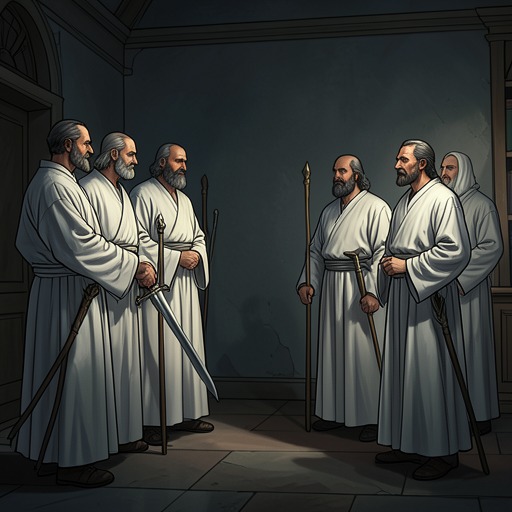
Kingsguard Vows
Fire & BloodThe Kingsguard Vows define the white-cloaked knights as a lifelong brotherhood whose members surrender ordinary claims to family, property, and advancement in order to protect and obey the king. Created at Queen Visenya’s insistence, the vows make the Kingsguard more than a company of skilled fighters: they turn personal service into a binding institution, and make fidelity to the king inseparable from chastity, obedience, and renunciation.
Creation and Purpose
The immediate cause of the Kingsguard’s creation was Queen Visenya’s conviction that King Aegon Targaryen needed more reliable protection. During the Dornish War, she wore mail beneath her court clothes and urged the king to do the same. When he trusted the guards already around him, Visenya demonstrated their inadequacy by drawing Dark Sister and cutting his cheek before they could react. Her point was that even a king armed with Blackfyre remained vulnerable if those assigned to guard him were too slow to defend him.
Visenya answered that danger by establishing seven champions for the lord of the Seven Kingdoms. Their sole purpose was to defend the king, even at the cost of their own lives. She modeled their vows on those of the Night’s Watch: the white-cloaked knights, like the black-cloaked brothers at the Wall, served for life. They surrendered lands, titles, and worldly goods, and accepted chastity and obedience. The vows thus placed their lives and service under royal obligation while removing the usual rewards and inheritances that might compete with it.
Selection and Service
The vows were supported by a deliberately selective method of recruitment. Many knights offered themselves, and Aegon considered holding a tourney to determine who was most worthy. Visenya rejected that approach. Skill at arms alone, she argued, could not establish that a candidate was loyal enough to live close to the king. She chose the knights herself rather than making a contest the measure of their fitness.
The first seven came from different parts and circumstances of the realm. Some were younger sons; others gave up the inheritance of ancient houses. The company included a hedge knight and a bastard-born knight. They were described as capable, observant, strong, and devoted to the king, while their varied backgrounds underscored the common renunciation required by the white cloak. Ser Corlys Velaryon served as their Lord Commander. Two of the original seven died defending Aegon, and all served with valor until the ends of their lives. Their service established a model later members were expected to follow, and the Kingsguard’s white cloak came to stand for honor.
Breach and Enforcement
The vows’ force is clearest in the case of Ser Lucamore Strong, a popular Kingsguard knight whose secret marriages came to light in 73 AC. He had taken three wives without any knowing of the others and fathered sixteen children. The scandal violated the order’s prohibition on marriage and children, and it exposed how a breach of one vow could call the knight’s entire loyalty into question. Ser Ryam Redwyne uncovered the conduct, and the Lord Commander brought it to the king. Speaking for his sworn brothers, Ser Gyles Morrigen said that Lucamore had dishonored what the Kingsguard stood for and asked that he be executed.
Jaehaerys distinguished Lucamore’s broken vows from mere private misconduct. He recalled that two Kingsguard had abandoned his uncle Maegor to fight for him, and that he had sent them to the Wall rather than reward their disloyalty with continued white cloaks or honors. He treated Lucamore’s vows of chastity and obedience as connected tests of trust: if the knight had set aside the prohibition on marriage, the king could not be confident that he would keep the obligation to defend and obey. Queen Alysanne also emphasized that Lucamore had broken his marriage vows repeatedly, while his wives and children were not to be treated as the principal wrongdoers.
The sentence made the consequences concrete. Jaehaerys ordered Lucamore gelded, bound in irons, and sent to the Wall, warning him that a further breach of the Night’s Watch vows could cost him his head. His punishment removed him from the Kingsguard and redirected him into another order built around lifelong vows. The episode presents the white cloak not as a privilege that could be retained despite disobedience, but as an office whose duties were forfeited when its defining obligations were violated.
The Vows in Political Conflict
Later conflicts show how the vow of obedience could become a test of allegiance when rival claims to the throne emerged. During the crisis after King Viserys’s death, Grand Maester Orwyle warned the green council that denying Rhaenyra’s claim risked war: she would not stand aside, and she had dragons. His warning made clear that the Kingsguard’s obligation to protect a monarch existed within a realm where competing sovereign claims could turn royal service into a dangerous political choice.
The dispute became explicit when Ser Steffon Darklyn left King’s Landing for Dragonstone with other loyalists and brought the stolen crown of King Jaehaerys to Rhaenyra. The following day, Daemon Targaryen placed that crown on Rhaenyra’s head. The episode does not set out a separate rule for how a Kingsguard should respond to disputed succession; instead, it shows the consequences of service divided by rival claims of legitimacy. Darklyn’s departure was treated by the opposing side as treachery, while his transfer of the crown helped give Rhaenyra’s claim a public emblem.
When Corlys Velaryon later proposed sending Rhaenyra’s half-brothers to the Wall rather than killing them, she rejected the proposal by asking what vows meant to oathbreakers who had taken her throne. The exchange extends the logic associated with the Kingsguard vows into the larger political argument: an oath can be invoked as a foundation for trust, but its moral authority is weakened when the people demanding obedience are themselves accused of breaking faith. The vows therefore serve both as a practical safeguard for the king and as a measure against which royal conduct and competing claims of loyalty are judged.