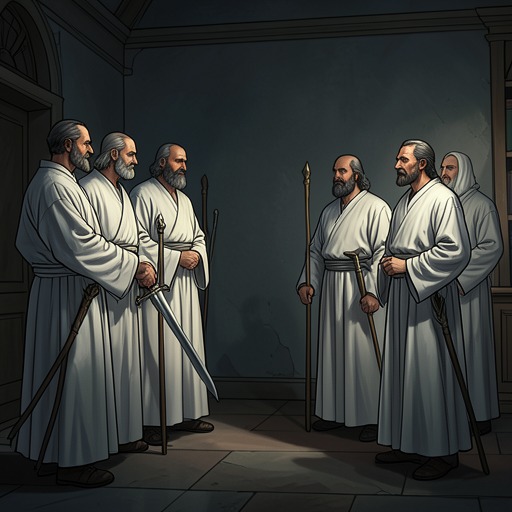
Kingsguard serve for life
Fire & BloodKingsguard serve for life is a principle of lifetime service that becomes politically consequential when the regents of the young King Aegon III remove knights from the royal guard. His protest against their decision exposes a conflict between the expectation of enduring service and the regents’ claim that an appointment’s legitimacy determines whether that expectation applies.
Meaning and Scope
The principle is stated directly by the young king: “Kingsguard serve for life.” In the episode, it functions as a claim about the permanence of a white cloak, not merely as a description of how long a knight might happen to serve. The king invokes it to challenge the regents’ authority to dismiss members of the guard.
The exchange also places a limit on the principle. Unwin Peake replies, “Only when they have been properly appointed, Your Grace.” His answer does not deny lifetime service outright; it makes that service conditional on the validity of the appointment. The passage offers no fuller definition of proper appointment, leaving the phrase as the basis for a politically useful distinction rather than a settled explanation of procedure.
The Regents’ Decision
The dispute arose after the regents reorganized the Kingsguard. They confirmed Marston Waters as Lord Commander and ordered Darklyn and Massey to surrender their white cloaks, so that Marston could bestow them on knights of his own choosing. The change therefore concerned both the tenure of individual knights and control over who would fill the guard’s places.
The young king reacted with sullen silence and spoke only to protest the dismissals. His brief appeal to lifetime service was a rare assertion of his own position during a minority in which the regents controlled the government. Peake’s answer recast the issue: rather than treating the white cloaks as protection against removal, he treated proper appointment as the condition that made the protection applicable.
Service and Political Loyalty
The surrounding history shows that a Kingsguard’s actual service could be disrupted by political allegiance. Ser Steffon Darklyn had left King Aegon II’s court and reached Dragonstone with the stolen crown of King Jaehaerys; he was subsequently welcomed among the loyalists at Rhaenyra’s coronation. His departure does not settle the rule’s legal meaning, but it distinguishes the ideal of service for life from the political realities in which knights might abandon one claimant for another.
The episode’s central tension is thus not simply whether a knight should serve for life. It is who has the authority to decide whether a knight belongs among those entitled to that service. The king appeals to continuity; Peake answers with a qualification tied to appointment, while the regents proceed to reshape the guard during the king’s minority.