Loren I Lannister
Fire & BloodLoren I Lannister was King of the Rock and one of the two western monarchs who joined forces against Aegon Targaryen. He led the western host into the Field of Fire, where the army was destroyed by the Targaryen dragons; unlike Mern IX Gardener, Loren survived, submitted to Aegon, and was confirmed in his lands and lordship.
Alliance and Command
Loren marched from the Westerlands to Castle Goldengrove, where he met Mern IX Gardener, King of the Reach. Their alliance assembled the largest host Westeros had yet seen: fifty-five thousand men, including about six hundred lords and more than five thousand mounted knights. The army’s scale was a strength, but it also meant the allies could not linger without stripping the surrounding countryside of food. They set out north by northeast through fields of wheat and tall grass.
Mern, whose force was half again as large as Loren’s, claimed command of the center. Loren and his knights were assigned the right flank, while Lord Oakheart held the left. The Two Kings planned to sweep around Aegon’s smaller army on both sides, close in behind it, and break its center with a wedge of armored knights and high lords. Their numbers and open ground seemed to favor the plan, but the dry fields that made the terrain suitable for cavalry would also make the battle ground for fire.
Defeat and Submission
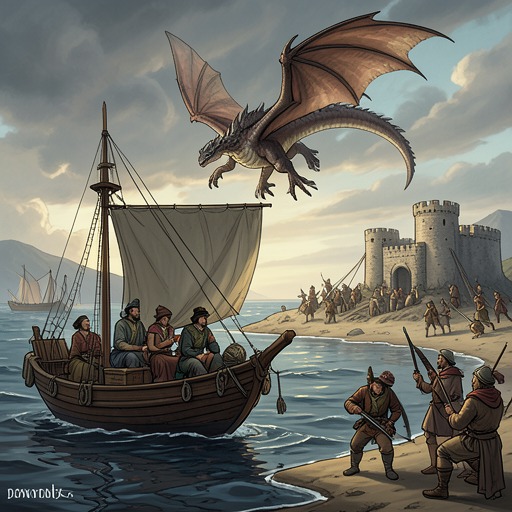
The battle turned on the very fields that had seemed to favor the Two Kings. As their host charged, Aegon and his queens took to the air: Aegon attacked from above on Balerion, while Rhaenys and Visenya kindled fires upwind and behind the advancing army. Dry grass and wheat caught at once; the wind drove smoke into the attackers’ faces, panicked their horses, and spread walls of flame across the plain. Loren’s right flank was caught in the rout that followed. The battle, later called the Field of Fire, killed Mern IX Gardener and the members of his family who had accompanied him, while Loren escaped through fire and smoke when he saw the fight was lost.
Loren’s escape did not preserve his independence. Captured the next day, he laid his sword and crown at Aegon’s feet, knelt, and rendered homage. Aegon raised his defeated opponent and confirmed him in his lands and lordship, granting him the title of Lord of Casterly Rock and Warden of the West. Loren’s survival thus carried a political consequence beyond his own submission: his bannermen followed his example, as did many surviving lords of the Reach.
The Settlement of the West
Loren’s submission settled the allegiance of the Rock and encouraged surviving western and Reach lords to follow him, but it did not complete Aegon’s conquest of the west. Aegon left his sisters and marched for Highgarden, seeking to secure it before another claimant could take it. There he received the castle’s keys from its steward, Harlan Tyrell, who pledged support without a fight. Aegon granted Harlan Highgarden and its domains, making him Lord Paramount of the Mander and Warden of the South over the former vassals of House Gardener. The change in lordship shows the two distinct outcomes of the Field of Fire: Loren survived to retain his lands under the new king, while the Reach’s old ruling house was extinguished and its seat passed to a new one.
Political Meaning
Loren’s fate illustrates how Aegon’s conquest could preserve a defeated ruler’s regional power while ending his kingship: after the Field of Fire, Loren retained his lands but held them as Lord of Casterly Rock and Warden of the West by Aegon’s grant. The contrast with House Gardener’s destruction is decisive. The western realm was brought under the new king not by replacing every local lord, but by turning a surviving enemy into a subordinate lord whose example helped draw other survivors into allegiance.