The secret siege of Maegor’s Holdfast
Fire & BloodThe secret siege of Maegor’s Holdfast was an eighteen-day confrontation between the child king Aegon III and the men exercising power outside his refuge. Its significance lay not only in the stand at the drawbridge, where Sandoq the Shadow stopped an armed attempt to enter, but also in the standoff that followed: the king’s opponents had the greater force, yet hesitated to storm the holdfast, while the question of whose orders the Kingsguard must obey remained unresolved.
Causes and Political Context
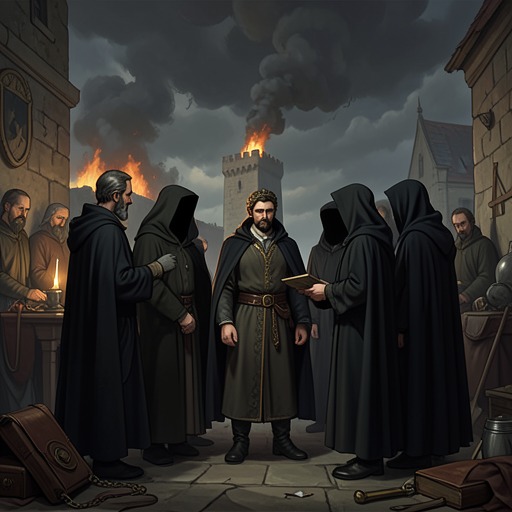
The immediate crisis unfolded amid a struggle over the government of an underage king. Ser Marston Waters, Hand of the King and Lord Commander of the Kingsguard, and Ser Lucas Leygood’s gold cloaks held the rest of the Red Keep and maintained their grip on King’s Landing. Aegon and his brother Viserys remained inside Maegor’s Holdfast, where the drawbridge and gates could be secured. The men outside described their actions as protection of the king from false friends and traitors; from within, Viserys called attention to the contradiction, ordering Grand Maester Munkun to send ravens throughout the realm so that people would know the king was effectively being held in his own castle. Munkun did not send them.
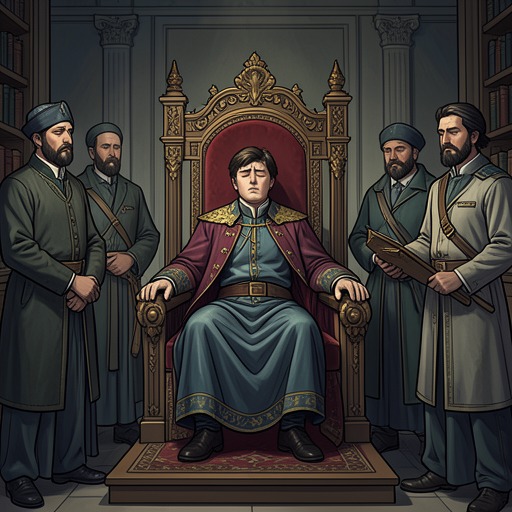
The dispute was also a contest over the meaning of royal obedience. Marston’s men argued that, while Aegon remained a child, they were bound to obey the Hand, who spoke with the king’s authority. Aegon’s position was that he had personally ordered Ser Amaury Peake to leave, and that the Kingsguard’s vows required obedience to the king. The holdfast thus became more than a defensible building: it was the place where competing claims to speak for the crown were put into action.
The Drawbridge and Sandoq’s Defense
The confrontation at the entrance began when Ser Amaury, unwilling to be turned back by the two boys, ordered his men to move them aside. Viserys had already warned that they must not advance beyond the axe he had driven into the drawbridge. Aegon drew his brother back into the holdfast, and Sandoq stepped out to face the approaching guards. The king’s command to stay back had failed to deter them; the shadow’s intervention made the threshold impassable.
Sandoq fought with a tall shield and a curved sword with a dragonbone hilt. He moved silently, deflecting attacks with his shield and driving his opponents away from the bridge. Several of Ser Amaury’s men died, and others were forced off the bridge onto the spikes below. Ser Amaury, dressed in white scale armor and his Kingsguard cloak, entered the fight without a shield. Sandoq wounded him while continuing to fend off the other guards, but the knight persisted. Near the end, one of the remaining men seized Sandoq’s sword and fell from the bridge with it, leaving Ser Amaury to charge his disarmed opponent.
Sandoq pulled Viserys’s axe from the timber where the prince had embedded it and killed Ser Amaury. He then cleared the dead and wounded from the drawbridge and withdrew inside. Aegon ordered the bridge raised, the portcullis lowered, and the gates barred. The immediate assault had ended, and Maegor’s Holdfast was secure. The clash also made the brothers’ warning at the entrance consequential: they had refused to yield the king’s refuge, and the attempt to force entry had cost Ser Amaury his life.
The Stalemate
Aegon’s security inside the holdfast did not mean he controlled the rest of the castle. The next morning Marston and Leygood appeared outside and urged him to leave, with Marston insisting that his men had acted to protect him. Aegon rejected the appeal and defended Sandoq’s conduct as obedience to his own order. Marston, in turn, maintained that the Kingsguard were required to follow the Hand while the king was still a child. Neither side accepted the other’s account of lawful service, and no settlement followed.
On the fourth day, Munkun came with Marston to appeal to Aegon. Viserys again demanded that the king’s confinement be made known to the realm, but Munkun did not dispatch the requested ravens. Later appeals came from Munkun, Marston, Septon Bernard, and Ser Gareth Long. They invoked legality, prayer, and threats of punishment, but Aegon remained silent and refused to surrender. He answered only when Long tried to persuade him to yield, challenging the justice of punishing Gaemon Palehair in his place.
The balance of force favored those outside. Marston had several hundred men in the Red Keep, while Leygood commanded more than two thousand gold cloaks. Inside the holdfast were only a small number of Lyseni retainers, a few men loyal to Lord Rowan, the king’s attendants, and a wounded Kingsguard prisoner. Queen Daenaera’s ladies put on mail and took up spears to make the defenders seem more numerous, but this could not have concealed how thinly the refuge was held for long. Despite that imbalance, Marston continued trying to end the standoff by negotiation rather than storming the building. The account treats the reason as uncertain: fear of Sandoq is offered as an explanation but judged unlikely, and a claim that the defenders threatened to hang their prisoner is described as false. The likelier explanation given is that Marston was unwilling to order an assault against the king he had sworn to protect, even as his vows and his position as Hand pulled in different directions.
End of the Siege and Its Aftermath
The holdfast remained secure for eighteen days, but the end of the immediate standoff did not immediately restore the king’s confidence. Aegon stayed inside for six more days after Viserys exposed Lord Rowan’s false confession. Only when Munkun sent out ravens summoning forty loyal lords to King’s Landing did Aegon allow the bridge to be lowered again. The refuge had run short of food: Daenaera wept herself to sleep, and two of her ladies were so weakened that they needed help crossing the moat.
By the time Aegon emerged, Lord Graceford had named alleged traitors; many had been arrested and others had fled. Marston Waters, Mervyn Flowers, and Lucas Leygood were dead. Lord Rowan returned to the Tower of the Hand but was too damaged by his treatment in the dungeons to resume his duties, and later died on the road to Goldengrove. Munkun served as both regent and Hand for the remainder of the year, while the accused traitors remained in the dungeons awaiting a new Hand. The siege therefore ended not with a simple restoration of trust, but with the political order further unsettled and the king’s government still dependent on others.
Significance
The episode turns on the difference between possessing the king and serving him. Marston’s party controlled the city and most of the castle, yet Aegon’s refusal to leave denied them the appearance of his consent. At the bridge, that dispute took physical form: the king and Viserys set a limit, Ser Amaury crossed it, and Sandoq’s defense closed the way. In the days that followed, the greater force outside could not resolve the question of legitimacy by force without risking the very king it claimed to protect. The secret siege exposed the precariousness of rule under a child monarch, when the authority of the crown and the authority exercised in its name could point in opposite directions.