
Secrecy and the Public Story
FirestarterThis thread traces the struggle over who gets to tell the McGees’ story, from the concealed experiment and intercepted evidence to a state-sanctioned cover narrative and Charlie’s attempt to reach an independent press.
increasing Bearing strength in each event
 decreasing
Bearing strength in each eventdecreasingThe Classified Beginning
The Classified Beginning
Knowledge withheld from participants
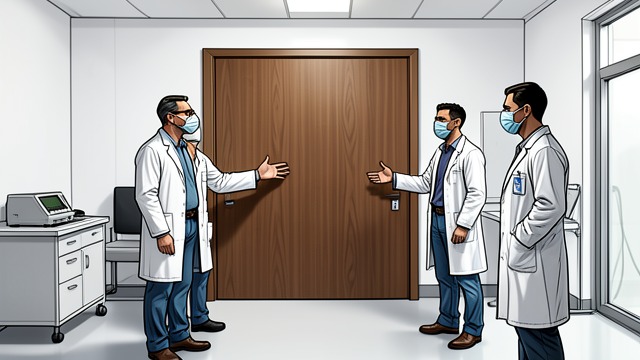
The volunteers at Harrison State College are told that Lot Six is a mild hallucinogen and that the study is conducted under ordinary research procedures. The government connection is kept at a distance, and the exact nature of the compound remains classified.
The participants therefore cannot give meaningful consent to the full purpose or risks of the experiment. The gap between the reassuring public explanation and the hidden institutional objective becomes the first act of concealment in the McGee story.
An evidence problem by design
After the trial, the volunteers’ accounts are confused by the drug’s effects. Shared visions, apparent injuries, and contradictory memories make it easier for the organization to dismiss testimony as hallucination.
Secrecy does more than hide a fact: it makes the truth difficult to establish. That advantage will later let the institution decide which records survive and which explanations the public is allowed to hear.
The Chart That Vanished
The Chart That Vanished
A trace left behind
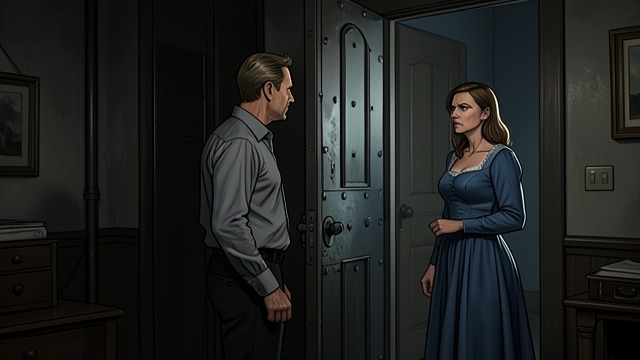
After the experiment, Andrew McGee returns to Room 70 and finds a dark comma-shaped stain on the brain chart where he remembers seeing a bloody hand strike it. The mark appears to confirm that at least part of the terrifying scene was real.
When Andrew brings Victoria Tomlinson back to the room days later, the chart has changed. The earlier evidence is gone, replaced by an ordinary anatomical image, leaving the couple with a memory that cannot be publicly verified.
The limits of private proof
The room becomes a miniature version of the larger struggle over evidence. Andrew and Victoria can compare their experiences, but neither has access to the missing records or the authority to compel an explanation.
The chart’s disappearance does not prove every detail of their memories. It does show how an institution can make uncertainty serve its interests by controlling the physical traces on which outsiders might rely.
Letters Seized
Letters Seized
A planned appeal
After months of hiding, Andrew McGee writes six accounts of the experiment, the pursuit, and Victoria’s death. He hopes that elected officials and major newspapers will make it impossible for the organization to continue treating the family as a secret national-security matter.
The letters embody a shift in strategy. Andrew recognizes that evasion alone will not protect Charlie and that outside witnesses might provide the scrutiny their pursuers have denied them.
Interception before publication
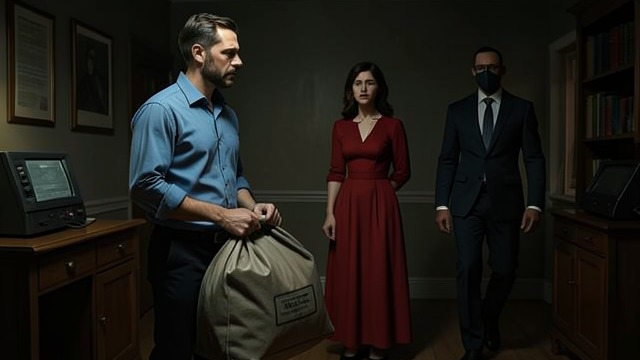
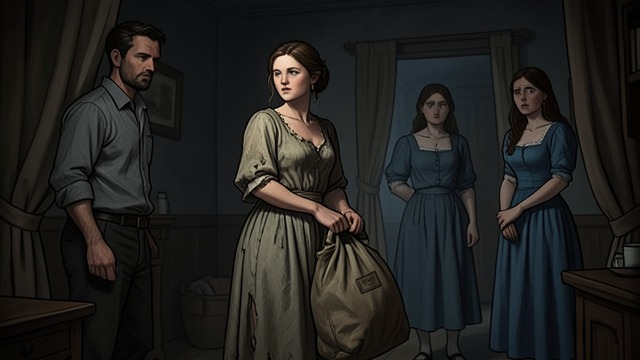
The organization learns of the mailing and intercepts the letters before they leave the region. A postal worker objects that the mail is protected, but armed agents take the bag and warn him against speaking.
The episode reveals that official secrecy depends not only on classified files but on interference with ordinary channels of communication. Andrew’s attempt at public disclosure fails before any editor or public representative can judge his account.
A Convenient Cover Story
A Convenient Cover Story
Violence repackaged
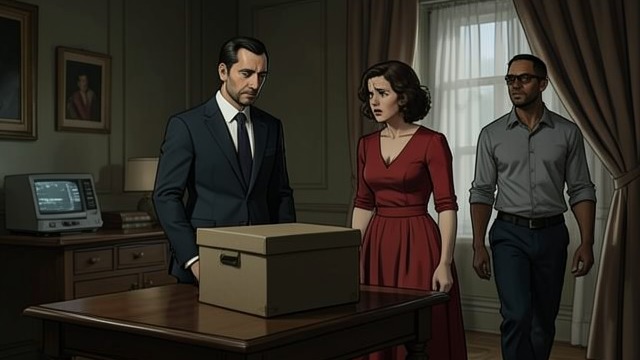
After the compound burns, the agency presents the disaster as a terrorist attack and identifies John Rainbird as a double agent. The account supplies a recognizable villain and a simple explanation for the deaths and fires.
The public version omits the experiment, Charlie’s confinement, and the attempt to control her ability. It turns institutional misconduct into an external attack and casts the agency as a victim of events rather than their architect.
The survival of a false narrative
The cover story is effective enough that the organization can regroup, preserve its political relationships, and continue to search for Charlie. Survivors are sequestered, limiting the chance that competing eyewitness accounts will reach the press.
The story’s neatness is itself suspicious: it gives the country the beginning, middle, and ending it expects, while excluding the facts that would make the moral picture harder to accept.
The Story Reaches the Press
The Story Reaches the Press
A search for an independent witness
Alone after Andrew’s death, Charlie tries to understand how to make the truth public without walking into another trap. She asks for help at the New York Public Library, carrying a question shaped by her father’s earlier plan to reach a newspaper.
The librarian directs her toward Rolling Stone, an outlet she hopes is both nationally visible and independent of the agency she is trying to expose. The choice shifts the question from whether the truth exists to whether anyone outside official channels will listen.
An unfinished act of testimony
Charlie arrives at the magazine’s office with a bag of quarters, an orange, and a promise that she has a story to tell and something to show. Her calm manner contrasts with the scale of the account she carries.
The novel ends before the interview or publication occurs. Charlie’s arrival nonetheless breaks the cover story’s monopoly: she has found a potential public witness and is prepared to make her evidence visible.
May 1969, before and during the Lot Six trial
The week after the experiment, at Jason Gearneigh Hall
March 10, during the winter at Tashmore
The morning after the October 9 disaster
Late April, after Charlie leaves the Manders farm again
