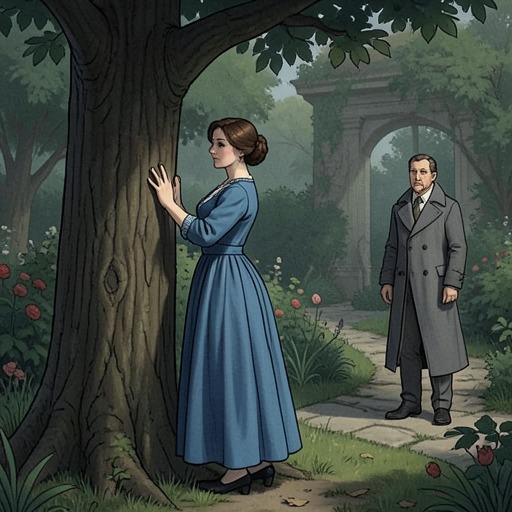
“He whom I love, who holds me in his power”
First Love“He whom I love, who holds me in his power” names the absent beloved at the center of Zinaïda’s story of a queen—and the uncertainty that takes hold of Vladimir Petrovitch after he hears it. The phrase reverses the apparent order of authority: a queen may command the attention of noble, wealthy admirers, yet her own desire draws her beyond their circle toward someone whose power over her is intimate and decisive. Whether the story discloses a fact about Zinaïda or remains an imaginative tale is never settled in these scenes. Its force lies in making the possibility difficult for Vladimir to dismiss.
The queen and the unseen beloved
Zinaïda tells the story after thanking Meidanov. The queen, she says, listens to her guests’ speeches and music without looking at any of them. Six tall windows stand open onto a dark garden, where a white fountain rises among large trees. The water’s soft sound reaches her through the talk and music. The scene divides attention between the brightly attended queen and the figure waiting outside: the guests are rich and devoted, ready to die at her feet, and she holds them in her power, but the beloved at the fountain holds her in his.
The beloved’s anonymity sharpens the contrast. He has neither fine clothes nor precious stones, and no one knows him; nevertheless, he waits with confidence that the queen will come. In the story, her wish to leave is stronger than any power that might stop her. She imagines going to him and remaining with him in the darkness, beneath the trees and beside the water. The fountain is therefore more than a setting: it marks the point beyond the formal gathering where the queen’s private attachment outweighs her public command.
Zinaïda stops without explaining whether the story is invented or referential. Count Malevsky slyly asks whether she made it up, but she does not look at him. Doctor Lushin follows by asking what the guests should have done if they had known of the fortunate man at the fountain. Their questions bring the story’s unspoken implications into the room without resolving them. The tale offers a charged image, not a confirmed account of an encounter.
Vladimir’s interpretation and search
The image stays with Vladimir Petrovitch after the gathering. Awake for a long time, he wonders whether Zinaïda’s story contained a hint and, if so, whom it concerned. He remembers her expression as she told it, as well as Doctor Lushin’s earlier exclamation in the Neskutchny Gardens and Zinaïda’s sudden change in her behavior toward him. These recollections accumulate into suspicion, but they do not identify the man at the fountain.
That uncertainty unsettles Vladimir’s understanding of Zinaïda. He has become accustomed to the disorderly household of the Zasyekins, down to its candle ends, broken cutlery, and shabby servants, but he cannot accept what he is beginning to imagine about her. His mother’s description of Zinaïda as an adventuress conflicts with his image of her as an idol. At the same time, he longs to occupy the place of the lucky man in the story. Admiration, jealousy, and suspicion converge around an attachment whose existence he cannot establish.
Vladimir acts on the image by going into the garden at night. He passes along its walks, approaches the fence, and waits, leaning against a thin bar. He thinks he sees a woman’s figure flash by, but immediately allows that it may be his fancy. He strains to make sense of possible footsteps, a laugh, rustling leaves, or a sigh, and softly asks who is there. None of these uncertain impressions confirms that Zinaïda—or anyone else—has met a lover at the fountain.
A falling star briefly crosses the sky, and Vladimir wants to call Zinaïda’s name, but cannot. The garden then grows still; after waiting, he returns to his cold bed. He feels as if he had gone to a tryst and been left alone, while passing close to another person’s happiness. The episode turns the tale’s imagined scene into a failed search: Vladimir approaches the possibility of the beloved’s presence but remains outside the knowledge he seeks.
The warning and the phrase’s afterlife
The fountain returns when Count Malevsky speaks to Vladimir about a page’s supposed duty to watch over his mistress. He advises vigilance at night and specifically recalls the garden and fountain as places where misfortune may occur. Malevsky’s warning connects the story’s setting to the possibility of a real nocturnal meeting, but it still supplies no direct evidence that such a meeting has taken place or identifies the person who might be involved.
Vladimir recognizes that Malevsky is known for mystifying people and may only mean to tease him. Even so, he experiences the words as poison and treats them as confirmation that there was a reason for his own attraction to the garden. His reaction escalates into a vow to take revenge on whoever enters it, whether Malevsky himself or someone else. He calls Zinaïda a traitress, though he cannot say precisely what he means by insisting that the suspected meeting must not happen. The phrase has thus moved from a queen’s imagined declaration to a pattern through which Vladimir reads ambiguous signs—and into a threat driven by what he still does not know.
Narrative significance
The expression binds together authority, desire, and uncertainty. In Zinaïda’s tale, the queen’s social power does not make her emotionally sovereign: she is drawn toward the unknown man who holds her in his power. For Vladimir, that reversal is painful because it suggests that the woman he adores may be oriented toward someone beyond his reach. Yet the story’s deliberate lack of confirmation matters. Zinaïda never identifies the queen’s beloved as a real person, and Vladimir’s night search produces only impressions he himself questions.
The recurring fountain gives the uncertainty a concrete focus. It first belongs to a story told indoors, framed by open windows and music; it then becomes the destination of Vladimir’s solitary search and the subject of Malevsky’s pointed warning. Each return intensifies the possibility without converting it into proof. The phrase’s significance lies in that gap: it makes a hidden attachment imaginable, while leaving Vladimir—and the reader of these scenes—unable to distinguish disclosure from suggestion.