Count Malevsky
First LoveCount Malevsky is a fashionable, charming visitor to Zinaïda Alexandrovna Zasyekin’s household and one of her admirers. To the sixteen-year-old Vladimir Petrovitch, the count’s ease and attractiveness are inseparable from a sense of falsity. His importance lies partly in the uncertainty surrounding him: he moves confidently among Zinaïda’s visitors, but Vladimir cannot tell what his closeness to her means. A pointed joke eventually turns that uncertainty into jealous suspicion, while his later expulsion from Vladimir’s home marks a sharp change in his standing with the family.
Introduction and Appearance
Vladimir first encounters Count Malevsky at a lively gathering in Zinaïda’s drawing-room. Zinaïda introduces him among the assembled visitors, and the count is asked to write Vladimir a ticket for the game. He objects that the newcomer has not played forfeits, placing himself on the side of the gathering’s rules against Zinaïda’s insistence that an exception be made. His resistance is brief: Zinaïda repeats her order, and the count is among those expected to comply.
The narrator remembers the count as a handsome, fashionably dressed brunette, with expressive brown eyes, a thin nose, and a small moustache. He speaks with a slight Polish accent. These details give him the finish and polish of a man who knows how to make an impression, but Vladimir’s account makes that surface uneasy rather than reassuring. Even as a boy, Vladimir thought he detected something equivocal and false in him. That judgment belongs to the narrator’s youthful perspective; the later episodes lend it weight without fully explaining the count’s private intentions.
Position in Zinaïda’s Circle
Count Malevsky is one of the men drawn into Zinaïda’s orbit, where each admirer has a distinct place. Vladimir finds his relation with her the hardest to understand. The count is clever and socially capable, and he approaches her in a manner that strikes Vladimir as sly and ingratiating. He leans on the back of her chair and whispers to her; she folds her arms, looks at him, and smiles. Vladimir watches the exchange with indignation, but the scene does not disclose what passes between them or establish that his interpretation is correct.
The uncertainty matters because Zinaïda’s household is presented as disorderly and unconstrained by the conventions Vladimir expects. The narrator connects her casual response to disturbances around her with her unusual upbringing, her mother’s constant presence, the family’s poverty, and her sense of superiority to many of those around her. In that setting, her smile toward Malevsky cannot be read as a simple declaration of trust or attachment. For Vladimir, however, the count’s familiar approach is enough to make him seem threatening.
Malevsky also has access beyond the lodge. Of Zinaïda’s visitors, he alone has managed to enter the home of Vladimir’s parents and make a favorable impression on Vladimir’s mother. Piotr Vassilievitch does not share her approval: he treats the count with a civility Vladimir regards as almost insulting. This difference places Malevsky at an uncertain social advantage. He can charm his way into a respectable household, but he has not won the confidence of its most reserved and authoritative member.
The Page and the Garden
At a later gathering, Malevsky mocks Vladimir by imagining him as the queen’s page, holding up Zinaïda’s train as she runs into the garden. The remark is delivered malignantly and lands as a public humiliation. Zinaïda promptly intervenes, lays a hand on Vladimir’s shoulder, and orders the count to leave. Malevsky turns pale, mutters an objection, and withdraws. Her defense of Vladimir checks the insult, but it does not settle the questions the count has raised about his place in her life.
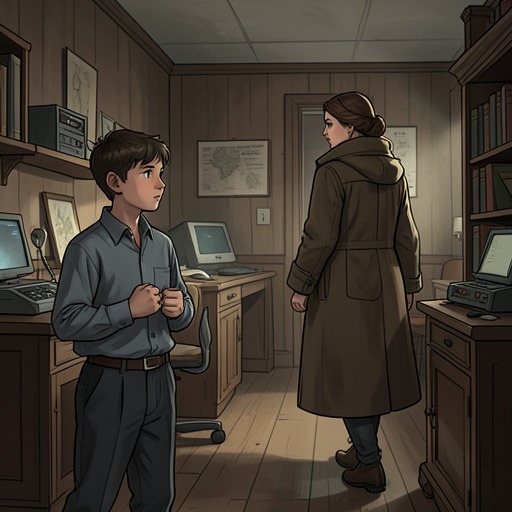
The next day, Malevsky addresses Vladimir with the same page imagery and asks what the “queen” is doing. Vladimir refuses to answer. The count’s manner appears to him contemptuously amused, and the brief exchange revives the previous humiliation. Vladimir reads the count’s teasing as a possible hint about a nighttime visit to the garden. He cannot determine whether Malevsky himself intends to go there or is merely provoking him, and his suspicion extends to the possibility that someone else may cross the low fence.
That uncertainty has a concrete consequence. Vladimir takes an English knife from his writing table and carries it while waiting for midnight, imagining that he may have to confront an intruder. He then keeps watch beneath a pine near the boundary between the family grounds and those of the Zasyekins, beside a path that leads toward an arbor. Malevsky’s words have turned a taunt into a vigil, but the count does not appear there. The episode shows how little evidence Vladimir needs, at this age, to convert jealousy into a plan for retaliation.
Expulsion and Narrative Significance
Malevsky’s position in the family home changes decisively after Vladimir’s parents have a private conversation. The following evening, Piotr Vassilievitch conducts the count through the dining-room and hall and tells him that he will be thrown out if he visits again. The father refers to the count having been shown the door a few days earlier, making this a renewed and explicit rejection. Malevsky bows, bites his lip, and leaves. The threat and his departure contrast with his earlier success in winning Vladimir’s mother’s favor: charm has secured access, but not durable acceptance.
The family is preparing to return to its house on Arbaty Street, and the departure is managed quietly. Malevsky’s expulsion forms part of the household’s withdrawal from the country setting, though the account does not establish that the move is caused by him. Nor does it resolve what he knew about Zinaïda or why he chose to needle Vladimir. His role remains that of a polished, unsettling intermediary: he gives the boy’s jealousy a target and a provocation, while the larger truths about Zinaïda’s life lie beyond what Vladimir understands at the time.