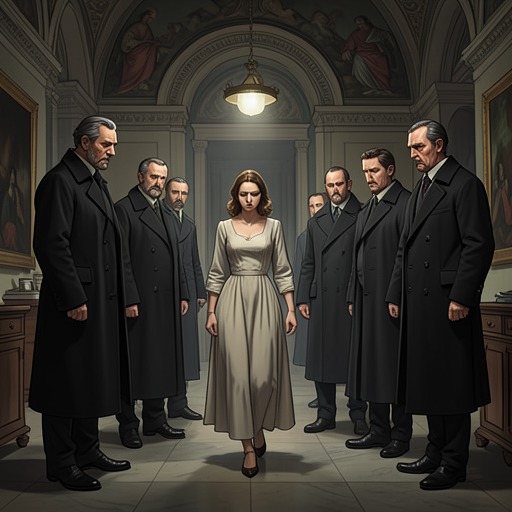
Doctor Lushin
First LoveDoctor Lushin is an ironic, intellectually perceptive physician and the most deeply attached of Zinaïda’s admirers, though he expresses affection through criticism and submits to her teasing power. He sees more clearly than the younger Vladimir what is happening around Zinaïda, but his insight does not make him detached: his visits, his changing manner, and his final advice all reveal a man wrestling with the costs of passion. Through Lushin, the story sets clear-eyed judgment against emotional dependence without pretending that the two can be cleanly separated.
Identity and First Impressions
Vladimir first recognizes Lushin as the dark man who had humiliated him in the garden. When Zinaïda introduces her guests at the lodge, Lushin is among the men gathered around her; to the inexperienced Vladimir, the doctor is already associated with embarrassment and a social world whose rules he does not understand. That first impression gives way to a more complicated one. Lushin’s irony can sting, but it is not merely a pose of superiority: he is observant enough to recognize the feelings Vladimir tries to hide, and his later frankness becomes a source of both discomfort and attraction.
The retrospective narrator describes Lushin as cynical in his words, yet says that he knew Zinaïda better than any of her other admirers and loved her more than all of them. His behavior holds those contradictions together. He abuses her to her face and behind her back, while she respects him and repeatedly makes him feel that he, too, is in her power. Lushin’s critical manner therefore does not cancel his attachment. It is part of the tense, intimate exchange through which the story shows how much each of them can see—and how little that knowledge frees him from her influence.
Attachment to Zinaïda
Zinaïda makes the imbalance between Lushin’s candor and his vulnerability especially visible in a small, deliberately uncomfortable test. In his presence, she describes herself as a flirt, heartless, and instinctively an actress, then asks him to hold out his hand. She drives a pin into it deeply, watches him, and laughs. Lushin blushes, turns away, and bites his lips, but ultimately lets her proceed; despite the pain, he begins to laugh too. The episode is not evidence that his feelings are light. Instead, his submission makes plain how little his intelligence and verbal cynicism protect him when Zinaïda chooses to exercise her power over him.
Vladimir sees that Lushin’s feelings have changed, but initially reads the change only as a deterioration in his manner. The doctor has grown thin; he still laughs frequently, but his laughter now seems hollow, spiteful, and shorter, while involuntary nervous irritability replaces his former light irony and assumed cynicism. This alteration registers the strain of his attachment without explaining its precise cause. Lushin remains difficult for Vladimir to interpret, just as Zinaïda’s relations with her other admirers remain difficult for him to understand. The contrast between the doctor’s exceptional knowledge of her and his own inability to escape her influence is central to his characterization.
Warnings and Unspoken Knowledge
When Vladimir continues to linger at the Zasyekins’ drawing-room, Lushin challenges him directly. The young man ought to study and work while he is young, the doctor says, rather than spend his time there. Vladimir answers that Lushin cannot know whether he works at home, but the doctor recognizes that this is not the real subject. He asks whether Vladimir is well, whether he is in a normal condition, and whether what he is feeling is good for him. Vladimir protests that he does not know what he is feeling, though inwardly he knows the doctor is right.
Lushin’s method is to expose what Vladimir’s face gives away. He tells the young man that his heart is visible and challenges him to understand what is happening around him. Yet he stops short of explaining it. The doctor’s compressed lips and abrupt restraint leave the warning unresolved: he knows, or suspects, more than he is willing to tell. This combination of perception and silence makes him a guide of a limited kind. He can identify Vladimir’s self-deception and urge him to look beyond it, but he neither supplies a full account nor removes the young man from the situation that is teaching him through pain.
Self-Sacrifice and the Later Encounter
During the five or six days when Vladimir hardly sees Zinaïda, Lushin visits the lodge twice a day, though he does not stay long. Vladimir is afraid of him after their unreserved conversation and at the same time feels genuinely drawn to him. On a walk together in the Neskutchny Gardens, Lushin shows a gentler side: he explains the names and properties of plants and flowers. Then, striking his forehead, he exclaims that he had thought Zinaïda a flirt and that self-sacrifice can be sweet for some people. When Vladimir asks what he means, Lushin abruptly refuses to tell him. The walk joins ordinary instruction to a sudden, private recognition: the doctor revises his judgment of Zinaïda, but keeps the grounds for that revision to himself.
After the move back to town, Vladimir does not quickly recover from the past or return to work. When he meets Lushin on a boulevard, the doctor notices the change in him. Vladimir is still yellow, but no longer has the same foolishness in his eyes; Lushin says he looks like a man, not a lap-dog. The remark is teasing, but it marks a shift from the boy who had been visibly ruled by his infatuation. Lushin asks whether he is working. Vladimir sighs, unwilling either to lie or to admit the truth, and the doctor lets him avoid a direct answer.
Lushin’s parting advice gives his earlier warnings a broader meaning. A person should lead a normal life rather than be a slave to passions, he says, and should stand on his own feet, even if all he can find is a rock. The image answers Vladimir’s susceptibility with an insistence on steadiness, not with a claim that feeling can simply be dismissed. Lushin himself is no dispassionate observer: he has loved Zinaïda, has submitted to her, and has recognized in her a capacity for self-sacrifice that he once mistook for mere flirtation. His counsel carries weight precisely because it comes from someone who understands both the attraction and the danger of surrendering judgment to passion. Even at this reunion, his concern reaches beyond Vladimir: after mentioning his own cough, he asks whether Vladimir has heard anything of Byelovzorov.