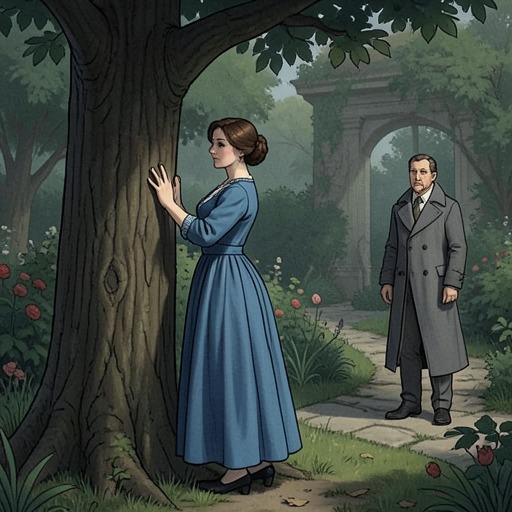
Peter Vasilyevich and Zinaiida's secret romance
First LovePiotr Vassilievitch and Zinaïda Alexandrovna Zasyekin’s secret relationship is revealed not through a confession but through accumulating evidence: an accusation at home, a servant’s account, and Vladimir’s own sight of them together. The discovery fractures the boy’s earlier romantic understanding of Zinaïda and becomes a decisive step in his emotional coming-of-age.
An Unequal Household
In the summer of 1833, sixteen-year-old Vladimir lives with his parents near the Neskutchny Gardens in Moscow. His father, Piotr Vassilievitch, is still young, handsome, controlled, and commanding; his mother, Maria Nikolaevna, is ten years older and lives in a state of concealed agitation. Vladimir understands that his father married her for mercenary reasons and describes their domestic relation as distant: Piotr treats his son with careless kindness, while Maria is absorbed by other cares and afraid of her husband. This strained marriage forms the background against which the secret relationship becomes explosive.
Zinaïda is twenty-one, five years older than Vladimir. When they meet, she makes their age difference part of the terms of their acquaintance: she expects him to tell her the truth and do what she says, while also inviting his gaze and suggesting that they may become friends. Her mixture of authority and warmth helps establish the imbalance that shapes Vladimir’s attachment to her. His feelings are intense, but he is still a boy; the adult relationship between Zinaïda and his father remains beyond his understanding until the family conflict forces it into view.
The Secret Comes to Light
The immediate disclosure begins after Vladimir returns from a long walk and learns that he must dine alone. Piotr has gone out, and Maria has shut herself in her room, unwell and unwilling to eat. The servants’ expressions persuade Vladimir that something serious has happened. Rather than question them directly, he turns to Philip, a young waiter who is devoted to poetry and plays the guitar.
Philip reports that Maria accused her husband of infidelity and of an intimacy with the young woman living next door, Zinaïda. Piotr initially defended himself, then lost his temper and made a cruel remark about Maria’s age, bringing her to tears. Maria also referred to a loan apparently made to the old Princess Zasyekin and spoke bitterly of both the princess and Zinaïda; Piotr, in turn, threatened her. Philip says that an anonymous letter prompted the confrontation, but no one knows who wrote it. The reported loan and the letter help explain how the affair became a household crisis, though neither account identifies the writer or establishes the loan’s purpose.
When Vladimir asks whether there was any truth to the accusation, Philip confirms that there was. He suggests that Piotr had been careful, but that arranging a carriage and dealing with servants made complete secrecy difficult. The account gives Vladimir what his suspicions had not: confirmation that his father’s connection with Zinaïda is real. Stunned, he falls onto his bed. He does not immediately investigate the timing or reproach his father; the revelation is too much to absorb, and he experiences it as the abrupt destruction of his former hopes.
The Encounter at the Window
Vladimir’s confirmation later becomes direct sight. While accompanying his father near the Moskva River, he is told to wait with the horses beside a timber-stack. When Piotr does not return, Vladimir walks toward the small street where his father disappeared. Forty paces away, he sees Piotr leaning over the open window of a little wooden house, speaking with a woman in a dark dress. The woman is Zinaïda.
Vladimir watches as Piotr appears to press her to agree to something. Zinaïda does not consent. He remembers her as solemn and distressed, and reads her lowered gaze and submissive smile as signs of devotion and grief, though she does not yield. Piotr’s impatience is indicated by his familiar gesture of straightening his hat. The scene makes their intimacy visible while preserving its private terms: Vladimir can witness their charged exchange, but cannot know all that has passed between them or what Piotr is asking of her.
The encounter turns suddenly into an act of violence. Piotr strikes Zinaïda with the whip he has been using to brush dust from his coat. She shudders, looks at him without speaking, and raises her arm to her lips; Piotr throws the whip away and rushes into the house, while Zinaïда leaves the window. Vladimir hurries back to the riverbank, unable to think clearly. What fixes the moment in his memory is not only the blow but Zinaïda’s look and gesture, which remain inseparable from his image of her. His father’s private relationship is no longer a suspicion conveyed by servants: Vladimir has witnessed both its intimacy and its violence.
What Vladimir Learns
That night, Vladimir interprets Zinaïda’s response as evidence of a passion he had never imagined. He contrasts her apparent willingness to bear a blow from someone she loves with his own youthful fantasies of love, which now seem small and childish. The episode does not give him a simple explanation of Zinaïda’s submission, nor does it settle the nature of her feelings; instead, he recognizes that her attachment to Piotr involves a depth and danger he cannot fully grasp. The contrast marks his movement from adolescent idealization toward a painful awareness that love may coexist with suffering and unequal power.
The affair also changes the meaning of Vladimir’s relationship with his father. Piotr had seemed serenely self-possessed and emotionally distant, but Vladimir now sees him as a man capable of secret passion, impatience, and sudden cruelty. When Piotr later says that he threw away the whip rather than lost it, Vladimir notices tenderness and pity in his father’s face, a brief expression he had scarcely seen before. That moment complicates rather than cancels the scene at the window: Piotr’s capacity for tenderness does not undo what Vladimir witnessed.
For Vladimir, the discovery is therefore both a family revelation and a change in scale. His own love for Zinaïda remains real to him, but it can no longer serve as the measure of adult passion. The hidden relationship, exposed through domestic accusation and then witnessed at close range, ends his innocence about the people he loves without giving him complete access to their motives. Its lasting force lies in that difference between seeing and understanding: Vladimir remembers the scene for life, while the relationship itself remains partly beyond his knowledge.