Self-sacrifice in love
First LoveSelf-sacrifice in love is the painful willingness to endure suffering for the beloved, but in Vladimir Petrovitch’s recollection it is not simply an ideal of noble conduct. It begins as a striking remark, takes shape in Zinaïda Alexandrovna Zasyekin’s story of a queen who abandons her admirers for the man she loves, and becomes unmistakably physical when Vladimir sees Zinaïda accept a blow from Piotr Vassilievitch. That scene makes the idea both intimate and disturbing: what the young Vladimir had imagined as the height of passion seems small beside a devotion he can witness but cannot fully understand.
A Principle Before It Becomes an Experience
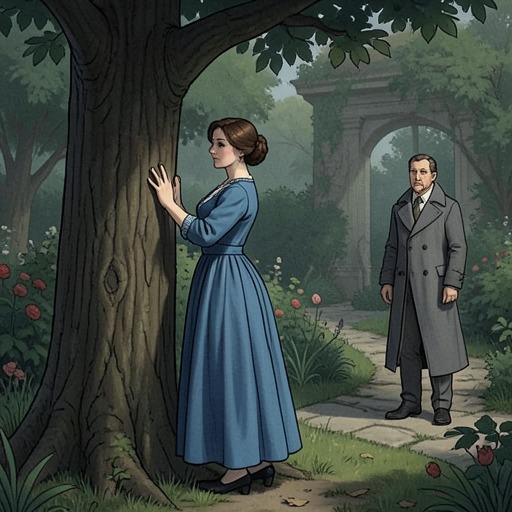
In the Neskutchny Gardens, Doctor Lushin first gives the idea its explicit form. Walking with Vladimir, he identifies plants and flowers, then suddenly strikes his forehead and exclaims that he had mistaken Zinaïda for a flirt, adding, “it’s clear self-sacrifice is sweet for some people!” The interruption matters: the observation breaks into an ordinary conversation rather than arriving as a considered lesson. Lushin appears to have revised his judgment of Zinaïda, but when Vladimir asks what he means, he abruptly refuses to explain. The principle is named and withheld at once, leaving Vladimir with a suggestive phrase rather than an account of the suffering behind it.
That withheld explanation establishes one of the concept’s recurring limits. Self-sacrifice may be visible in its effects, yet its inward meaning is not readily available to an observer. Lushin can recognize something in Zinaïda that changes his opinion of her, but does not disclose what he knows. Vladimir, still drawn to Lushin and uneasy after their earlier frank conversation, receives the remark without the context needed to understand it. The episode plants a thought that will acquire its force only through what Vladimir later sees.
The Queen and the Choice Beyond Admiration
At a gathering, Zinaïda gives the idea an imaginative form in a story about a queen. While guests speak and music plays, the queen looks past the assembled men and out through six open windows toward a dark garden. A fountain rises among the trees, and beside it waits the man she loves. The courtiers are noble, clever, and rich; they admire the queen and are ready to die at her feet. Yet their admiration does not command her. She is drawn instead to the unnamed man who has neither rich clothes nor precious stones, and who, in her telling, “holds me in his power.”
The queen’s choice reverses the apparent hierarchy of the scene. The guests possess social standing and gather around a woman who seems to command them, but her attachment lies elsewhere. Her declared resolve to go to the man and remain with him makes love a surrender that she chooses, not a prize bestowed on those who flatter or serve her. Zinaïda’s story thus links power with its opposite: the queen holds her admirers in her power, yet describes herself as held by the beloved. The imagined departure into the dark garden turns self-sacrifice into a choice to leave comfort, attention, and public admiration for an uncertain private attachment.
When Malevsky slyly asks whether the story is made up, Zinaïda does not look at him. The scene does not establish the tale as a literal confession, but its language gains a grave resonance from what Vladimir later witnesses. Its contrast between the queen’s many admirers and the one man who commands her feeling anticipates the difference between being surrounded by devotion and being bound by love. The story offers a lyrical image of voluntary surrender; the later scene strips away the music and the imagined garden.
The Blow and the Limits of Understanding
Vladimir comes upon the reality of Zinaïda’s attachment unexpectedly. From a street forty paces away, he sees Piotr leaning over the open window of a small wooden house, with Zinaïda sitting inside, partly hidden by a curtain. Piotr appears to insist on something she will not accept. Her face seems mournful and serious; she speaks in monosyllables, keeps her eyes lowered, and smiles submissively without yielding. Vladimir hears Piotr say, “Vous devez vous séparer de cette…” Before he can understand the whole exchange, Piotr lifts the whip he has been using to brush dust from his coat and strikes Zinaïda’s bare arm.
Zinaïda shudders, looks at Piotr without speaking, then slowly raises her arm to her lips and kisses the red streak. Piotr throws away the whip and rushes into the house; Zinaïda turns from the window with outstretched arms and lowered head. Nothing in the scene makes the violence harmless or explains it away. Its force comes from the contrast between the blow and Zinaïda’s response: she does not retaliate or speak, and the kiss directs attention to the mark inflicted on her. Vladimir recognizes in her submissive smile the Zinaïda he remembers, but what he now sees exceeds his earlier understanding of her.
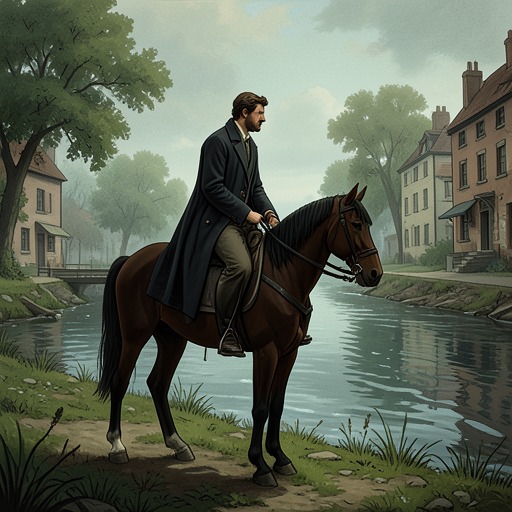
The experience overwhelms him before he can interpret it. He runs back toward the river, nearly losing his hold on Electric, and stares vacantly at the water while tears stream down his face. The thought repeating in his mind is simply that she has been beaten. When Piotr returns and asks for the mare, Vladimir gives him the bridle mechanically. He notices Piotr’s haste and, when asked about the missing whip, hears him say that he threw it away. Piotr then rides on, and Vladimir cannot catch him; the distance between them remains even as the boy carries the image home.
What the Witnessing Changes
That night Vladimir names what he has seen as love and passion, but his reflection is not a confident explanation of Zinaïda’s choice. He wonders how anyone could refrain from revolt and bear a blow from even the dearest hand, then recognizes that love might make such endurance possible. The question unsettles his previous understanding: the suffering he has witnessed cannot be measured against his own earlier transports as though they were equivalent. He judges his love childish and pitiful beside the other, scarcely imaginable experience before him.
Vladimir describes himself as having grown much older during the preceding month, yet the change is not presented as complete comprehension. The scene remains something he can hardly grasp, beautiful and menacing to him at once. Its memory fixes itself in gestures and expressions—the glance, the smile, the kiss on the wounded arm—rather than in an explanation of what passed between Zinaïda and Piotr. His response therefore preserves both the intensity of the revelation and its limits: witnessing makes him recognize the possibility of self-sacrifice, but does not grant him full access to its cause.
A dream that follows rearranges the witnessed scene: Piotr stands with the whip, Zinaïda crouches with a red stripe on her forehead instead of her arm, and Byelovzorov appears behind them, bloodied and threatening Piotr. The dream does not clarify the event; it returns its images in a more fearful form. Later, Piotr’s letter to Vladimir warns him to “fear the love of woman; fear that bliss, that poison…” That warning gives passion a double aspect—bliss and danger—consistent with Vladimir’s first encounter with a devotion that appears beautiful precisely where it is painful. Self-sacrifice in love remains, for him, less a settled moral rule than the overwhelming image that marks the end of his childish measure of passion.