The game gathering at Zinaïda's home
First LoveThe game gathering at Zinaïda's home is Vladimir Petrovitch’s first entry into the young princess’s social circle, an evening when a drawing-room game turns his earlier humiliation into an intoxicating mixture of welcome, spectacle, and sudden intimacy. Through forfeits and improvised performances, Zinaïda Alexandrovna Zasyekin commands the room; Vladimir, at once self-conscious and elated, finds himself drawn into the company and singled out for a kiss of her hand.
Invitation and Arrival
The invitation follows a painful encounter. After Vladimir’s father escorts Zinaïda to the hall door, she passes Vladimir, who stands staring at the floor, crushed by her treatment of him. She quietly tells him to come to the lodge at eight and leaves with a white scarf thrown over her head. The contrast shapes his arrival: he has been wounded by her conduct, yet she has summoned him back into her presence.
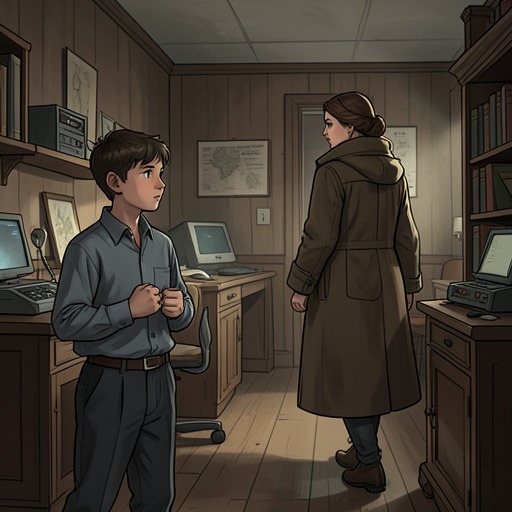
At eight precisely, Vladimir enters the passage in a tail-coat, his hair brushed up into a tuft. The old servant rises unwillingly from his bench, while merry voices come from the drawing-room. Inside, Zinaïda stands on a chair holding a man’s hat above a crowd of about half a dozen men, who reach toward it in search of a ticket. Rather than treat Vladimir as a spectator, she declares that the newcomer must have a ticket too, takes him by the cuff, and presents him as the son of their neighbour. Her guests include Count Malevsky, Doctor Lushin, Meidanov the poet, the retired captain Nirmatsky, and Byelovzorov, whom Vladimir has already seen. Vladimir recognizes Lushin as the dark man who had humiliated him in the garden; the other men are strangers.
The Forfeit and the Kiss
The hat contains the lots for a game of forfeits. As Lushin explains, Zinaïda must pay a forfeit, and whoever draws the lucky lot wins the privilege of kissing her hand. Vladimir initially stands bewildered while the others reach for tickets. Zinaïda asks Meidanov, as a poet, to give up his number so Vladimir can have two chances instead of one. Meidanov refuses; Vladimir draws after the others and unfolds the word “Kiss!”
Zinaïda answers his success with visible delight, coming down from the chair and giving him a bright, sweet look before asking whether he is glad. Byelovzorov objects that Vladimir is too young, but Vladimir responds with an indignant look; Zinaïda claps her hands, and Lushin praises his spirit. Lushin then insists that, as master of ceremonies, he must enforce the rule that Vladimir kneel. Zinaïda holds out her hand with dignity. Vladimir means to kneel on one knee but sinks onto both, and presses his lips to her fingers so awkwardly that her nail scratches him. The prize is both formal and intensely personal: the company makes a game of the kiss, but for Vladimir the moment carries the force of Zinaïda’s renewed attention.
A Room Turned into a Stage
The forfeits continue, with Zinaïda inventing unusual tasks. She performs a statue and chooses Nirmatsky as her pedestal, making him bend into an arch with his head lowered to his chest. The laughter does not stop. Vladimir, raised in the seclusion of a dignified manor-house, is swept up by the noise, the unfamiliar company, and the near-riotous informality. He begins laughing and talking more loudly than the others, so conspicuously that Princess Zasyekin, in the next room consulting a clerk from the Tversky gate about business, comes in to look at him.
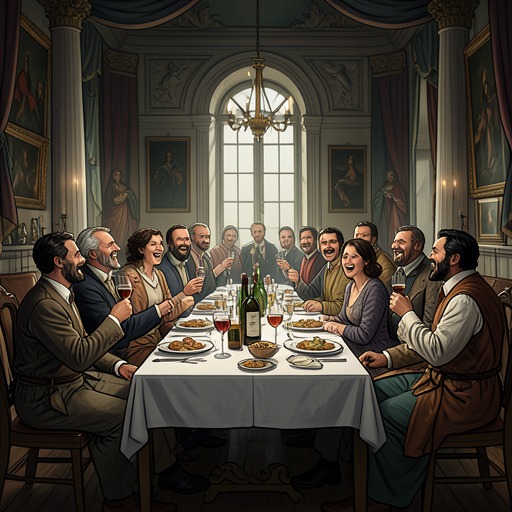
The evening expands beyond the game into a succession of performances and pranks. The company plays the piano, sings and dances, and acts out a gypsy encampment. Nirmatsky is dressed as a bear and made to drink salt water. Count Malevsky demonstrates card tricks and, after shuffling the cards, deals himself all the trumps at whist, prompting Lushin to offer mock congratulations. Meidanov recites passages from his poem “The Manslayer,” which he plans to publish in a black cover with blood-red lettering. The guests steal the clerk’s cap from his knee and make him dance a Cossack dance to get it back; they put a woman’s cap on old Vonifaty, while Zinaïda puts on a man’s hat. The reversals of costume, role, and decorum make the room’s playfulness tangible, set against the formal, private world from which Vladimir has come.
Byelovzorov remains apart from the general merriment. He grows increasingly angry, flushes, and looks as if he might rush at the company and scatter them. Zinaïda restrains him with a glance and a shake of her finger, and he retreats to his corner. Her playful authority over the room is therefore not merely a matter of inventing forfeits: she can also quiet a threatening guest without breaking the evening’s momentum.
Supper and the Return Home
The gathering lasts until the company is worn out. At midnight, supper is served: a piece of stale, dry cheese and cold turnovers filled with minced ham. To Vladimir, faint with happiness, the turnovers seem more delicious than any pastry he has tasted. There is one bottle of wine, dark-coloured with a wide neck and holding pink wine, but no one drinks it. The precise, meagre meal stands in comic contrast to the abundance of amusement that has filled the night.
When Vladimir leaves, Zinaïda presses his hand warmly and smiles mysteriously. Outside, the air is heavy and damp against his heated face; stormclouds gather, wind shakes the dark trees, and distant thunder mutters. He returns to his room by the back stairs and has to step over his sleeping old nurse on the floor. The nurse wakes and tells him that his mother has again been angry and wanted to send for him, but his father prevented it. Vladimir has not gone to bed after saying goodnight to his mother and asking her blessing, as he has always done; after the gathering, that familiar observance is broken. The evening thus ends with two sharply different consequences: Zinaïda’s warm farewell sustains his happiness, while his return places that happiness beside the family discipline and expectations he has left behind.