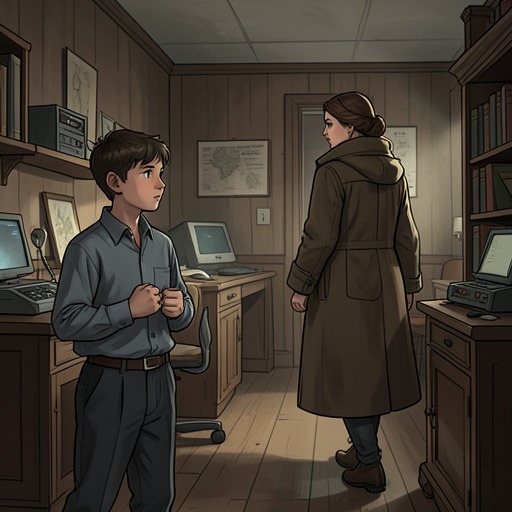
Vladimir Petrovitch
First LoveVladimir Petrovitch is both the adult narrator of First Love and the sixteen-year-old at its emotional center. In the frame narrative, his willingness to write rather than tell the story marks the difference between the remembered experience and the older man’s deliberate account of it: what once overwhelmed a boy is shaped, years later, into a reflection on desire, loss, and time.
Identity and Narrative Frame
At forty, Vladimir Petrovitch has black hair turning grey. He is among the last people left after a gathering has broken up at half-past twelve, when the host proposes that the remaining men tell stories of their first love. Vladimir says that his own was not ordinary, but hesitates to narrate it aloud. He worries that he is poor at storytelling, liable to make it either dry and brief or prolonged and affected, and proposes instead to write down what he remembers and read it to his friends.
His friends initially resist the change of form, but he insists. Two weeks later they meet again, and he keeps his promise: the story they hear is the manuscript that constitutes his account. This frame makes recollection an action in its own right. The adult does not simply return to his youth; he selects and arranges the memory, presenting an experience that its younger self could not yet understand as a finished narrative.
Family Background and the Summer of 1833
The manuscript begins in the summer of 1833, when Vladimir is sixteen and living with his parents in Moscow. The family has taken a country house near the Kalouga gate, facing Neskutchny Gardens. He is preparing for university but studies little and feels no urgency. After his last French tutor departs, no one interferes much with his freedom, and he does as he pleases.
That apparent ease sits alongside a strained household. His father treats him with careless kindness, while his mother, though he is her only child, scarcely notices him, absorbed in other cares. In the account of his parents’ marriage, Vladimir says his father married for mercenary reasons and that his mother was ten years older. He remembers her as melancholy, jealous, and angry, yet careful not to display those feelings in her husband’s presence because she fears him. His father appears severe, cold, and distant, but also elaborately serene, self-confident, and commanding. The boy’s freedom therefore belongs to a family atmosphere shaped by his parents’ unequal and unhappy relationship, not by close parental attention.
First Love and the Younger Vladimir
Vladimir’s first encounter with Zinaïda begins before he knows who she is: he has seen her in the garden the previous evening. When another door opens during his visit to her mother, the girl appears in the doorway with a mocking smile. Her mother introduces her as her daughter and identifies the visitor as the neighbours’ son. Asked his name, Vladimir rises and stutters with excitement. The moment gives the remembered infatuation a precise social beginning: he is not yet at ease in Zinaïda’s presence, and even the simplest introduction unsettles him.
The next morning, the intensity of the previous day has ebbed into a dreary blankness, as if something in him had died. At lunch he looks from his father to his mother, waiting to see whether his father will speak to him as he sometimes does; instead, his father withholds even his usual cold greeting. Vladimir wonders whether to tell Zinaïda everything, but concludes that it is all the same and that matters between them are at an end. When he goes to see her, he does not disclose what is troubling him and cannot secure a conversation with her.
Zinaïda redirects him by entrusting him with her twelve-year-old brother, a cadet newly arrived from Saint Petersburg for the holidays. She asks Vladimir to be kind to the boy, show him Neskutchny Gardens, walk with him, and take him under his protection. Her affectionate use of the pet-name Volodya, and her hands laid on his shoulders, leave Vladimir bewildered. At her urging the two boys embrace, and Vladimir takes the cadet into the garden. He sits him on the narrow plank of an old-fashioned swing and pushes him; later, the boy cuts a pipe from a thick stalk of wild parsley and whistles. Vladimir notices that the cadet’s eyes recall his sister’s. Caring for him gives Vladimir pleasure, but it also sharpens his sadness: beside this younger boy, he feels himself returned to childhood, while remembering how much had seemed to happen the day before.
Loss, Retrospect, and Significance
Years later, Meidanov gives Vladimir Zinaïda’s address. He intends to visit her the next day, but business intervenes; a week passes, then another. When he finally goes to Hotel Demut and asks for Madame Dolsky, he learns that she died almost suddenly in childbirth four days earlier. The delay becomes part of the loss. Vladimir feels the sharp reproach of having had a chance to see her and failed to take it, and the news brings the past back in a rush. The brilliant, agitated life he remembers has ended while he is still alive and, as he thinks, perhaps only a few paces from his father.
His response is not only grief for Zinaïda but recognition of how youth handles grief. He reflects that youth can treat even sorrow as something to enjoy or turn to its own advantage, while its days pass and its sense of limitless possibility disappears. Looking back, he measures the distance between the future he once imagined and what has actually come to pass; among the things left to him, he singles out the memory of early life as a storm already over, an early morning, a spring.
A few days after hearing of Zinaïda’s death, Vladimir is present when a poor old woman in the same house dies. She lies on hard boards, with a sack beneath her head, covered in rags, after a life of daily want and little happiness. Even as she suffers, she crosses herself and whispers a plea for forgiveness; only at the last moment does the fear of death leave her eyes. Beside her deathbed Vladimir feels aghast for Zinaïda and longs to pray for her, for his father, and for himself. The juxtaposition widens the story beyond the recollection of romantic loss: the adult narrator sets youthful self-absorption against the suffering and mortality that demand a different kind of attention. His account preserves the first love not as a fulfilled promise but as a memory whose meaning changes under the pressure of missed chances, death, and the passage of time.