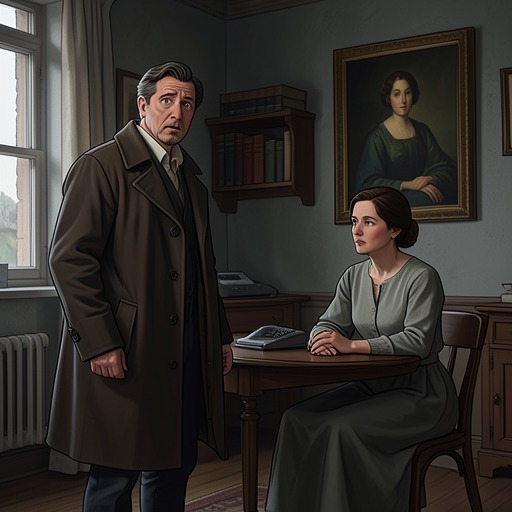
Vladimir jumps down from the wall and receives Zinaïda's kiss
First LoveVladimir jumps down from the wall and receives Zinaïda's kiss in a scene that turns youthful devotion into an impulsive physical act. Invited to prove his love by leaping from a height of about fourteen feet, Vladimir obeys, falls, and briefly faints. When he regains consciousness, Zinaïda Alexandrovna Zasyekin is beside him, first tender and alarmed, then suddenly intent on concealing the intimacy of her response. For Vladimir, the encounter brings an overwhelming happiness that he carries into the following day, when her ordinary manner leaves him unsure how to read it.
The challenge and the leap
Before the encounter, Vladimir has been absorbed in solitude and melancholy. He has taken to sitting on the wall of a ruined greenhouse, indulging the sadness that follows his distress over Zinaïda Alexandrovna Zasyekin. During one such vigil, he looks into the distance and listens to bells. The scene is interrupted by Zinaïda Alexandrovna Zasyekin’s arrival along the path: she wears a light grey gown and carries a pink parasol on her shoulder. She notices him above her, stops, and looks up.
Her question about what he is doing at such a height becomes an invitation to act on his repeated declarations of love. She tells him to jump down to the road if he truly loves her. The challenge makes devotion something immediate and bodily: Vladimir does not pause to negotiate its meaning or consider the danger. He leaps as though pushed, lands on his feet, then loses his balance and falls. The wall is about fourteen feet high, and the shock briefly leaves him unconscious. The scene’s decisive turn is not a planned display of courage but the speed with which an emotional declaration becomes an action with physical consequences.
Zinaïda’s response
When Vladimir comes to, he keeps his eyes closed. He hears Zinaïda Alexandrovna Zasyekin leaning over him and addressing him with alarmed tenderness; she tells him that she loves him and urges him to get up. Her concern and affection meet him before he has opened his eyes or answered. She caresses his head, and her kisses cover his face and reach his lips. The sequence makes her response unmistakably intimate, while Vladimir’s continued stillness means that, for a moment, she may believe he has not regained consciousness.
Once she apparently recognizes that he is awake, Zinaïda Alexandrovna Zasyekin rises quickly. Her manner changes: she calls him naughty and silly, asks why he is lying in the dust, and tells him not to stare at her. She sends him to go home, brush himself off, and not follow her, warning that otherwise she will be angry and never again—without completing what she means to withhold. She also asks for the parasol she has dropped. These abrupt practical instructions follow the tenderness without erasing it. Instead, they leave Vladimir with a moment that has been both explicitly loving and quickly disavowed as something he should not dwell on.
The immediate aftermath
After Zinaïda Alexandrovna Zasyekin walks away, Vladimir sits beside the road because his legs will not support him. He has been stung by nettles, his back aches, and his head feels giddy; nevertheless, the dominant consequence he recalls is rapture. It moves through him as a sweet ache and then breaks into hopping, skipping, and shouts. His response preserves the scene’s mixture of vulnerability and exhilaration: the leap has left him physically shaken, but the kisses make the experience seem like an extraordinary happiness.
For the rest of that day, he feels proud and light-hearted. He repeatedly recalls the kisses and Zinaïda Alexandrovna Zasyekin’s words, holding on to his unexpected happiness so tightly that he is almost afraid to see her. He imagines that fate has given him all he can ask for. The intensity belongs to the young Vladimir’s immediate experience; he is sixteen, and the narration stresses that he remains a child despite his age.
The following day and the scene’s significance
The next day brings no continuation of the roadside scene in the same register. When Vladimir visits the lodge, he is embarrassed and tries to hide it beneath a show of confidence, as if he knows how to keep a secret. Zinaïda Alexandrovna Zasyekin receives him simply, shakes a finger at him, and asks whether he is black and blue. Her ordinary, lightly admonishing manner dissolves his performance of secrecy and his embarrassment. The contrast does not cancel what happened; it shows how quickly the encounter’s extraordinary meaning for him meets her composed public manner.
The event therefore rests on a sharp imbalance between action and interpretation. Vladimir treats the invitation as a command to prove his love and obeys before considering the consequences. Zinaïda Alexandrovna Zasyekin’s tenderness is real within the scene—she says she loves him and kisses him—but she also hastens to restore distance, sending him away and telling him not to follow. The first-person recollection gives unusual weight to the bodily shock, the brief loss of consciousness, and the joy that follows, while the next-day meeting supplies no simple explanation of her conduct. The leap becomes a defining memory not because it settles their relationship, but because it offers Vladimir a moment of unmistakable affection whose meaning remains unsettled.