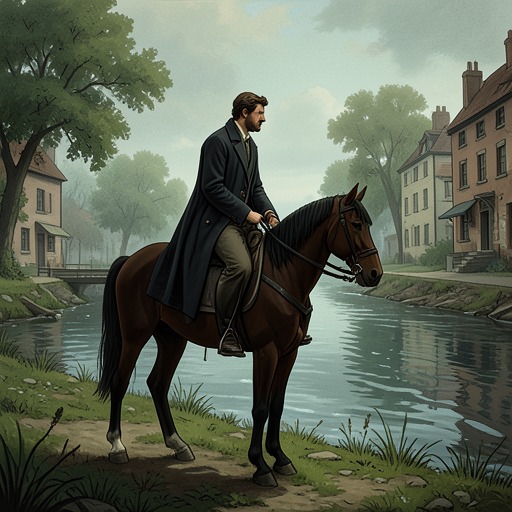
Vladimir witnesses his father whip Zinaïda
First LoveVladimir witnesses his father whip Zinaïda when he unexpectedly finds them together at a small wooden house. The blow, and Zinaïda’s response to it, overturn the young man’s ideas about love: what he sees is not merely violence but a devotion that seems to him capable of enduring even injury from a beloved hand.
Discovery at the Window
Vladimir’s father has left him waiting with the horses by the Moskva River, near a timber-stack, and disappeared into a small street. Growing impatient, Vladimir walks after him and turns a corner. Forty paces away, at the open window of a wooden house, he sees his father leaning over the sill and speaking to Zinaïda Alexandrovna Zasyekin, who sits partly concealed by a curtain in a dark dress. Vladimir had not expected to find them together. He first wants to flee, afraid his father will turn and see him, but a force stronger than curiosity, jealousy, or fear keeps him watching.
The exchange appears tense: his father seems to be insisting on something, while Zinaïda refuses to consent. She does not raise her eyes; she answers in monosyllables and smiles submissively without yielding. Vladimir registers her face as mournful and serious, marked by devotion, grief, love, and despair. His father’s shrug and the familiar act of straightening his hat signal impatience. From his hiding place, Vladimir catches enough of their words to understand that his father is demanding a separation. The private conversation at the window thus becomes, for the watching son, an unexpected disclosure of a relationship he had not known about.
The Blow and Its Aftermath
The demand for separation turns abruptly into violence. As Zinaïda stretches out her arm, Vladimir’s father lifts the whip he has been using to brush dust from his coat and strikes her bare arm, exposed to the elbow. Zinaïda shudders, looks at him without speaking, then raises the injured arm to her lips and kisses the red streak. Her response neither matches the blow with violence nor grants the demand: she has refused to consent, and after the strike she leaves the window with her arms outstretched and her head bowed. Her silence and gesture become the scene’s most arresting answer.
Vladimir can scarcely keep from crying out. He runs back down the lane to the riverbank, almost losing his hold on Electric, and finds himself unable to think clearly. He had known his father, usually cold and reserved, could be seized by fury; knowing this does not help him comprehend what he has witnessed. What remains with him is the image of Zinaïda: her gesture, glance, and smile, fixed in his memory. Staring vacantly at the river, he weeps without noticing his tears and can only repeat to himself that she has been beaten. The violence is not absorbed as an ordinary quarrel; the sight arrests his understanding and becomes an image he knows he will not forget.
His father returns and asks for the mare. Vladimir hands him the bridle mechanically. Electric rears and leaps away after standing in the cold, but his father soon subdues her, drives in his spurs, and strikes her neck with his fist. He then notices that he has no whip. When Vladimir asks where it went, his father glances quickly at him and explains that he threw it away. He falls silent and lowers his head; for the first, and almost the last, time, Vladimir sees tenderness and pity in his stern features. The man who has just struck Zinaïda has discarded the instrument and now shows a feeling his son has rarely seen. He gallops ahead, and Vladimir reaches home fifteen minutes later.
That night, sitting at his writing table among books and papers, Vladimir tries to name what he has seen. He calls it love and passion: Zinaïda, he thinks, could bear a blow even from the dearest hand because she loves the person who dealt it. The vision sharply displaces his own infatuation, which now seems small, childish, and pitiful beside an experience he had never imagined. Yet this larger form of love does not become clear to him. It frightens him like a beautiful but menacing face glimpsed in half-darkness, difficult to make out. The episode therefore changes not only what Vladimir knows about his father and Zinaïda, but also the scale by which he measures his own feelings: the witnessed blow leaves him with an image of love at once powerful, submissive, and disturbing.
The Dream and the Scene’s Afterlife
That night, the witnessed violence returns in a dream, but its images are displaced and intensified. In a low, dark room, Vladimir sees his father stamping with anger and holding a whip; Zinaïda crouches in a corner, marked not on her arm but across her forehead by a red stripe. Behind them towers Byelovzorov, covered in blood, his white lips opening as he threatens Vladimir’s father. The dream does not clarify what the scene meant. Instead, it rearranges its participants and injuries, carrying the blow from Zinaïda’s exposed arm to her face and bringing a rival from Vladimir’s earlier emotional world into the violence. Its nightmarish substitutions register how thoroughly the sight has unsettled him.
The episode also stands at the threshold of later knowledge. Two months afterward, Vladimir enters university; within six months, his father dies of a stroke in Saint Petersburg. Shortly before that death, a letter from Moscow throws his father into violent agitation, and he goes to Vladimir’s mother to ask a favor, reportedly shedding tears. On the morning he is stricken, he begins a letter to his son warning him against a woman’s love as both bliss and poison. These later details do not explain the private scene at the window, but they extend its pattern of concealed feeling, distress, and belated revelation. For Vladimir, the blow remains an image of a love he could not comprehend at the time; the father’s final warning gives that memory a further, still unresolved weight.
The Limits of the Witness
The scene reveals a relationship through fragments rather than explanation. Vladimir catches the beginning of his father’s French demand that Zinaïda separate from someone or something, but the phrase trails off at “cette…”. He can read the pressure in the exchange—his father insists, and Zinaïda does not consent—without learning its full terms. The blow makes the encounter unmistakable in its intensity, yet does not supply the knowledge that would make its history transparent. The reader, like the young witness, must distinguish what the scene shows from what it leaves unresolved.
That narrow vantage shapes the episode’s force. Vladimir sees his father and Zinaïda at close quarters, but from outside their conversation; the adult narrator can preserve the woman’s expression and gesture as unforgettable while still acknowledging that the experience once exceeded his understanding. The scene is therefore both a disclosure and a limit: it changes what Vladimir knows, but its unfinished speech and uncomprehended passion prevent knowledge from becoming a complete explanation.