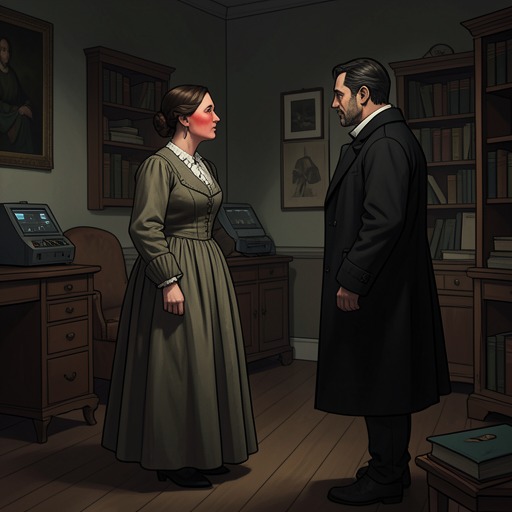
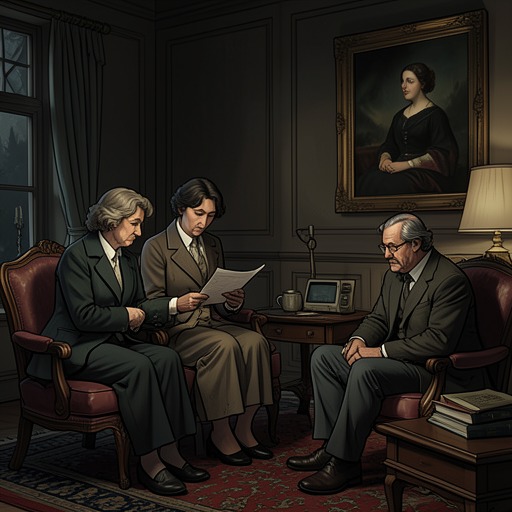
Vladimir's parents clash over his father's relationship with Zinaïda
First LoveVladimir's parents clash over his father's relationship with Zinaïda is the moment when a private suspicion becomes a family crisis. In the summer of 1833, sixteen-year-old Vladimir Petrovitch hears that his mother has accused Piotr Vassilievitch of infidelity with their young neighbor, Zinaïda Alexandrovna Zasyekin. Because the confrontation reaches him through a servant rather than through either parent, the revelation arrives as both intimate shock and fragmentary household intelligence; its aftermath is a subdued departure from the country house, not a public reckoning.
Background and marital strain
The dispute enters a household already marked by distance and unequal power. Vladimir’s mother, Maria Nikolaevna, is ten years older than Piotr Vassilievitch, and the narrator says that he married her for mercenary reasons. She lives anxiously, often jealous and angry, but not in her husband’s presence, and is very much afraid of him. He is severe, cold, and distant toward her, while retaining a composed and commanding manner. Vladimir, their only child, is largely overlooked by his mother; his father treats him with careless kindness. This domestic arrangement helps explain why the conflict is described not as a sudden exchange between equals, but as an eruption within a marriage already shaped by apprehension and restraint.
The immediate setting sharpens the revelation. The family is spending the summer near the Kalouga gate, across from the Neskutchny Gardens, while Vladimir prepares for university and lives with considerable freedom. He is sixteen; Zinaïda is twenty-one. Her earlier insistence that he tell her the truth and do what she tells him, together with his intense devotion to her, establishes the unequal ages and attachments surrounding the affair. The conflict between his parents thus reaches him at the point where his own youthful feelings have made the neighbor more than a distant figure.
The confrontation and its disclosure
Vladimir comes home from a long walk expecting dinner, only to learn that he will eat alone: his father has gone out, and his mother, unwell, has shut herself in her bedroom and wants no food. The servants’ expressions persuade him that something serious has happened. Rather than question the household openly, he turns to Philip, a young waiter with whom he is friendly. Philip, who is fond of poetry and plays the guitar, reports what the servants have learned: a scene took place between Vladimir’s parents, and the servants’ room had overheard it. The account is explicitly mediated; Vladimir does not witness the argument, and the reader receives its details as household report.
According to Philip, Maria Nikolaevna accused her husband of infidelity and of an intimacy with the young woman next door. Piotr Vassilievitch initially defended himself, then lost his temper and made a cruel remark about his wife’s age, which made her cry. Maria Nikolaevna also referred to a loan made to the old princess, spoke harshly of the princess and her daughter, and elicited a threat from her husband. Philip attributes the exposure to an anonymous letter, whose author is unknown. When Vladimir struggles to ask whether there was any real basis for the accusation, Philip indicates that there was: his father had taken care this time, but hiring a carriage and getting by without servants had proved difficult. The report therefore distinguishes the mother’s accusation from the circumstantial confirmation Vladimir receives through the servant.
Vladimir’s response and the family’s retreat
The information overwhelms Vladimir. He does not break down or immediately interrogate his father; he lies on his bed stunned, unable to take in what he has learned. His earlier hopes are abruptly recast by the knowledge that his father’s connection to Zinaïda is real. The emotional force of the scene lies partly in the route by which truth arrives: a private marital dispute becomes legible to the son through overheard speech, an anonymous letter, and the practical traces of a carriage and servants. The revelation also changes the meaning of his own attachment, which can no longer be separated from the adults’ concealed relationship.
The following day, Maria Nikolaevna announces that the family will return to Moscow. Piotr Vassilievitch spends a long time alone with her in her bedroom; no one hears what he says. Afterward she no longer weeps, regains her composure, and asks for food, but does not appear and does not change her plan to leave. The private conversation may have eased the immediate distress, but the narration does not disclose what passed between them or suggest that the underlying marital conflict has been resolved.
Preparations for the move to the family house on Arbaty Street proceed quietly and without haste. Vladimir infers that his father has persuaded his mother not to make a public scandal. Maria Nikolaevna nevertheless sends her compliments to the old princess and regrets that illness prevents her from seeing her before the departure. The contrast between the hidden accusation and these restrained courtesies gives the aftermath its distinctive shape: the family removes itself without openly naming the rupture to its neighbors.
Significance
The clash is both a disclosure about Piotr Vassilievitch and a turning point in Vladimir’s understanding of love. His own feelings for Zinaïda have involved obedience, longing, and the shock of physical proximity; now he learns that the young woman is connected to his father in a way that implicates the whole household. The scene does not give him direct access to the adults’ motives or private conversation. Instead, its partial, servant-carried account leaves him with evidence and inference, and makes the limits of his childhood knowledge part of the event’s force.
The departure closes the immediate episode without settling its moral or emotional questions. Vladimir is left to consider Zinaïda’s involvement, his father’s conduct, and his mother’s response, while the adults preserve outward composure and avoid public confrontation. The event therefore marks a shift from private adolescent bewilderment to painful knowledge of adult passion and marital conflict: the home that had seemed merely distant now contains a concealed history with consequences for every member of the family.