Whip
First LoveThe Whip is an ordinary riding implement that becomes inseparable from Vladimir Petrovitch’s discovery of the emotional force between his father, Piotr Vassilievitch, and Zinaïda Alexandrovna Zasyekin. In the scene Vladimir witnesses, it is first used to brush dust from Piotr’s coat, then turned against Zinaïda. Piotr’s immediate decision to throw it away does not undo what Vladimir has seen: the discarded object becomes a lasting token of violence, devotion, and the limits of the young narrator’s understanding of love.
Appearance and Immediate Use
The Whip enters the encounter without ceremony. Piotr is switching dust off his coat with it while speaking to Zinaïda at the open window of a small wooden house. Vladimir, watching from a distance, notices his father’s impatient gestures and hears part of the exchange, but cannot yet understand its full significance. The object’s presence initially belongs to an everyday action; its sudden change of use gives the scene its shock.
When Zinaïda stretches out her arm, Piotr strikes her with the Whip. She shudders, looks at him without speaking, and kisses the red mark. Piotr throws the object away and hurries into the house; Zinaïda turns from the window and moves away. The Whip therefore marks a rapid turn in the encounter, from an argument whose terms Vladimir cannot fully hear to an act that exposes the intensity of the relationship before him. The narration does not explain the dispute or assign a motive beyond what the scene shows.
Discarding the Whip
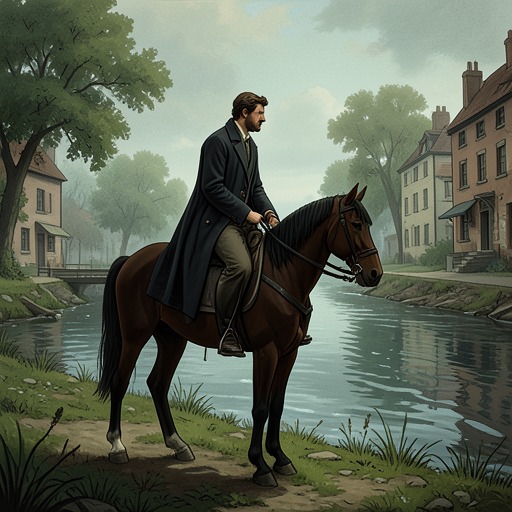
After fleeing to the riverbank, Vladimir is found by his father, who asks for the mare. Piotr rides off without the Whip, and when Vladimir later asks where it went, Piotr explains that he threw it away. The object’s disposal is a concrete consequence of the encounter, not a repair of it: the sight and sound of the blow have already become fixed in Vladimir’s memory.
The exchange also places the Whip beside a strikingly different image of Piotr. As Vladimir rides after him, he wants to see his father’s face; Piotr eventually glances at him, and Vladimir perceives tenderness and pity in features he had understood as stern. The discarded Whip thus belongs to a moment that alters Vladimir’s view of both his father and Zinaïda. It does not make Piotr’s action disappear, but the scene holds that action alongside an unexpected expression of feeling.
Memory and Interpretation
That night, seated at his writing table, Vladimir returns mentally to the Whip’s fall. He contrasts his own youthful transports with what he has just witnessed: a person bearing a blow from someone deeply loved. The Whip gives this realization a specific, remembered form. For Vladimir, the scene suggests that love can involve a surrender he had not imagined, and his former conception of passion now seems childish beside it.
The moment is conveyed through recurrence rather than explanation. Vladimir first witnesses the Whip in motion, then recalls its sound after Piotr rides away without it, and finally makes it central to his reflection on love. Each return alters its weight: an implement in an argument becomes an event he cannot forget, then evidence through which he tries to understand a relationship that exceeds his own experience.
The Whip in the Dream
In a fearful dream that same night, the Whip appears again in Piotr’s hand. The dream relocates the mark from Zinaïda’s arm to her forehead and places Byelovzorov, bloodied and threatening Piotr, behind them. These altered details belong to the dream, not to the witnessed encounter. They show Vladimir’s mind transforming the scene into a more disturbing image, while keeping the Whip at its center.
The object’s narrative significance rests on this movement between witnessed action, recollection, and dream. It is first an ordinary possession, then part of a revelation Vladimir cannot fully comprehend, and finally an image through which his fear and new understanding take shape. Though Piotr discards it, the Whip remains active in the story as a material trace of the encounter and as the recurring sign of the gap between Vladimir’s youthful ideas of love and the painful reality he has seen.