Bryant King
Five Days at MemorialBryant King was a young physician at Memorial Medical Center during the Katrina crisis whose insistence that care should continue, even under severe constraints, set him at odds with colleagues and hospital leadership. He argued for people turned away from the hospital, organized practical treatment for patients waiting to be evacuated, and later became a public witness in the controversy over injections. The book presents him neither as a detached observer nor as someone untouched by the emergency: his conduct grew out of a clinical outlook shaped by earlier work with limited resources, while his public account brought professional conflict and personal risk in its wake.
Background and Clinical Formation
King had recently come to work at Memorial. His experience before Katrina had accustomed him to practicing without the equipment and infrastructure that ordinarily made hospital medicine feel controlled. During a two-month medical-school rotation in Jamaica, he cared for patients without sophisticated machinery or even an X-ray machine, learning to rely on clinical judgment and make the best of what was available. He had also practiced in the comparatively austere setting of Charity Hospital in New Orleans during his internal-medicine residency.
King’s upbringing and early discipline formed part of this background. He grew up in East Chicago, Indiana, with three younger siblings; the family sometimes relied on welfare, and his parents were divorced. His father, a military sergeant, insisted that the children learn discipline, including through Army Reserve boot camp. King later described spending a high-school summer in South Carolina in difficult conditions, a memory that gave him a point of comparison for the discomfort of working through the night at Memorial.
The year before Katrina, King had become chief resident, a distinction reflecting high achievement. He left the position halfway through the year after disagreeing with those in charge about his administrative duties. The book also describes him as strong-minded, sometimes impatient with authority, and poorly disposed to criticism or rejection. Those traits do not erase the practical basis of his actions at Memorial, but help explain why disagreement there could become open confrontation rather than quiet accommodation.
Advocacy and Conflict at Memorial
When a couple arrived at Memorial by rowboat with their small children, the family was told to leave. King confronted CEO L. René Goux, insisting that the hospital had to help them. His advocacy did not change the decision: the family was refused. Karen Wynn, who saw the hospital as already full, did not interpret the refusals as racial discrimination, although nearly all the people turned away were African American and she was African American herself. King, the only African American doctor on duty and one of very few African American physicians at the hospital, was offended by the racial dimension of turning them away. He did not make race the basis of his argument, believing it would make others defensive. In his view, the immediate conflict was about helping people in danger, even as the hospital was also sheltering animals and families were arriving over polluted floodwater in unstable boats.
That confrontation reflected a broader disagreement over what Memorial had become. To Ewing Cook, the hospital was now a shelter with dwindling supplies that needed to be emptied, and King seemed out of touch with the circumstances. Their tension had already emerged over whether treatments that were not strictly necessary should be stopped. King believed patients should continue receiving care, including monitoring, when the hospital could provide it. Cook’s view of the emergency emphasized the limits of the site and the need to move people out; King kept returning to what could still be done for them.
Organizing Care Under Constraint
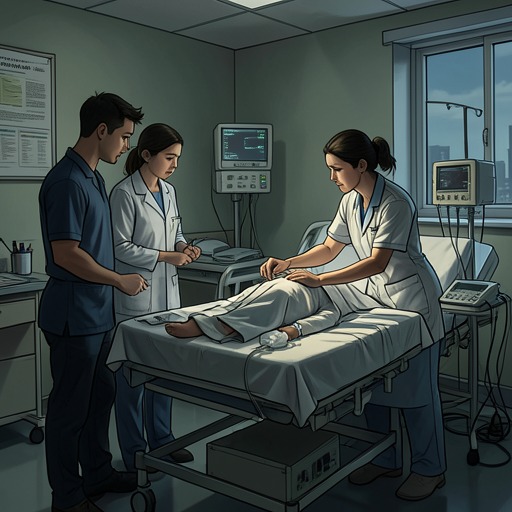
As evacuation proceeded, patients remained in the lobby and on the emergency-room ramp, where basic needs were often met while medical care was limited. King tried to make that care more systematic. He sent nurses through the lobby to check blood pressures for patients with hypertension and blood-sugar levels for patients with diabetes, and directed that insulin and other medications be given when needed. He also had nurses take photocopied charts from their manila envelopes, identify diagnoses or concerns requiring attention, and write that information on paper attached to the patients. The markings were meant to help the next shift recognize needs more quickly, turning scattered records into a practical handoff in a crowded, disrupted space.
King’s approach was not a belief that ordinary hospital practice could simply continue unchanged. He recognized that the storm had shattered the usual sense of clinical control: damaged windows and lost power left staff exposed to the elements, and the hospital resembled a field hospital more than a sterile, equipped institution. He wanted to leave as much as anyone, but understood the task as finding the best available way to keep caring for the sickest patients. That distinction—between acknowledging the emergency and treating it as a reason to stop providing care—runs through his disputes with colleagues.
Before sunrise, King returned from a short rest and examined an unresponsive man in a patterned hospital gown. He pronounced the man dead and recorded the finding in the medical chart. The patient, in his early sixties, had heart disease and had come to Memorial with pneumonia symptoms as the storm approached. His wife had been separated from him and escorted toward the boat line by armed security after he was brought downstairs. With help from staff family members, King carried the body to the chapel. A nurse prayed over the dead there; King counted five other bodies before the altar. His role in this moment was both clinical and physical: he documented the death and helped move the patient from the lobby into the chapel.
Witness to the Syringes
King later became one of the public witnesses in the allegations surrounding patient injections at Memorial. In a CNN report in late December, he said that he had seen a doctor holding a handful of syringes on the second-floor lobby. The reporter identified the doctor as Anna Pou, and King recounted hearing her say that she would give someone something to make the person feel better. The statement was presented as King’s account of what he had seen and heard; it was not, by itself, a resolution of what the injections contained or what they meant.
His account had an important context: King had worked closely with Pou during the disaster, taking turns with her caring for patients on the second floor, and had thought she was doing a very good job. Later, he struggled to understand how someone with whom he had been cordial could participate in conduct he considered terrible. He believed the first response to a proposal outside normal medical practice should have been to stop and question it, rather than proceed as if extraordinary circumstances could make it acceptable. His distress therefore involved not only the alleged acts but the distance between his previous professional relationship with Pou and what he believed he had witnessed.
King’s departure from Memorial was later disputed in accounts of who had been present during the events. Some employees said they believed he had left on Wednesday, which would have excluded him from witnessing events in the second-floor lobby on Thursday. The book notes that the specificity of his recollections and numerous employees’ memories of seeing and working with him that day support his presence on Thursday. He also spoke with Kathleen Fournier about what she had told him; her account indicated that King was upset by the discussion and left. The evidence presents his departure as part of the disagreement, not as proof by itself of the underlying allegations.
Public Fallout and Lasting Effects
The CNN appearance exposed King to intense public reaction. At a Memorial staff gathering the following spring, Horace Baltz heard several attendees condemn King for speaking to the network, describing him as untrustworthy, disruptive, and unwilling to be a team player. Baltz considered the attacks racially prejudiced. King had moved out of state after the uproar began. Later, he stayed away from New Orleans and declined further CNN interview requests because he feared for his safety. A friend advised him to keep quiet and out of sight, warning that influential people seeking to discredit him could make him a target.
King’s public silence did not mean the experience had become settled for him. He continued to question how someone he had worked beside could be drawn into conduct he could not reconcile with ordinary medical practice, and he could not understand why Pou was allowed to continue practicing medicine. The book places that judgment alongside his awareness that Katrina had stripped away the ordinary protections and routines of medical work. The emergency made care difficult, but, in King’s view, it did not remove the responsibility to ask whether a patient could still be helped.
His account also had a cost beyond the immediate professional dispute. The Memorial gathering’s denunciations occurred in his absence, while King was already living outside the state; he had become a figure argued over by colleagues rather than a participant in their reunion. His trajectory—from arguing face-to-face for people at the hospital’s door, to organizing treatment in the lobby, to speaking publicly about syringes, and then withdrawing from the city—shows how his insistence on care became entangled with the later struggle over credibility. He remained convinced that the crisis demanded continued clinical effort, and that the circumstances did not make it acceptable to stop questioning what was being done to patients.