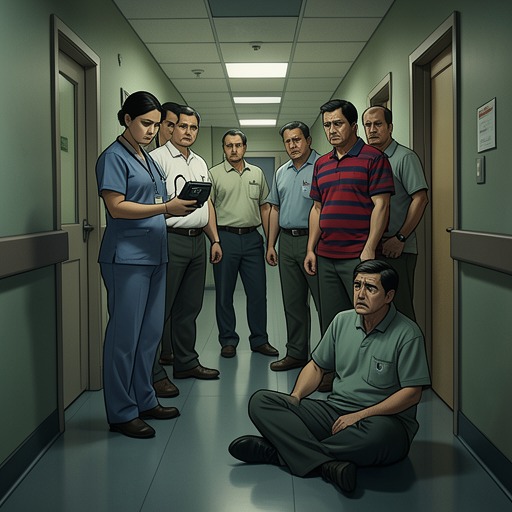
Claimed martial law at Memorial
Five Days at MemorialThe claimed martial law at Memorial Medical Center was a belief reported by staff during the hospital’s evacuation crisis, not a verified declaration that the military had taken control. Its importance lies in how it turned uncertainty into perceived authority: some LifeCare staff thought orders came from higher up, and that understanding helped determine whether they stayed, objected, or left patients behind.
Origins of the Belief
As the LifeCare floor was being cleared, Diane Robichaux told Gina Isbell that all staff except the core leadership team were to leave. Isbell had spent five days trying to keep patients alive and struggled to accept that some could not be saved. A colleague told her the hospital was under martial law; Isbell believed orders had to be followed and did what she was instructed to do. The account establishes what she believed, not that military authorities had issued or enforced such an order.
The belief circulated amid real confusion about who controlled the evacuation and what was expected of staff. LifeCare leaders directed nurses and aides to gather their belongings and leave, in some cases without arranging a handoff of patient care. When the leaders later tried to reach patients on the second floor, a Memorial employee blocked them. A doctor had instructed certain staff to direct people away from the area where DNR patients were located. That barrier was an actual hospital restriction in the account; it does not confirm the separate claim of martial law.
How It Shaped Staff Decisions
Therese Mendez understood Anna Pou’s actions through the assumption that Pou had received orders from a higher authority and was acting under military command. Mendez recalled Pou referring to martial law and to the military making decisions while helicopters carried people out. When a coworker whispered about going to search for patients despite the restriction, Mendez urged against it, fearing they could be shot or arrested. Her response shows how the belief could constrain action even without evidence in these accounts that the threatened consequences came from an actual military authority.
Mendez had asked whether the plan applied only to LifeCare patients. Pou told her it did not, and said staff from elsewhere in the hospital would assist while LifeCare employees packed and left. Mendez went to gather her colleagues. She believed the nurses and aides who had worked to keep patients alive should not witness what was about to happen. In her later account, the word lethal made the situation feel like an abrupt retreat, with patients potentially left behind. The narrative notes that her recollection broadly accorded with Robichaux’s while retaining differences in detail; it also emphasizes that the alleged plan was put into action as evacuation was underway, not merely while staff waited for rescue.
Kristy Johnson likewise connected the martial-law belief to the plan as she understood it. She recalled hearing the previous day that a physician had told Mendez they were under martial law. When Mendez later called her away from the crowded evacuation route and told her that patients would receive lethal doses, Johnson initially understood this as an order being carried out under military authority. Her account documents the force of that interpretation, not independent confirmation of who issued the plan or whether a military order existed.
Limits and Aftermath
The distinction between perceived authority and verified authority matters. These accounts describe staff hearing that martial law was in effect and interpreting hospital decisions through that claim. They do not establish a formal declaration, identify a military officer who issued orders, or show that the military directed the decisions about LifeCare patients. The reported restrictions and evacuation instructions came through hospital personnel, while the staff’s understanding of their source remained uncertain.
For Isbell, following instructions did not settle the emotional consequences. After leaving Memorial in a small boat, she slept poorly, had nightmares in which she saw patients’ faces, and felt guilt about the staff she had selected and the patients who had died. She remained angry that help had arrived too slowly and described herself as changed by the storm. The claimed martial law thus belongs not only to the confusion surrounding decisions at the hospital but also to the later effort to explain how staff understood their choices under pressure. It is evidence of a powerful belief in the chain of command, not proof that the authority attributed to that chain was real.