Eric Yancovich
Five Days at MemorialEric Yancovich was Memorial Medical Center’s plant operations director and a member of its emergency leadership team. He understood that the hospital’s elevated backup generators were only one part of a vulnerable electrical system: switches and distribution equipment closer to or below ground could disable power even if the engines themselves remained above floodwater. His advance warnings gave the looming blackout a documented history, and his engineering staff later helped improvise limited power and cooling after the main generators failed.
Identity and First Warning
When a National Guard soldier approached people outside Memorial and asked who was in charge, Yancovich answered. In his early forties, short and muscular, he had been outside photographing the damage Hurricane Katrina had done to the hospital: blown-out windows and light fixtures, a collapsed penthouse, bent antennas, and exposed joints on the roof. The soldier told him that the levees protecting New Orleans had been breached and warned that fifteen feet of water could follow. Yancovich initially muttered in disbelief, then recognized that the warning was serious. He asked the soldier to come into the command center with him; he did not want to carry the news inside alone.
The exchange captures the work Yancovich occupied between physical plant and emergency command. He was not simply recording storm damage: he knew that the visible destruction was connected to a less visible danger in the hospital’s infrastructure. The possibility of floodwater disabling Memorial’s power had already been raised in planning and calculations, long before the soldier’s warning made it immediate.
Forecasting the Electrical Weakness
After Hurricane Ivan narrowly missed the city in September 2004, Memorial’s leaders reviewed their hurricane plans. Yancovich attended a meeting with the US Army Corps of Engineers and studied storm-surge models known as SLOSH, which estimated how high hurricane-driven water could rise over land. The scenarios he considered included a Category Four or Five storm flooding the city from the lake or river. Memorial stood three feet below sea level; those models suggested that twelve to fifteen feet of water could rise around it.
Yancovich translated that broad hazard into the hospital’s particular elevations. On lined paper, he sketched entrances and critical outdoor equipment in relation to Magnolia Street, the narrow road behind the hospital and perpendicular to Napoleon Avenue. His measurements indicated that less than four feet of street flooding could carry water over the loading dock and into the hospital. The generators on the second floor were comparatively safe, but some essential parts of the emergency power distribution system sat below ground or only inches to a few feet above it. The distinction was crucial: having generators did not guarantee that their electricity could reach the hospital’s equipment.
In a note to his supervisor several months before Katrina, Yancovich warned that little water could disable most of the medical center. He predicted that the main hospital would lose power and that patients would have to be moved to the newer Clara Wing, where he believed the electrical circuitry was better protected. This was not a general forecast of storm damage but a specific account of how flooding could interrupt the hospital’s ability to function.
Mitigation Deferred
Yancovich’s department had made some protective changes, including installing floodgates and raising the vent for the underground diesel tanks. He also recommended elevating the emergency power transfer switches in the basement and at ground level, along with pumps supplying medical air and vacuum suction. Those systems mattered directly to patients with respiratory problems, so the threat extended beyond darkened rooms: flood damage to power distribution or the pumps could undermine essential care.
The proposed work encountered a financial limit. A partial bid for the electrical improvements alone exceeded a quarter of a million dollars. Yancovich’s memo concluded that, for lack of capital, he did not expect the work to be approved at that time, though he would keep it on file for future consideration. The larger citywide effort to assess hospitals’ ability to withstand fifteen feet of water had also stalled after hospitals responded without enthusiasm to the likely expense. In the days before Katrina, emergency officials were told that all but two New Orleans hospitals had generators, electrical switches, or both at ground level. Memorial’s vulnerability was therefore not a surprise that appeared only after the flood; the risk had been identified, while the costly remedies remained unfinished.
As water threatened the hospital, Yancovich and emergency committee head Susan Mulderick understood that evacuation was necessary. Mulderick advised CEO L. René Goux, who spoke with his superiors at Tenet Healthcare and told them evacuation looked likely. Yancovich’s technical assessment thus intersected with a decision about the institution’s next step: the emergency was not only whether the generators could run, but whether patients could safely remain in a building whose electrical systems were exposed.
Failure and Improvised Power
Memorial’s three large, teal-colored generators had already been running for two days, though the hospital’s disaster plans called for them to support operations for at least three. They were designed for short periods of backup service, not prolonged operation. When an engine shut down, maintenance workers thought it had overheated, added water to its radiator by flashlight, and got it running again. Later, low oil pressure appeared to be a problem; workers brought diesel to prime the motors and retrieved more fuel from a generator in the surgery building. These efforts unfolded as parts of the hospital lost power and the remaining light dimmed.
After one generator could not be restarted, engineers tried to transfer some of its electrical load to another. In rubber boots, they waded through knee-deep basement water to reach the electrical building’s mezzanine. Roughly a third of the automatic transfer switches were at a low level, and the water suggested that switches and distribution panels might be submerged—the failure mode Yancovich had described in advance. The engineers tried a bypass handle, but the working generator began drawing excessive current, suggesting a short circuit. They separated the loads to reduce the risk of fire, especially dangerous because the sprinkler pumps were underwater, and shut off branch circuits serving unused equipment. Another generator failed, and an attempted repair using parts salvaged from it did not succeed. At about two in the morning on Wednesday, August 31, the last backup generator surged and died.
Yancovich was not among the on-site generator mechanics—none of the electricians or engineers there was a generator specialist—but the later response again involved his department. After returning Wednesday evening from ferrying passengers in his fishing boat, he and his staff found and repaired two small generators. One electrician set a generator up in the parking garage and ran an extension cord through the stairwell to the lobby, powering a high-speed blower normally used to dry floors. It was put to a different purpose: cooling patients and staff. Box fans and lamps gathered from around the hospital came back into use, supplementing cardboard fans and Coleman lanterns; a few old bulbs on the helipad also lit. This limited source of electricity arrived after the main system had failed. The account notes that earlier use of the small generators might have saved some patients dependent on electrical equipment, but does not establish that it would have done so.
Engineering as a Record of What Could Have Been Known
Yancovich’s role is defined by a repeated contrast between the system’s apparent safeguards and its actual dependencies. The second-floor generators seemed protected, but their usefulness depended on transfer switches, distribution panels, and supporting equipment vulnerable to much shallower water. His hand-drawn elevation sketch, written warning, and recommendations for costly improvements make that hidden dependency legible before the crisis; the submerged basement and failed generators later give it physical consequence.
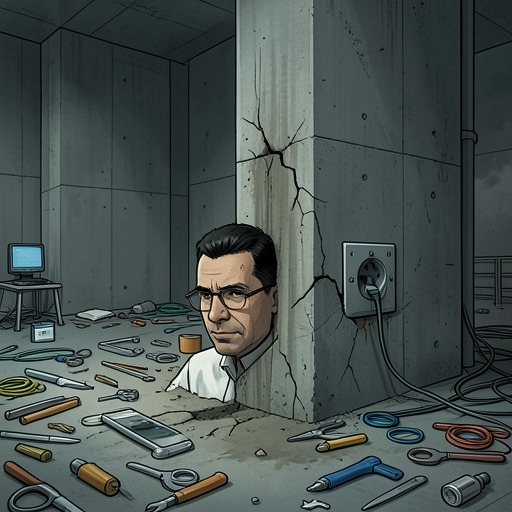
His work also appears in smaller decisions made under pressure. He had discussed creating a direct route through a hospital wall to connect the building to the parking garage beneath the helipad when elevators could no longer be relied on. A worker instead recalled a concealed, rough-edged opening in a machine-room wall, ordinarily covered by hinged metal and thought by Yancovich to have been made for servicing equipment from the garage. Nurse manager Karen Wynn and Thao Lam passed a patient through it to volunteers waiting on the other side. The account does not present the opening as a planned evacuation route, but its practical use belonged to the same improvised engineering landscape that Yancovich had been trying to understand and adapt.
Taken together, his foresight and the later breakdown do not make him the author of Memorial’s failure: the evidence places him among those who identified and tried to mitigate a known infrastructure risk, while funding for major work remained unavailable. His significance lies in the specificity of that record. He saw that a hospital could possess backup generators and still lose power because the system connecting them to patients was exposed; when disaster arrived, that distinction ceased to be a calculation on lined paper and became the condition shaping evacuation, care, and survival.