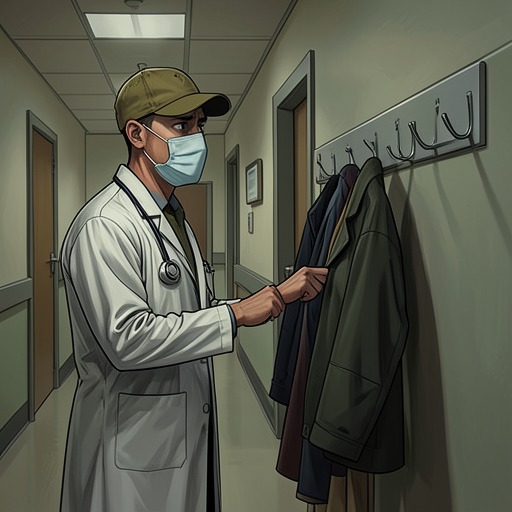
Hippocratic Oath
Five Days at MemorialThe Hippocratic Oath is presented as the expression of a medical tradition that places preserving life at the center of a physician’s responsibilities and rejects the use of lethal drugs, even when requested. Its importance in the book lies not only in its ancient wording but in the boundary it draws between curing and killing—a boundary tested by disaster, scarce resources, and competing claims about what compassionate care requires.
The oath and the separation of healing from killing
The book describes the oath as a tradition attributed to Hippocrates and still honored by many medical schools through versions taken by graduating doctors. Its prohibition reaches beyond administering a lethal drug at a patient’s request: it also rejects advising such a plan. The principle is presented as a limit on medical power, not simply a rule about what a physician may do when treatment is easy or recovery likely.
Anthropologist Margaret Mead described the Greek medical tradition as marking a decisive separation between killing and curing. In the account she gave to psychiatrist Maurice Levine, the healer’s role had once been joined to the power to kill; the Greek distinction committed physicians to life across differences of rank, age, and ability. Mead warned that society could press doctors to become agents of death, including by asking them to end the lives of people considered defective or to provide lethal medication to a cancer patient. Her argument was that society should protect physicians from those demands. The oath thus functions in the narrative as both a professional commitment and a safeguard against turning judgments about suffering or social worth into authority to kill.
A principle tested in the history of war
The account of Napoleon Bonaparte’s campaign at Jaffa shows the principle under pressure well before modern intensive care. In May 1799, after plague struck his troops, Napoleon proposed that the army’s chief medical officer, René-Nicolas Dufriche Desgenettes, give the patients an overdose of opium. Desgenettes disagreed, both on principle and because some patients might survive. He understood his responsibility as preserving life.
Less than two weeks later, as Turkish troops approached, Napoleon ordered that hospital patients too weak to retreat be poisoned with laudanum. Desgenettes refused. The chief pharmacist administered the drug instead, apparently in an insufficient dose; Turkish troops found several patients alive and protected them. The episode distinguishes a commander’s calculation about danger and retreat from a physician’s professional duty. Even the conditions of a battlefield, the book suggests, did not erase the ethical meaning of the refusal.
The oath’s relevance during the Katrina crisis
At Memorial Medical Center, the approaching floodwaters turned emergency planning into an urgent effort to move patients before the power failed. Susan Mulderick and other staff faced the practical question of how to evacuate nearly two hundred patients, including people dependent on life support and mechanical aids. During the helicopter evacuations, nurses resisted a flight plan that would take newborns to a hospital other than the one that had agreed to receive them. Richard Deichmann said the babies could go wherever the pilot was headed; the nursing director countered that the pilot must obtain approval to fly to Baton Rouge or she would not allow the babies to leave. The plan changed, and the infants reached Baton Rouge. This exchange does not cite the oath, but it shows medical responsibility operating through concrete advocacy for vulnerable patients, even amid hurried evacuation and contested authority.
Later, investigators asked Mulderick whether the discussion of medication had involved palliative care that might ease pain while also speeding death. She denied that the aim was to hasten dying and described the discussions as being about comfort. As an example, she mentioned Ativan to relax patients. The prescriptions recovered from the pharmacy showed that Ativan and other ordinary comfort medications had already been prescribed for patients by Anna Pou and other doctors during the disaster. That evidence complicated the suggestion that a new recommendation was needed, but it did not by itself settle the purpose or effect of every medication given. The distinction central to the oath—relieving suffering versus intending to cause death—therefore remains a question of purpose and circumstances, not merely the name of a drug.
Professional duty and its human cost
The book also follows the aftermath among staff who had worked through the disaster. Gina Isbell described poor sleep, nightmares in which she saw patients’ faces, guilt about the staff she had scheduled, and distress over patients who died. She remained angry that help had come too slowly, yet believed that she and her colleagues had done the best they could and said she would serve again if asked. Her account shows how an asserted duty to care could persist alongside grief and painful uncertainty about what had happened.
Karen Wynn, preparing for a possible grand-jury appearance, found that discussing the events could feel like reliving them; after meetings with her lawyer, it sometimes took weeks to feel able to move forward. She recognized what she thought were symptoms of post-traumatic stress in herself and colleagues and no longer wanted the responsibility of nursing management. These accounts do not establish a single moral judgment about the staff’s decisions. They show instead that professional duty could not make catastrophe ethically simple or psychologically costless. In the book, the Hippocratic tradition supplies a demanding boundary against deliberate killing, while the disaster exposes how difficult it can be to interpret that boundary amid suffering, evacuation, and institutional breakdown.