Horace Baltz
Five Days at MemorialHorace Baltz was one of Memorial’s longest-serving doctors, a former president of its medical staff, and a physician whose commitment to professional ethics became more urgent as medicine grew more technological and commercial. During and after Hurricane Katrina, he moved from a trusted senior clinician to a troubled witness: the death of a longtime patient, an overheard conversation about persuading nurses, and his later suspicions about euthanasia led him to urge an investigation. His account is marked by both moral conviction and uncertainty about what he had actually seen.
A physician shaped by service
At seventy-one as Hurricane Katrina approached, Baltz had treated patients at Memorial and Baptist Hospital for more than forty years. His habits embodied a form of practice that was increasingly giving way to specialization and technology: he still performed basic blood tests by hand instead of sending them to a laboratory. In his office, a large black-and-white photograph showed a nurse in a white cap bringing water to an elderly man on a cot. The nurse and Baltz had worked together in 1965, caring for residents displaced by Hurricane Betsy. The image joined his long hospital career to an earlier emergency, and to a practical kind of care grounded in personal presence.
The changes in medicine troubled him. Intensive care had grown into a major specialty, bringing difficult questions about when to initiate life support and what counted as an extraordinary measure. New forms of critical care and transplant surgery were also expensive; as medical institutions became more conscious of costs and for-profit medicine expanded, physicians feared that decisions about care might increasingly be shaped by accountants and other nonclinicians. In a mid-1980s Baptist Hospital newsletter, Baltz objected to the business motive displacing the professional ethic. Although Baptist was still nonprofit and faith-based, it faced the pressures of a commercializing medical environment.
As president of the medical staff, Baltz urged colleagues to remain compassionate and to be selective about adopting new technologies. He encouraged the creation of a hospital ethics group and took part in discussions of cases that tested the boundary between treatment and abandonment. One was the case of Clarence Herbert, a comatose patient whose doctors in Los Angeles were tried for murder after withdrawing life support and intravenous fluids. A nurse’s complaint had prompted the investigation, while Herbert’s family alleged that doctors misrepresented his prospects for recovery to secure agreement to withdraw treatment. For Baltz, the case made visible how end-of-life decisions could divide doctors, nurses, and families, and why ethical deliberation could not be treated as a technical afterthought.
A senior doctor at Memorial
Baltz’s first impression of Anna Pou came soon after she joined Memorial in the fall of 2004. He asked nurses about her before she consulted on one of his patients, who had an esophageal pouch that trapped food and made eating and swallowing difficult. Their guarded reactions led him to suspect that they considered Pou difficult to work with. When she saw the patient, Baltz felt that she took command of the case without discussing important aspects of care with him. He considered her competent but lacking in finesse, and offered constructive criticism afterward, consistent with his practice of advising younger and newer doctors. Pou appeared to listen.
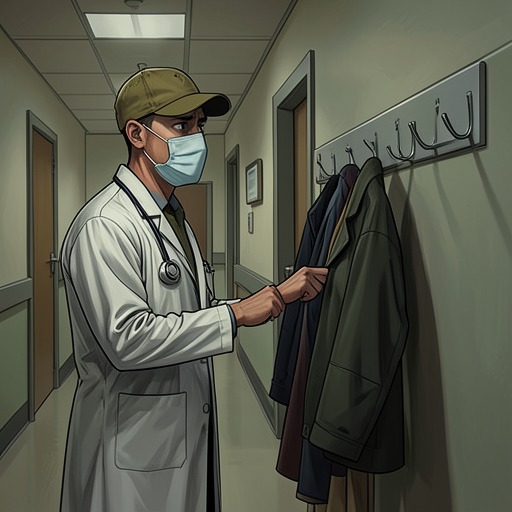
As the storm approached, Baltz was among the physicians summoned to the emergency room. He arrived in a white coat thrown over shorts, with black Oxford shoes, having hurried downstairs. The improvised appearance offered a small measure of the speed and informality of the hospital’s response. Later, as patients were moved toward evacuation, nurse manager Karen Wynn learned from Ewing Cook and Roy Culotta that the most salvageable patients were to go first, and passed that information to Susan Mulderick. Baltz’s own evacuation came near the end of his long association with the hospital.
John Kokemor, intent on getting as many people aboard the boats as possible before the expected cutoff, moved Baltz toward the front of the line. Kokemor also wanted to get Baltz’s older sister and her daughter, an intensive-care nurse, out because of their medical problems. Baltz had not asked to leave, but accepted the offer. Ewing Cook and Susan Mulderick, longtime colleagues, hugged him and tearfully told him they loved him; their emotion surprised him. Two men wearing camouflage caps helped him step down into an unstable boat. In shorts and white socks, he held one man’s rifle while the man assisted others. Looking back at the hospital, Baltz believed he was watching it die.
An overheard conversation and a patient’s death
After the storm, while evacuated in northern Alabama, Baltz saw Bryant King appear on CNN. He turned off the television and sat stunned, distressed by what the broadcast might mean for the reputation of the hospital where he had spent his career. He had recounted his own hurricane experiences with pride at the small rural hospital where he had taken refuge; now he wondered how he could face that community after the allegations became public.
Searching his memory for an explanation, Baltz returned to a conversation he had overheard on the morning of September 1 in a second-floor doctor’s office at Memorial. One physician had said that the hardest task would be convincing nurses that what they were asked to do was acceptable. When Baltz asked what they meant, a colleague told him that some patients could not get out on their own and would need help. Baltz briefly wondered whether the discussion concerned euthanasia, but dismissed the possibility as absurd and left. The recollection later acquired a significance it had not held in the moment: he had heard words that seemed ominous in retrospect, but had not witnessed what the speakers ultimately intended or did.
A longtime patient of Baltz’s died at Memorial that Thursday. She was seventy-eight and had advanced Parkinson’s disease, but had not been acutely ill when he last saw her. For eight years, whenever a hurricane approached, he had admitted her for safety because her care depended on electrical equipment. At her request, he had consistently entered a Do Not Resuscitate order: she did not want extraordinary efforts if her heart or respiratory system failed. Her sister and caregiver had been separated from her inside the hospital. The patient’s death surprised Baltz. Because her vocal cords were paralyzed and she could not speak for herself, he wondered whether someone had euthanized her. He resolved to find out what had happened and refused to remain silent.
Baltz and Kokemor had practiced together briefly in the early 1980s before parting ways, and the two men held low opinions of one another. Baltz believed Kokemor shared what he regarded as a Governor Lamm philosophy, and later suspected that Kokemor had placed him at the front of the evacuation line to remove him from the hospital before euthanasia could proceed. Kokemor called that interpretation a fabrication, attributing it to Baltz’s guilt over his patient’s death. The disagreement leaves a distinction central to Baltz’s account: his suspicion was real, but the evidence in his recollection did not establish that Kokemor knew of or acted to facilitate euthanasia.
Speaking out and breaking with colleagues
When Baltz later heard that nurses Cheri Landry and Lori Budo had been arrested, he was shocked. He knew them as principled professionals who had cared for his intensive-care patients on the night shift with sound judgment and skill. He felt particular concern for Budo, whose mother he had regarded as a model of nursing. His mind returned to the September 1 conversation: he wondered whether one of the doctors he had overheard had devised the alleged acts and whether the nurses had followed a physician’s orders. These were anguished questions, not conclusions based on direct observation.
Baltz wrote to investigators for the attorney general urging continued inquiry into possible mercy killings, and in mid-November met with coroner Frank Minyard after Minyard contacted him. In his written reflections on Memorial, Baltz argued that the disaster could not be explained solely by outside abandonment or the threat of lawlessness. He called attention instead to possible failures in leadership, corporate neglect, and a disregard for law and professional ethics within the hospital. He also set out what he believed responsible conduct should have required: resisting euthanasia, securing narcotics and sedatives, questioning the use of DNR orders, protecting nurses from being enlisted in improper actions, confirming safe destinations for evacuees, and holding hospital leadership visibly accountable.
His position placed him outside the dominant defense of the medical community. Baltz objected to supporters of Pou invoking the possibility that doctors would leave New Orleans if she were indicted; he saw that warning as a threat to abandon patients and as damage to public trust. After Pou’s press conference, he remained deeply opposed to what he believed had happened, considered it unethical and unnecessary, and feared that the profession’s coordinated defense was deepening the loss of trust. His condemnation was forceful, even though his own understanding of the events rested partly on a patient’s unexplained death and a conversation he had initially dismissed.
Departure and remembrance
At a Memorial Day weekend gathering for former employees, workers set up white tents in the parking lot across Clara Street from the emergency-room ramp and served crawfish. The event was festive in its details but subdued in mood; some attendees were tearful. The main hospital would remain closed, although Tenet planned to reopen the newer surgery building where staff had tried to sleep on the night Katrina struck. Baltz regarded the gathering as a chance for emotional closure. He came to say goodbye to colleagues and to the institution where he had spent forty-three years. The mixture of celebration and grief made the gathering feel to him like a wake.
He also heard attendees condemn Bryant King for speaking publicly about the hospital. Baltz considered their denunciations racially prejudiced, while King had moved out of state after the backlash began. The episode reinforced Baltz’s sense that the dispute was not only about what happened to patients, but also about whether colleagues would permit open scrutiny of the hospital’s conduct.
As staff doctors discussed the possibility of reopening Memorial under new ownership, Baltz found that what had happened after the storm remained off limits. Some colleagues were preparing for leadership roles even though he believed they included doctors involved in the conversation he had overheard. He opposed a cover-up and felt that his values no longer aligned with theirs. On the back of a news story about Tenet’s fraud settlements, he wrote a resignation note to medical staff president Reuben Chrestman. The note ended his membership in the medical staff of the hospital where he had worked for more than four decades.
On September 1, the anniversary of the deaths, Baltz placed two small wreaths at the corner of Napoleon and Clara Streets. He held hands with his sister, who worked as his receptionist, and prayed for the dead; several security guards joined them. The gesture gave public form to a grief that had also driven his inquiry, but did not resolve what had happened or his doubts about the evidence.
Baltz’s role in the aftermath was not that of an investigator who could settle the case. The grand jury appeared unaware that doctors, including Baltz, had contacted prosecutors in support of pursuing it, and he did not appear before it. Yet his letters and testimony to investigators made him part of the effort to keep the possibility of patient killing under examination. His arc rests on an unresolved tension: a senior physician committed to preserving professional ethics, a witness who had left the hospital before the deaths at issue, and a colleague whose suspicions hardened into public opposition as the institution he loved closed and its staff resisted discussion.