Hurricane Betsy
Five Days at MemorialHurricane Betsy was a Category Three storm that brought devastating flooding, levee breaks, and pumping-system failure to the St. Bernard area in 1965. Its aftermath entered the memory of nearby Memorial Medical Center, then Southern Baptist Hospital, both as a test the hospital had endured and as a warning about the region’s exposure to flooding.
Storm and Regional Vulnerability
In St. Bernard Parish, residents had already lived with the consequences of flood-control failures. The parish had been slowly rebuilt after being sacrificed to spare New Orleans during the 1927 floods; when Betsy was followed by levee breaks, extensive flooding, and pumping-system failure, confidence in officials and levees weakened further. The storm’s significance therefore extended beyond its passage: it reinforced fears that the protections on which residents depended could fail.
Baptist as a Refuge
Memorial Medical Center had been known as Baptist since its years as Southern Baptist Hospital. During Betsy, it sheltered more than one thousand people. The hospital’s administrator later celebrated its performance in the hospital newsletter, presenting the storm as one the institution had weathered successfully. That account strengthened Baptist’s reputation as a place where staff, families, and patients could ride out hurricanes rather than face them at home.
The confidence lasted into the next generation of storms. When Hurricane Katrina threatened, surgical intensive-care nurse Cathy Green told her adult daughter that if Baptist failed, the entire city would be destroyed. Her assurance reflected the institution’s accumulated reputation as a shelter, with Betsy remembered among the storms it had survived.
A Memory Carried Forward
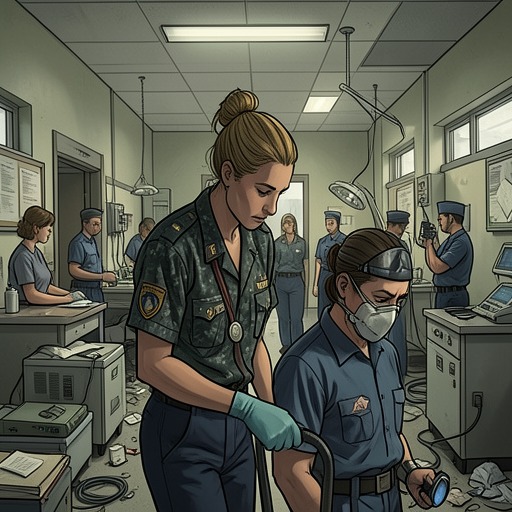
The event also remained personal for longtime Memorial physician Horace Baltz. He kept a large black-and-white photograph of a nurse giving water to an elderly man on a cot; he and the nurse had worked together caring for displaced residents after Betsy. The image preserved a record not only of the storm’s disruption but of the hospital workers’ response to people uprooted by it.
That memory connected Betsy to later emergencies without making the events identical. For Baltz, the photograph recalled hands-on care after displacement; for the hospital, the storm became part of a public history of endurance. In St. Bernard, meanwhile, Betsy remained evidence that levees and pumping systems could not be assumed to hold. Its legacy thus joined institutional reassurance to a continuing regional awareness of vulnerability.