Hurricane Katrina
Five Days at MemorialHurricane Katrina was both a powerful storm and a disaster whose consequences were shaped by decisions made before, during, and after landfall. Its threat was forecast in stark terms, but New Orleans’ evacuation and transport capacity could not move everyone to safety. Flooding and infrastructure failures then overwhelmed hospitals and care homes that had remained open, including Memorial Medical Center, where the loss of power and basic services turned an anticipated emergency into a prolonged crisis. The book treats Katrina not as an isolated act of nature, but as a test of systems whose weaknesses had been known and whose failures compounded one another.
Forecast and Evacuation
On Sunday morning, Katrina’s immense spiral filled television screens at Memorial. The storm had reached Category Five, the highest level on the Saffir-Simpson scale, and the National Weather Service’s New Orleans office warned that much of the area could be uninhabitable for weeks. Its forecast described catastrophic structural damage, power outages lasting weeks, and water shortages severe enough to cause extraordinary suffering. The warnings were not simply about the force of the wind: they anticipated a long interruption of the systems on which ordinary life and medical care depended.
At about ten that morning, New Orleans mayor Ray Nagin ordered an immediate mandatory evacuation. The decision came after hours of delay while officials worked through logistical and legal questions. Nagin would later acknowledge the delay; no previous mayor, as far as he knew, had ordered a citywide evacuation, though state law gave him authority to do so. The order therefore marked a consequential change in official policy, but it could not by itself provide residents with a way out.
Many residents had no car or other means of leaving. Officials knew that the city’s transportation plans had serious gaps, including too few drivers, while people who could evacuate independently were already caught in traffic on the interstate. The New Orleans Superdome was designated a shelter of last resort, and shuttle buses were intended to bring people there. Nagin specifically urged people with medical conditions, including those on dialysis, to move there quickly, but the appeal did not explain what assistance they would find once they arrived. The distinction between ordering evacuation and enabling it became especially consequential for people whose health or circumstances made independent travel difficult.
Acadian ambulance dispatchers faced a surge of calls to move patients from hospitals, nursing homes, and private homes. The company made roughly two dozen ambulances available, but many were trapped on the congested interstate. Some crews began taking patients to the Superdome rather than attempting to carry them out of the city. Even before the storm arrived, the movement of vulnerable people was being redirected by limited vehicles, blocked routes, and an evacuation system unable to operate at the scale demanded of it.
A Foreseeable Infrastructure Crisis
At just after six on the morning Katrina moved over land as a Category Three hurricane, its eye passed through the Buras area, about sixty miles southeast of New Orleans. The storm continued after daybreak. From Memorial, the view was obscured by an impenetrable white curtain, and gusts of 135 miles per hour were expected by midmorning. The danger outside was immediate, but the hospital’s exposure also lay in less visible infrastructure: the connections and electrical equipment needed to distribute emergency power throughout the building.
Months earlier, Eric Yancovich had sketched the elevations of hospital entrances and critical outdoor equipment against Magnolia Street. His calculations showed that less than four feet of street flooding could carry water over the loading dock and into the hospital. Although the backup generators themselves stood on the second floor, parts of the emergency power distribution system were below ground or only inches to a few feet above it. Yancovich had warned his supervisor that relatively little water could disable most of the medical center, and predicted that patients might have to be moved to the newer Clara Wing, whose electrical circuitry he believed was better protected. The later crisis thus followed a vulnerability that had been identified in advance, not an entirely unforeseen interaction between water and power.
When an Acadian worker at Memorial confirmed that a canal had been breached, the hospital command team shifted its operating posture from assault mode to survival mode. The change reflected a new understanding that water could be heading toward the hospital and that staff might not leave after their shifts. The distinction between a temporary storm response and an extended emergency narrowed: workers who had expected to hand patients to a returning team could instead find themselves sheltering and working at the hospital for an uncertain period.
Power Failure and the Hospital Crisis
By early Wednesday, August 31, the struggle to keep Memorial’s generators operating had become central to the hospital’s ability to function. The facility had three teal-colored generators, each rated at 750 kilowatts, linked to the hospital through feed lines, riser circuits, and transfer switches. An outside company normally serviced them; hospital maintenance staff changed the oil and conducted brief monthly tests. The equipment had not been designed for prolonged operation, even though the disaster plan called for the generators to support the hospital through an extended emergency.
When one generator failed and could not be restarted, engineers tried to connect some of the circuits it served to another unit. Wearing rubber boots, they went through knee-deep water in the basement and climbed to the mezzanine of the core electrical building. Their effort continued for two hours. At about two in the morning on Wednesday, nearly forty-eight hours after Katrina made landfall near New Orleans, the last backup generator surged and died. The failure was not merely the loss of a machine: it severed the remaining source of emergency electricity from the hospital’s interdependent systems at a moment when evacuation and rescue were still unresolved.
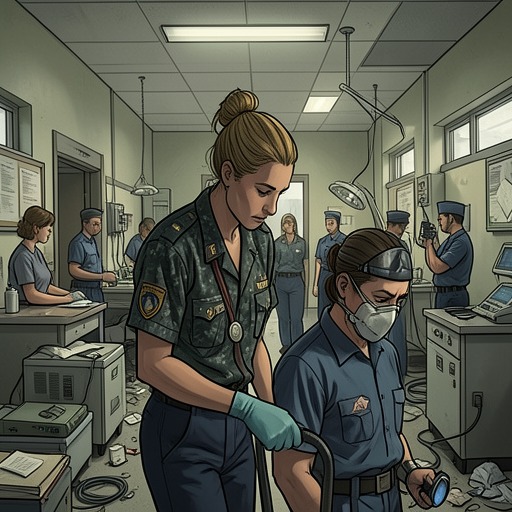
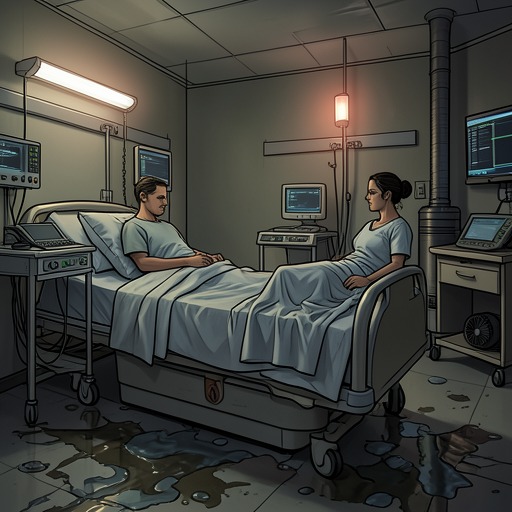
With the sun came rising temperatures, while the hospital’s services deteriorated. Water stopped flowing from taps, toilets backed up, and the building lost working phones, televisions, computers, and overhead pagers. Darkness made flashlight beams the visible means of navigating corridors, and messages had to be passed by voice up and down staircases. The breakdown of communication mattered as much as the breakdown of utilities: staff had less access to shared information precisely when the crisis required coordination across floors and units.
The disaster also contracted people’s attention to the emergencies nearest them. One morning, an outpatient made it through the floodwaters for a regularly scheduled chemotherapy appointment. The water around the sloping hospital grounds had stabilized at roughly five to six feet, rather than rising by the additional fifteen feet that had been feared. Karen Wynn told the patient that chemotherapy would not be given that day. The episode sets the hospital’s extraordinary conditions against the routines that persisted beyond its walls: a scheduled treatment could still draw someone through floodwater even as the institution itself struggled to sustain basic operations.
Deaths, Responsibility, and the Lessons of Katrina
Memorial was not the only care facility in danger. More than thirty residents had apparently drowned at St. Rita’s Nursing Home, a single-story facility near failed levees in St. Bernard Parish. Its owners, who had been urged to evacuate before the storm, were missing as the disaster unfolded. At Chateau Living Center in Jefferson Parish, thirteen residents died in the heat after power failed; the facility’s contracted tour company had refused to provide buses before the storm. The book places these events beside Memorial’s crisis to show that medical-facility deaths were part of a wider pattern, not an isolated institutional tragedy.
The pre-storm evacuation order did not apply to hospitals, which had been directed to stay open and staffed. Nursing homes were ordered to evacuate, but the order was not enforced, and many facilities lacked both preparation and the support needed to move residents in the short interval before landfall. About two-thirds of affected nursing homes kept residents in place. The uneven outcomes reflected more than a single question of whether leaders chose to leave: transportation, staffing, building design, backup systems, and government assistance shaped which patients could be moved and which remained exposed.
In the months and years after Katrina, investigations and reports examined failures across government agencies, private organizations, and the health system. The explanations were cumulative: a delayed city evacuation order, too few buses and drivers, people with the means to leave who chose to stay, uncoordinated rescue operations, jurisdictional disputes, poor communications, and hospitals and nursing homes without sufficiently robust backup power or water. Alarm about lawlessness also interrupted rescue work. The levee and flood-control system around New Orleans had known weaknesses; the account connects the scale of the flooding to the loss of wetlands and to failures to address those weaknesses, despite the short-term savings involved.
The book’s retrospective framing emphasizes how little of the danger was unknowable. The Times-Picayune had written about the scenario, and Hurricane Pam emergency exercise had modeled it. Yet, as official reviews accumulated, the larger failure appeared to be a lack of situational awareness: institutions did not adequately perceive the whole crisis or what needed to be done across it. Memorial becomes a microcosm of that failure, with compromised infrastructure and operations alongside acts of individual courage. The contrast matters: systems can collapse, while decisions by people on the scene still shape immediate outcomes.
The disaster’s meaning recurs in a later scene set in 2012, when the narrator enters the Memorial chapel shortly before Hurricane Isaac is expected to reach New Orleans. Almost seven years earlier, the bodies of people who died in the hot, dark, powerless hospital had been blessed there. The return links Katrina’s unresolved history to the risk of repetition. During Hurricane Sandy, New York City mayor Michael Bloomberg likewise exempted hospitals in low-lying Zone A from a pre-storm evacuation order, although officials knew that storm tides could threaten hospital generators. Another major city then faced a hospital power emergency. The comparison does not make the two storms identical; it shows how the central lesson of Katrina remained difficult to translate into durable preparation.
The account ultimately places the first hours of disaster within the reach of local preparedness and action. When larger systems fail, the resources and decisions available to people near the danger can determine immediate consequences. That insight sharpens the significance of Katrina: the storm exposed physical hazards, but also the limits of plans that did not secure transportation, communications, power, and water for those most dependent on them. The possibility of future catastrophe was documented; the tragedy was that warning did not become reliable protection.