Hurricane Sandy
Five Days at MemorialHurricane Sandy became a test of whether hospitals had learned from Katrina: not simply whether they possessed backup generators, but whether they had planned for flooding to disable the systems that made those generators useful. In New York, known vulnerabilities and a last-minute request to rescue critically ill patients reopened questions about evacuation and triage. Bellevue Hospital Center faced a power emergency that could have forced life-and-death choices; staff improvisation kept patients on backup power until they could be evacuated.
Katrina’s Warning Returns
Two months after the Katrina crisis, on the night of October 29, the book’s reporter was at the command center of North Shore-LIJ Health System as Sandy battered New York City. The storm’s arrival brought an urgent call from New York University’s Langone Medical Center: it wanted ambulances to evacuate four critically ill babies from its neonatal intensive care unit. The request came during the storm, when moving patients was itself a dangerous logistical problem.
The account draws a direct parallel between New Orleans mayor Ray Nagin’s decision before Katrina and New York City mayor Michael Bloomberg’s pre-storm order. Bloomberg had exempted hospitals in low-lying Zone A from evacuation, even though city and state health officials knew that storm tides could disable hospital backup generators. The exemption left hospitals open as places of refuge while exposing them to the very conditions that could make continued care impossible. As with Katrina, the danger was not only the storm: it was the assumption that hospitals could remain safely operational through it.
Warnings Inside the Hospital Network
North Shore-LIJ had sixteen hospitals across New York City and Long Island to monitor. While its command center was responding to the request from Langone, officials received a warning from Southside Hospital in Bay Shore: water was still rising, with roughly an hour remaining before high tide. Earlier, corporate leaders had already called Southside and Staten Island University Hospital to discuss what to do if backup systems failed or facilities lost some or all power.
The threat was specific, not hypothetical. An official at Staten Island University Hospital warned that part of its power system was below ground and could not be used if it flooded. At the command center, doctors wrote priorities on a whiteboard, including establishing a clinical command structure and triaging patients. Workers piled sandbags and operated pumps to protect electrical switch gear. The two coastal hospitals narrowly avoided disaster as the tide approached, but the preparations also revealed how close the region had come to a failure that had been anticipated in advance.
The book contrasts this response with the support Memorial Medical Center and LifeCare had received from their corporate headquarters during Katrina. North Shore-LIJ had an organized local command center and was offering active assistance to its own hospitals and others in the region. Yet even there, some staff members said they had not considered what to do if the backup plan itself failed and the hospitals lost all power. Sandy therefore showed both change and continuity: stronger coordination did not mean every contingency had been understood.
Bellevue’s Power and Triage Crisis
At Bellevue Hospital Center, the danger centered on the systems that sustained its backup power. Storm surge from the East River threatened the pumps that supplied oxygen and vacuum suction and those that moved fuel from underground tanks to the generators. If city power failed, the small reserves attached to generators on the thirteenth floor could last only about two hours. Nearly all patients in the fifty-six-bed adult intensive care unit depended on electrically powered equipment; some relied on life support or intravenous drugs to regulate their heartbeats and blood pressure.
The hospital began preparing for the possibility that not every patient could remain connected to powered equipment. Staff identified six power outlets and communicated which patients would use them. They completed the list and moved patients between beds and outlets in about two hours. The choices were shared with other staff, some of whom challenged them before accepting the plan. Laura Evans, the critical-care medical director, wanted a process that could be explained and applied consistently. She knew the history of Anna Pou and Katrina and wanted decisions made under pressure to remain defensible to families and the wider public.
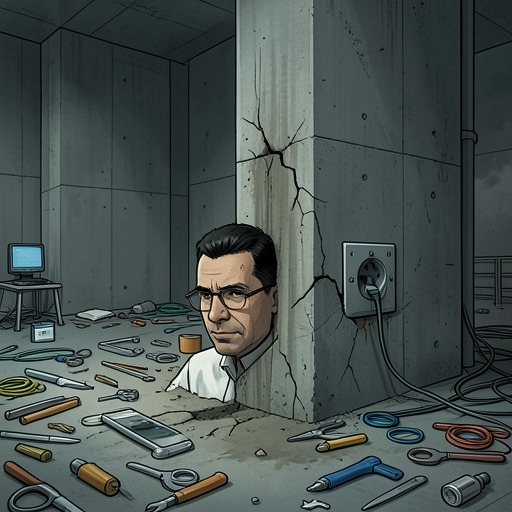
Then Bellevue’s lights went out. Backup generators took about seven seconds to restore power, but the hospital command center soon warned that all power except for the six designated outlets could be lost within sixty to ninety minutes. Floodwater was filling the basement of the twenty-five-story hospital and entering elevator pits. Staff prepared to ventilate patients manually with Ambu bags, stationed two health professionals beside each ventilator-dependent patient, and ran bright-orange extension cords through the corridors. Nurses also counted drops on intravenous pumps so they could administer vasopressors manually if the equipment failed.
The staff postponed telling patients and families who would not receive one of the six outlets because they could not imagine how to explain the decision and feared doing so. Evans later concluded that families had a right to know. Staff also had not considered asking whether patients or relatives might volunteer to give up an outlet for someone else. The crisis thus exposed not only the technical limits of emergency power but the human difficulty of communicating a rationing decision before it had to be carried out.
Improvisation and Evacuation
Bellevue avoided the worst outcome through a practical intervention rather than a completed triage plan. When generator fuel pumps failed, volunteers formed a chain and carried fuel up thirteen flights of stairs so it could be supplied manually. The improvised effort kept backup power running; Evans’s patients remained on that power as the hospital’s evacuation proceeded. Staff carried a baby in a transport incubator downstairs, while others hauled supplies up the stairs. With elevators unavailable, moving patients out of the large hospital took days.
Two patients were left until last because moving them posed particular challenges. One weighed about six hundred pounds, making transport without elevators difficult. The other was severely ill, and his doctors feared he might die during the move. Staff continued to care for both. After other patients had been evacuated, soldiers carried fuel up the stairs for several more days until the elevators could be operated. Doctors performed heart surgery on the fragile patient in the disabled hospital, and both patients were safely transferred to another hospital.
What Sandy Revealed
Sandy’s hospital emergencies did not end in the mass deaths feared during the power crisis, but their near misses made the remaining weaknesses visible. North Shore-LIJ’s hospitals escaped flooding of their switch gear; Bellevue’s patients stayed on backup power and were evacuated, including the two difficult-to-move patients. Those outcomes depended on both preparation and decisions made by people at the scene, including the volunteers who carried fuel when the intended system failed.
The episode also widened the book’s argument beyond one city or one storm. Hospitals in flood zones may place electrical systems in basements; others may face earthquakes or tornadoes. Plans created after Katrina could still be inadequate or misguided, and staff could remain unprepared for the failure of a backup plan. Sandy therefore functions as a recurrence of the central Katrina problem in a changed institutional setting: a disaster tests not only written protocols and equipment, but whether people have anticipated how care will continue when those protections are exhausted.