LifeCare Hospital at Memorial
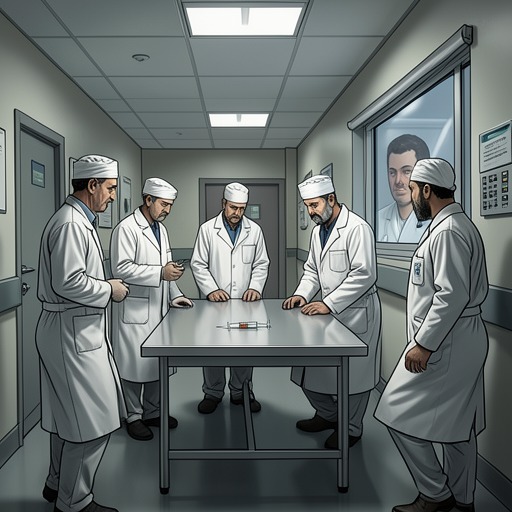
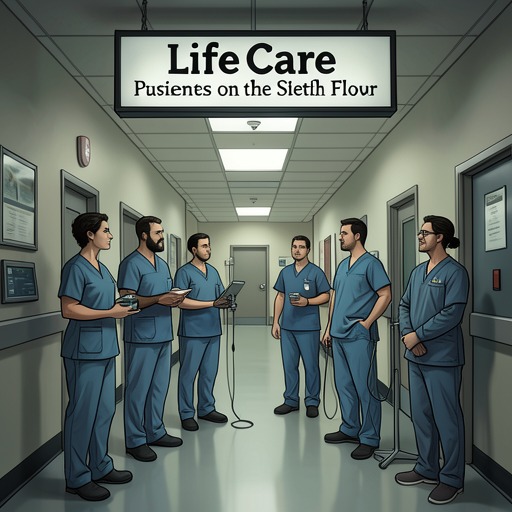
Five Days at MemorialLifeCare Hospital at Memorial was a hospital unit within Memorial Medical Center whose seventh-floor patients became central to the crisis and its aftermath. During the evacuation, decisions about which patients would be moved—and when—placed people with Do Not Resuscitate orders at a particular disadvantage. After the evacuation, the unit’s rooms, pharmacy, and patient records became part of an investigation into deaths there. The same location thus carried two histories: an unfolding emergency in which care and rescue were constrained, and a later forensic inquiry in which the meaning of the available evidence remained disputed.
Setting Within Memorial
LifeCare operated within the larger Memorial complex, with patient rooms and a pharmacy on its seventh floor. The location’s physical arrangement mattered during the emergency: patients were in rooms along the ward, staff worked at a nursing station, and investigators later focused on the LifeCare pharmacy and the physical therapy charting room. A return visit by Anna Pou and nurses Cheri Landry and Lori Budo also connected the unit to Memorial’s wider layout, including the route up to the parking-garage helipad. These were not interchangeable spaces. A patient room could be where treatment was attempted or disputed; the pharmacy was where controlled medications were stored; and the charting room became a place from which a witness recognized people associated with the events.
The unit existed inside a hospital with a longer and unequal history. Memorial had opened in 1926 as Southern Baptist Hospital. Jannie Burgess, an African American licensed practical nurse who worked for decades in New Orleans hospitals and nursing homes, was born only months after its opening, but could not receive care there for more than four decades. Southern Baptist was among the last Southern hospitals to integrate. It refused federal hospital programs introduced in the mid-1960s, programs that made federal reimbursement contingent on nondiscrimination. The history gives added weight to the presence of Burgess among the Memorial patients later placed under an evacuation rule: the hospital that had once barred her as a patient became, in crisis, a place where her status and access to rescue were shaped by institutional decisions.
Patients and Evacuation Decisions
Earlier in the crisis, Memorial’s doctors made an exception to the general priority of moving the sickest patients and those dependent on machines. They decided that all patients with DNR orders would be evacuated last. The distinction mattered because a DNR order means that a patient should not be resuscitated if breathing or heartbeat stops; it does not, by itself, mean that the patient is terminal or should receive lower priority for evacuation. The decision therefore turned a directive about resuscitation into a broader judgment about rescue. At LifeCare, that rule reached patients whose families understood the DNR designation differently from the staff applying it.
Angela McManus, whose seventy-year-old mother Wilda was a patient on the LifeCare floor, learned that patients with DNR orders were being deferred. She tried to have her mother’s order rescinded, but staff told her no doctor was available to do so. The episode shows how the policy operated not only as an abstract ranking but as a practical barrier: a family member could seek to change the status, yet the means to make that change were unavailable at the moment it mattered. Wilda was among the patients whose care would later become part of the investigation into the seventh floor.
The pressures around LifeCare belonged to a larger emergency at Memorial, where patients, staff, and families faced evacuation constraints and failing services. Other scenes in the hospital show how DNR status could be mistaken for an instruction not to rescue, even when relatives said they had intended only to refuse resuscitation. Those incidents clarify the stakes of the LifeCare decision without making the separate patients or floors interchangeable. The unit’s story is part of a broader institutional crisis, but its own patient rooms and evacuation decisions remain central to the evidence about what happened there.
The Seventh-Floor Deaths and the Investigation
On September 1, 2005, LifeCare pharmacist Steven Harris later told investigators that the pharmacy’s entire stock of morphine—125 vials, each containing 10 milligrams—was missing, along with dozens of injectable Versed and Ativan vials. Other controlled drugs remained, a circumstance investigators considered consistent with selective removal rather than an ordinary burglary. Harris also recognized Pou and two Memorial nurses from the physical therapy charting room, and later reported seeing Pou beside Emmett Everett’s bed. His account, along with other witness interviews, helped investigators reconstruct events in the unit.
LifeCare nurse Kristy Johnson subsequently described drawing and carrying syringes, accompanying medical workers to patients’ bedsides, and witnessing some injections. She said she held patients’ hands and prayed with them. Johnson reported seeing a nurse inject Rose Savoie in Room 7305; Savoie said that it burned. By that afternoon Savoie and the other nine remaining LifeCare patients were dead. Johnson’s later account supplied investigators with eyewitness evidence concerning the seventh floor, while the patient rooms and the sequence of events remained subjects of further interviews and review.
The investigation also depended on evidence recovered from the bodies. After the Memorial patients had remained in heat for more than a week, investigators initially worried that decomposition would make toxicology testing useless, particularly because blood could no longer be sampled. A volunteer pathologist explained that drugs might still be detectable in more durable tissues, including liver, brain, and muscle, or in fluid in the abdomen. Tissue samples from eighteen Memorial bodies were sent to National Medical Services, Inc., a forensic toxicology laboratory in Pennsylvania. In an early report on those cases, nine tested positive for morphine and roughly five or six for midazolam.
The results required careful interpretation. Of forty-one bodies from Memorial and LifeCare tested by laboratory director Robert Middleberg, twenty-three showed morphine, midazolam, or both. But postmortem tissue concentrations are not equivalent to measurements in living patients: heat and decomposition could have changed drug levels. Investigators and experts therefore considered toxicology alongside clinical histories, prescriptions, documented symptoms, and the timing of death. For example, the chart for Alice Hutzler, a ninety-year-old LifeCare patient treated for pneumonia, showed morphine and midazolam in her liver, brain, and muscle tissue, although neither drug had been prescribed; the chart was current until a few hours before her death was recorded.
Disputed Evidence and the Location’s Significance
Experts disagreed about how far the toxicology could support conclusions about cause of death. Steven B. Karch argued that drug levels in bodies exposed to extreme heat for ten days could not reliably establish the medical cause of death, and advised that the cause remain undetermined. Michael Baden argued that uncertainty about the precise dose did not erase the finding that morphine and Versed were present shortly before death, while Cyril Wecht considered some of the detected levels very high. Wecht also conducted a small, unpublished comparison of samples exposed to hot, humid conditions with refrigerated samples; it found no significant difference, but was not definitive. The competing interpretations kept the investigation from treating drug detection, a particular mechanism of death, and criminal intent as if they were the same conclusion.
The setting also stood in contrast to the response at Charity Hospital. That public hospital faced severe failures of power, plumbing, communications, computers, and elevators, lacked a helipad, and took until September 2 to transfer its patients. Despite conditions described as similarly threatening or worse, fewer than ten patients died there. The comparison does not by itself settle what happened at LifeCare, but it places the unit’s decisions within a wider question about how institutions organized care and evacuation under disaster conditions.
LifeCare Hospital at Memorial is significant because the physical site concentrates several kinds of evidence and consequence: a ward where vulnerable patients awaited evacuation, a pharmacy whose missing stock became part of the inquiry, and rooms connected to witness accounts and patient records. Later examination could establish that drugs were detected in many bodies, but the meaning of those findings depended on clinical context and contested expert reasoning. The unit’s history therefore remains both spatial and ethical: a particular floor inside a larger hospital became the point where evacuation policy, family understanding of DNR orders, bedside actions, and the limits of forensic certainty converged.