Medical resource allocation
Five Days at MemorialMedical resource allocation is the distribution of care, treatment, and rescue when the resources available cannot meet every need at once. The book traces that problem from the rules governing charity at Southern Baptist Hospital to the evacuation of patients during Hurricane Katrina. Its central tension is that allocation can be framed as a practical necessity, yet the categories used to make decisions—poverty, ability to pay, illness, and Do Not Resuscitate status—can determine whose needs are recognized and whose are deferred.
Charity, Access, and Institutional Purpose
When Southern Baptist Hospital opened in 1926, its superintendent, Louis J. Bristow, described a mission encompassing the alleviation of pain, the prolongation of life, and the relief of suffering. The hospital promised charity patients rooms like those of wealthy patients rather than segregating them in separate wards. But that commitment operated within strict limits. A family seeking charity care had to bring a letter from its church attesting to need and promising a donation; the early definition of eligible patients focused largely on widows, orphans, and older people. A poor man seeking treatment for his wife might instead receive credit and a lecture about the loss of dignity that charity supposedly entailed.
The institution also used accounts of charity patients, especially children, to solicit donations and publicize its missionary work. Its benevolent purpose therefore coexisted with a system that screened applicants and sought support for the hospital itself. The book connects this history to the hospital’s racial exclusions: Jannie Burgess, a Black nurse who worked in New Orleans hospitals and nursing homes, could care for patients at many private hospitals but could not receive care at them. Although she was born shortly after the hospital opened, more than four decades passed before she could be a patient there. Southern Baptist Hospital was among the last Southern hospitals to integrate, refusing federal hospital programs in the mid-1960s rather than accept their nondiscrimination requirements. Allocation was thus not only about how much care existed; institutional rules helped decide who could access it.
A later example at the University of Texas Medical Branch shows scarcity administered through formal financial procedures. Facing an $80 million budget deficit and declining state support, the hospital began screening patients financially and charging an entry fee before a medical visit. People unable to pay, or already indebted to the hospital, could be turned away, except for children and emergencies. A committee of doctors and administrators decided which other patients would receive drugs, surgery, or treatment, with each member allotted $25,000 per month. The arrangement recalled Bristow’s earlier charity decisions, but now complex cancer care made the consequences especially stark: surgery depended on a team spanning specialties such as radiation therapy and rehabilitation, and finding resources for uninsured patients was difficult even when an individual physician was ready to treat them.
Evacuation as a Form of Triage
During the approach of Hurricane Katrina, allocation extended beyond clinical treatment to transportation and physical safety. New Orleans ordered a mandatory evacuation, but many residents lacked cars, and the public transport plan had significant gaps, including too few drivers. The New Orleans Superdome was designated a shelter of last resort, and the mayor urged people with medical conditions to go there without specifying what help they would receive. Acadian dispatchers were overwhelmed by requests to move patients from hospitals, nursing homes, and homes; many ambulances were stuck in traffic, and some began taking patients to the Superdome rather than out of the city. The bottleneck made transport itself a scarce medical resource.
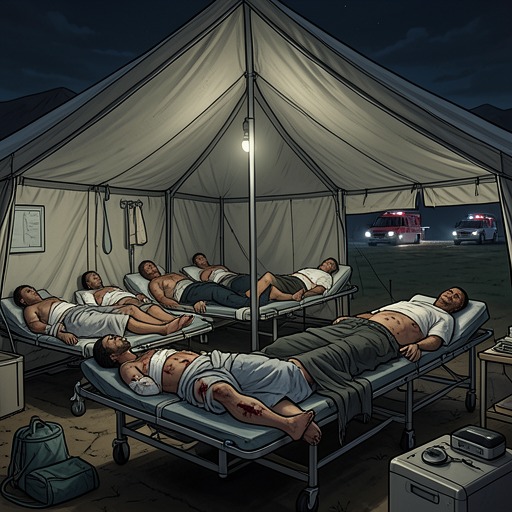
At Memorial Medical Center, nurse manager Karen Wynn recalled that the announcement of approaching floodwaters turned the command room’s focus toward acting before the power failed. Nearly two hundred patients needed evacuation. The initial proposal was to move the sickest first, including intensive-care patients dependent on life support, newborns, high-risk pregnant patients, people needing dialysis, and bone marrow transplant patients vulnerable to infection. That plan had to operate amid limited transport and uncertain coordination. Memorial requested help from ambulance and helicopter services, while arrangements for evacuation involved outside agencies and other hospitals.
The distinction between Memorial patients and those of LifeCare Hospitals became consequential. Memorial’s request to the Coast Guard covered about two hundred people, slightly more than the number of its own patients; LifeCare patients were not included. LifeCare staff had believed that federal coordination would include them, while Memorial was proceeding on the understanding that LifeCare’s transport was being handled elsewhere. The resulting priority placed even Memorial’s less sick patients ahead of LifeCare’s generally very ill patients. LifeCare staff questioned why their critical patients should wait while Memorial patients who were not as sick were evacuated. The episode shows how confusion about responsibility and patient counts could function as an allocation decision, even without a single agreed policy.
DNR Status and the Meaning of Priority
The most consequential classification at Memorial involved Do Not Resuscitate orders. Doctors decided that patients with DNR orders would be evacuated last, creating an exception to the general proposal to evacuate the sickest and those dependent on machines first. Four intensive-care patients had DNR orders, including Jannie Burgess and Helen Breckenridge. The decision rested in part on a mistaken understanding: medical chairman Richard Deichmann later said he believed DNR patients had certified terminal or irreversible conditions and therefore had less to lose if disaster struck. But a DNR order meant that a patient whose breathing or heartbeat stopped should not be revived. It was not the same as a living will, and neither the order nor Memorial’s disaster plans said that the patient should be left behind.
Other doctors accepted the policy on the assumption that people who did not want extraordinary measures to prolong their lives would not want to be saved at the expense of others. That inference converted a limited instruction about resuscitation into a broader judgment about rescue. Breckenridge was returned to intensive care after being taken downstairs for evacuation; her pumps and ventilator were reconnected, but she soon died. The episode makes visible the human consequence of treating a medical directive as a general ranking of whose life should receive scarce transport.
The same distinction became clear when staff were told to leave a ninety-three-year-old patient on a fifth-floor hallway because of her DNR order. Her daughter explained that she had agreed not to have her mother resuscitated after cardiac arrest, not to have her abandoned during evacuation. She canceled the order, and the patient was moved toward rescue. On LifeCare’s seventh floor, Angela McManus likewise tried to rescind the DNR order for her mother, Wilda, after learning that DNR patients were being deferred, but staff told her no doctor was available to do so. These cases show how the same label could constrain patients and families differently depending on whether a clinician was available to change it.
Authority, Advocacy, and Unequal Capacity
Allocation during the evacuation was also shaped by who could claim authority over the process. On the helipad, doctors argued with a Coast Guard pilot about how many patients would fit in his helicopter; he left to rescue people elsewhere. An Air Force captain, drawing on her flight-line training, took charge of the helipad, cleared doctors and patients away from the landing area, and moved onlookers off the rooftops so pilots could work. The contrast was not simply between competing opinions: the pilot’s knowledge of aircraft capacity and the nurse’s operational training proved essential to managing a limited rescue resource.
A separate dispute arose when a helicopter assigned to transport critically ill newborns had a flight plan to a hospital west of Baton Rouge rather than to the hospital that had agreed to accept them. Richard Deichmann said the babies could go wherever the pilot was headed. The neonatal nursing director refused to release them unless the pilot obtained approval to fly to Baton Rouge. Approval came within minutes, and the babies arrived safely; one infant’s oxygen level matched the level maintained by high-tech equipment, after the physician had improvised life support during the journey. Here, advocacy within the hospital hierarchy changed the destination and protected continuity of care.
The limits of hospital capacity also reached beyond admitted patients. When a family with small children rowed up to Memorial, staff turned them away. Bryant King protested that the hospital had to help people, while Wynn believed Memorial was already at its limit; she did not perceive the refusals as racist, although nearly all those turned away were Black, as she was. The scene places the allocation dilemma inside a wider emergency: the hospital was sheltering animals while people, including babies, moved through polluted floodwater on unstable boats. A regularly scheduled chemotherapy patient also made her way through the flood to Memorial, only to learn that treatment could not be provided that day. These encounters expose the distance between the needs people carried to the hospital and the help the institution could actually offer.
Contrasts and Ethical Stakes
The account of Memorial and other private hospitals is set against Charity Hospital, which also flooded, lost power and basic infrastructure, lacked a helipad, and had no corporate overseers to assist. It had roughly twice as many patients across its two campuses as Memorial and fewer staff relative to patients; its transfer of all patients took until the afternoon of September 2, later than Memorial’s evacuation on September 1. Yet fewer than ten patients died. Staff described continuing care in patient rooms despite severe threats and maintaining morale through regular lobby meetings and a flashlight-lit talent show. The comparison does not reduce allocation to a single measure of success, but it challenges the assumption that extreme conditions alone explain who receives sustained care.
Across these episodes, scarcity is real, but its effects depend on the rules and institutions that organize it. Charity requirements, financial screening, evacuation categories, disputed counts, and interpretations of DNR orders all made practical decisions about care. The book’s account therefore treats allocation not as neutral arithmetic but as a series of choices about responsibility: who is counted, who has a voice in setting priorities, what a patient’s instruction actually means, and whether limited resources justify postponing care or rescue.