Medical resource allocation in disasters
Five Days at MemorialMedical resource allocation in disasters concerns who receives limited treatment, equipment, transport, and staff attention when ordinary medical capacity is overwhelmed. The book traces the problem from improvised decisions during Hurricane Katrina to later plans for rationing ventilators and electricity, asking not only how scarce resources might save the most lives, but who should set the rules, explain them, and answer for their consequences.
Scarcity Before the Hospital Door
The allocation problem began well beyond the bedside. When Ray Nagin ordered New Orleans evacuated, many residents lacked cars or other means of leaving, while officials knew the city’s transport plans had serious gaps, including too few drivers. The New Orleans Superdome was designated a shelter of last resort, and Nagin urged people with medical conditions to go there without specifying what care they could expect. Meanwhile, traffic immobilized evacuees and ambulances. Acadian Ambulance dispatchers faced calls from hospitals, nursing homes, and homes; some of the company’s roughly two dozen available ambulances were stuck on the interstate, and some began taking patients to the Superdome rather than trying to get them out of the city.
These constraints shaped the choices inside Memorial Medical Center. In a hastily assembled command meeting, Susan Mulderick’s announcement that floodwaters were approaching changed the room’s character, in Karen Wynn’s account, from a hospital emergency response to something resembling a military operation. Nearly two hundred patients needed safety. The initial proposal was to move first those most dependent on life support or mechanical assistance, including intensive-care patients, newborns, high-risk pregnant patients, dialysis patients, and bone-marrow transplant patients. Yet the hospital had to seek outside transport, and the staff had to make decisions while power failure seemed imminent. On the helipad, a nurse with experience running an emergency flight line took control after a dispute over a helicopter’s capacity; she cleared doctors and patients from the landing area so pilots could operate. Later, neonatal nurses resisted a flight plan that would take babies to a hospital they had not agreed to use, and insisted that the pilot obtain approval to fly to Baton Rouge. These episodes show allocation as a matter of equipment and transport, but also of coordination and authority.
Categories, Rules, and Their Limits
At Memorial, an exception to the proposed sickest-first evacuation order placed all patients with Do Not Resuscitate orders last. Four ICU patients were affected, including Helen Breckenridge and Jannie Burgess. A DNR order applies to resuscitation if a patient’s heartbeat or breathing stops; it does not, by itself, mean that the patient is terminal or should receive less treatment. It is also distinct from a living will under Louisiana law, which can address withholding or withdrawing life-sustaining procedures for a terminal and irreversible condition. Richard Deichmann later said he believed DNR patients had the least to lose if disaster struck, reflecting his understanding that the orders implied a terminal or irreversible condition. The account’s distinction matters: a category intended to guide one treatment decision became a basis for deciding who would wait for evacuation.
The book contrasts such crisis-time improvisation with advance planning. After the arrests of health professionals in the Memorial case, New York planners published a ventilator-allocation protocol in 2008, prompted by exercises in which hospitals repeatedly ran short of ventilators during severe-influenza scenarios. The plan sought to save as many lives as possible within an ethical framework, while recognizing that ventilators require trained operators and oxygen as well as the machines themselves. It proposed using a scoring system adapted from the Sequential Organ Failure Assessment tool, first used in an Ontario resource-allocation proposal. The score was not designed to predict survival and had not been validated for assessing children, but planners adopted it in the absence of a suitable alternative.
The New York protocol would deny ventilators to some patients with the highest scores and to people with certain serious chronic conditions, including kidney failure, cancers that had spread with a poor prognosis, and severe irreversible neurological conditions likely to be fatal. It also contemplated removing ventilators from patients who did not improve during a trial period, potentially without family permission. Officials studied whether the governor could suspend a state law requiring express consent before a patient was taken off life support. Advance rules could spare exhausted clinicians from inventing criteria in the middle of a disaster, but they could also turn a plan into an instrument with substantial legal and practical force. The book therefore treats written protocols as neither automatically fair nor self-justifying.
The Patient Behind the Calculation
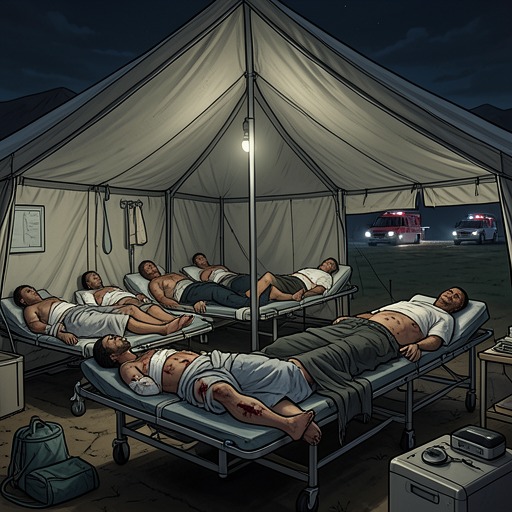
A 2010 field hospital in Port-au-Prince made the human stakes of resource rationing concrete. The American team initially recorded one patient as Jane Doe 326; her name was Nathalie LeBrun. She had chronic health problems that worsened after the earthquake and needed oxygen. When her first oxygen supply ran out, staff found another tank. A portable concentrator then proved unreliable, overheating and shutting down, while the field hospital’s generators depended on scarce fuel. Even after more fuel was found, bottled oxygen remained limited.
A nurse serving as liaison officer reasoned that LeBrun might need oxygen indefinitely, whereas injured patients might need it only temporarily, for example during surgery. He decided to withdraw her oxygen and arrange transfer to a damaged Haitian hospital where staff believed none was available. The decision was checked with the head doctor. Yet when LeBrun was transported in a Humvee ambulance, personnel who did not know the plan reassured her that she would be cared for elsewhere; despite an oxygen tank being available in the vehicle, the team withheld oxygen on the basis of the triage decision. The book emphasizes the gap between making a utilitarian allocation and communicating or carrying it out. The professionals involved had not told LeBrun what had been decided and were not willing to face her with the decision.
The outcome was not settled by the initial calculation. At the receiving hospital, a volunteer physician found a tank with some oxygen left and treated LeBrun with diuretics to reduce fluid in her lungs. Her condition stabilized, at least temporarily, to the point that she did not need oxygen. The episode does not establish that the original scarcity was unreal; it shows instead how a decision based on prognosis and expected duration can be changed by available treatment, and how the patient’s experience disappears if allocation is made without her participation.
Applying Plans Under Pressure
During Superstorm Sandy, Laura Evans faced a related problem at Bellevue Hospital. Fifty-six patients might have to share six power outlets expected to remain available if the hospital lost electricity. Evans had studied the New York ventilator guidelines and repurposed their scoring approach to help decide which patients should receive power. She convened an ad hoc committee of clinicians, nurses, and ethicists whose members had no patients under consideration, so primary doctors could continue advocating for their own patients while the committee considered broader factors.
The process had important limits. The committee did not include patients or family representatives. As the lights went out and backup power took several seconds to engage, staff prepared to ventilate patients manually with Ambu bags and to administer some drugs by counting drops if pumps failed. Evans later identified communication with families as the hardest part of the triage process: the staff feared telling families that a patient would not receive an outlet and postponed doing so. They also did not consider asking whether a selected patient or family might volunteer to give up an outlet. At Connecticut Hospice, by contrast, staff consulted patients and families during a hurried evacuation, and the sickest patients and their families chose to let healthier patients go first. The comparison shows that participation can reveal choices that professionals might not anticipate, even when time and safety are pressing.
Fairness, Accountability, and Public Trust
The book argues that disaster triage is a decision about social values as well as medical evidence. Possible goals include saving the greatest number of lives, saving the most years of life, considering quality of life, promoting fairness, and maintaining social trust. Those goals may conflict, and a small group of medical professionals may not represent the values of the larger community. In Seattle and King County, members of the public objected to withdrawing life-sustaining treatment and warned that survival statistics could be biased by institutional racism if African American and immigrant patients had not received equal-quality care. The concern was not merely that a scoring system might be inaccurate; it was that apparently neutral measurements could carry inequities from the health system into emergency decisions.
Public input, however, does not guarantee that public views will shape policy. During a 2009 consultation about emergency vaccination, public opinion differed substantially from expert opinion, but the policy had essentially been made by the time feedback was gathered. A 2012 Institute of Medicine report endorsed public involvement in developing disaster-allocation guidelines and emphasized providers’ duties to care, treat patients fairly, and steward limited resources. It also cautioned that DNR orders are not useful triage measures because they express advance preferences more than they predict survival. Decisions that restrict access to scarce treatment, the report argued, should be transparent, consistent, proportionate to the shortage, and accountable.
The book links these principles back to Katrina’s wider failures: delayed evacuation, inadequate transport, fragmented rescue efforts, poor communications, and hospitals and nursing homes without sufficiently robust backup power and water. Those conditions made scarcity more severe and shifted its costs onto patients already dependent on care. Allocation rules may help organize unavoidable choices, but they cannot substitute for preparation or erase the consequences of institutional failure. Nor can a scoring system settle, by itself, who deserves a chance, what patients should be told, or whether the public will trust decisions made in its name.