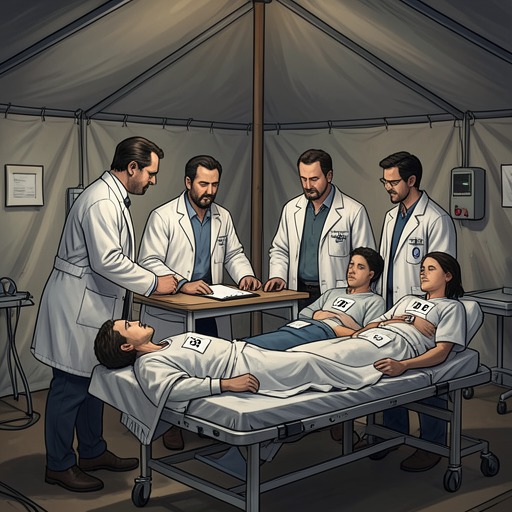
Memorial Hospital Ranks DNR Patients Last for Evacuation
Five Days at MemorialMemorial Medical Center’s decision to evacuate patients with do-not-resuscitate orders last turned a narrow instruction about resuscitation into a broad judgment about whose lives should be prioritized. The distinction mattered as the hospital tried to move patients during Hurricane Katrina: a DNR order meant not to revive someone whose breathing or heartbeat had stopped, not that the person should receive less protection during evacuation. Yet four DNR patients in the intensive care unit, including Helen Breckenridge and nurse Jannie Burgess, were placed at the end of the line.
The Rule and What a DNR Order Meant
At a meeting before the evacuation, Memorial’s doctors established an exception to the usual approach of prioritizing the sickest patients and those dependent on machines. Patients with DNR orders would go last. The decision applied to all four DNR patients in the ICU, rather than being described as an individual assessment of each person’s chances of surviving the evacuation. It also set aside the practical urgency of moving patients whose treatment relied on equipment and continuous care.
A DNR order had a specific and limited meaning: if a patient’s breathing or heartbeat stopped, the patient should not be revived. A doctor signed the order, almost always with the informed consent of the patient or a health-care proxy. Informed consent, established as a legal concept in the United States beginning in the 1950s, was meant to protect patient autonomy in medical decisions shaped by a history of abuses. It required disclosure of a proposed intervention’s nature, risks, benefits, and alternatives. A DNR order was not the same as a living will. Under Louisiana law, a living will allowed a patient with a terminal and irreversible condition to request in advance that life-sustaining procedures be withheld or withdrawn.
That distinction exposed the weakness in the evacuation rule. The available account does not describe the DNR orders as instructions to forgo evacuation, treatment, or rescue. Nor did Memorial’s disaster plans say that patients who declined resuscitation should be left until last. The rule instead attached a wider meaning to a medical instruction whose scope was narrower.
The Reasoning Behind the Decision
Medical chairman Richard Deichmann later explained that he thought the law required patients with DNR orders to have a certified terminal or irreversible condition. On that understanding, he believed they had the “least to lose” if calamity struck and should therefore be evacuated after others. His account identifies a misunderstanding that shaped the policy: the presumed prognosis associated with a DNR order became a basis for ranking patients, even though the order itself specified what should happen only if breathing or circulation ceased.
Other doctors agreed with Deichmann’s plan. Neuroradiologist Bill Armington later said he thought patients who did not want their lives prolonged by extraordinary measures would not want to be saved at the expense of others. But nothing in the orders or in Memorial’s disaster plans stated that those patients preferred to be rescued last. The distinction between a clinician’s assumption about a patient’s wishes and the patient’s documented instruction was therefore central to the decision.
The plan might have seemed less consequential if the hospital could be emptied quickly. Instead, the evacuation proceeded in circumstances where sequence had immediate force. The rule did not simply sort paperwork: it determined who could leave in the first sweep and who had to wait.
Breckenridge Is Sent Back
The policy became visible when medical workers moved Breckenridge from the eighth floor. One person squeezed air into her lungs by hand while others watched the battery-powered pumps delivering drugs to regulate her fragile circulation. When she reached the lower level, a doctor ordered, “Bring her back up,” and said, “She can’t go in the first sweep.” The instruction translated the general rule into a direct reversal of her movement toward evacuation.
Nurse manager Karen Wynn learned of the decision from Ewing Cook and Roy Culotta and passed the information to Susan Mulderick. A nurse helping transport Breckenridge also heard how the priorities were being applied: “the most salvageable had to go.” The phrase made the ranking explicit. It placed the burden on the patient’s assessed prospects, while her DNR status had already assigned her to the last group.
Back in the ICU, Breckenridge’s pumps and drips were reconnected to emergency wall outlets and her mechanical ventilator was restored. She was barely alive and soon died. The account allows that her death may have been imminent, but presents it as seemingly the hospital’s first death hastened by Katrina. That qualification preserves both parts of the episode: her grave condition and the possibility that the evacuation decision shortened the time she had left. It does not establish that the DNR order itself authorized the decision to return her upstairs.
The Human and Ethical Aftermath
The rule’s significance also lies in who was included in its category. One of the four ICU patients was Jannie Burgess, an African American nurse who had once cared for patients in hospitals where she herself could not receive treatment. Her presence brings the abstract sorting decision into contact with a history of unequal access to care; the evacuation rule placed her among those to be moved last because of an order directed at resuscitation.
The larger evacuation crisis left staff carrying memories of patients, choices, and losses. LifeCare nurse Gina Isbell later described poor sleep, nightmares in which she saw her patients’ faces, guilt about the staff she had selected to work the storm, and distress about patients who died. She had left Memorial by small flat boat, physically and mentally drained, and then discovered that her home and community in St. Bernard Parish had been lost. Nurse manager Wynn later recognized symptoms of post-traumatic stress in herself and colleagues. Preparing for possible grand-jury testimony made her feel that discussing the events meant reliving them; after meetings with her lawyer, it could take weeks to feel able to move forward. These accounts do not reduce the rule’s consequences to a single decision, but they show how the crisis continued to inhabit the people who had worked through it.
The DNR-last policy is consequential because it transformed a patient’s limited choice about resuscitation into a criterion for evacuation priority. Its rationale depended on assumptions about prognosis and patient preference that the orders and disaster plan did not state. In the scene of Breckenridge’s return to the ICU, that gap between what the order meant and what the policy made it mean became concrete: a patient being ventilated and supported by pumps was sent back while the first evacuation sweep went on without her.