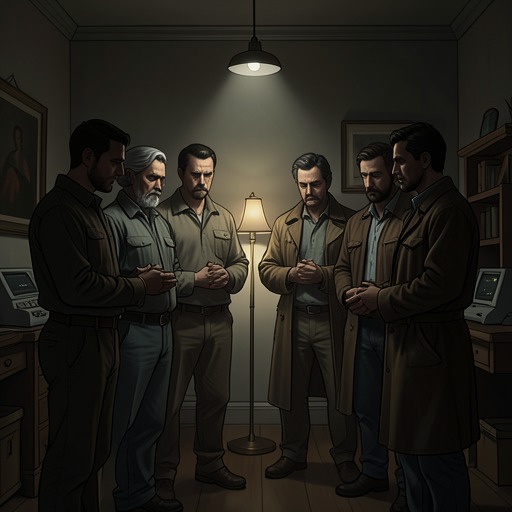
Memorial Hospital's Post-Evacuation Code of Silence
Five Days at MemorialMemorial Hospital's Post-Evacuation Code of Silence was the informal refusal by people associated with Memorial Medical Center to discuss events after Hurricane Katrina. Described by nurses as an almost immediate post-evacuation understanding, it overlapped with formal legal guidance from Tenet Healthcare and helped make the investigation into patient deaths harder to conduct: witnesses became guarded, records were disputed or unavailable, and investigators had to separate what people remembered from what they had learned later.
A norm after the evacuation
In the aftermath, Memorial staff avoided conversation about Thursday, September 1, 2005. Curtis Dosch, who had recently become the hospital’s interim CEO, later said that people seemed to be protecting themselves. He had confronted Susan Mulderick, who denied having spoken about medicating patients. Dosch wondered whether some patients might have survived if they had been evacuated, and whether someone else had the right to decide they would not.
Nurses described the pattern as a code of silence: a shared expectation not to discuss the events and to protect colleagues from trouble. The label captures more than a lack of public comment. It points to a social boundary around what could be acknowledged even among people who had been at the hospital. The evidence does not establish that every employee followed the same rule or had the same reasons for remaining quiet.
Legal guidance and company interests
As news coverage intensified, a confidential email to Memorial personnel advised employees contacted by government or media representatives to speak with the hospital’s lawyer. It also said employees could request a hospital representative during an interview and urged them not to discuss the matter with other employees or people outside the hospital. The message framed this guidance as protection against words being misunderstood, while also channeling questions back to the hospital’s counsel.
Tenet Healthcare’s attorney separately asked government officials to tell employees that they could consult a Tenet lawyer and have an attorney or hospital representative present before questioning. Virginia Rider and Butch Schafer complied, both because they considered it ethically required and because they wanted information gathered in a way that would be admissible in court. Schafer also recognized the strategic advantage for a company facing possible lawsuits: representation could give the company insight into what its employees told investigators.
The response was not uniform across organizations. LifeCare’s attorneys eventually advised their clients to be open in interviews, including volunteering relevant information. Other lawyers took a more guarded approach. One lawyer involved in the events later recalled Anna Pou’s attorney saying that it was in nobody’s interest for the events to become public. The contrast shows how legal advice could shape whether a witness spoke freely, without by itself proving that any particular account was false or that counsel’s involvement was improper.
The effect on witness interviews
The investigators found that some of the people they most wanted to interview had obtained lawyers and were unwilling to speak. Others agreed to interviews but answered cautiously. Drawing on decades of legal practice, Schafer sensed that some witnesses had been coached about what they could say; when someone answered that they could not recall an event, investigators had limited means to press further. The resulting interviews did not readily resolve who had made decisions about patient medication or what had happened on the seventh floor.
The difficulty was not only that witnesses withheld information. Public reporting could also alter recollection. Investigators worried that media accounts might prompt memories, or shape them, and that discussions among witnesses and the creation of a shared timeline could affect later testimony. They therefore sought more interviews, took care not to suggest answers, and looked for physical and written records made at the time. The Code of Silence thus formed part of a wider evidentiary problem: investigators had to contend with reluctance to speak and with the possibility that later accounts had been influenced by intervening information.
Records, suspicions, and reconstruction
Memorial pathologist John Skinner and laboratory director David Heikamp had recorded the names and locations of people who died when they walked through the hospital after the evacuation. Richard Deichmann and René Goux had earlier asked Skinner to keep track of deaths. Their notes and recollections later mattered to investigators trying to establish when patients died—a record created in the immediate aftermath that could be compared with testimony given later.
Rider and Schafer also believed that some medical records had not been supplied, although Tenet’s attorneys maintained that they had provided copies of the records in the company’s possession. Tenet had initially barred LifeCare representatives from entering the hospital; in the meantime, patient records, computer equipment, and other materials went missing, and LifeCare sought their return through legal action. These circumstances increased Schafer’s suspicions. He considered whether a decision about injections had come from higher up, including whether corporate officials might have known of or issued an order. Those were investigative questions and suspicions, not established findings in the evidence presented here.
The book’s account of silence
The book reconstructs the crisis through more than five hundred interviews as well as materials dating from the disaster and its immediate aftermath, including photographs, emails, notes, diaries, and other records. Its author states that he was not at Memorial during the events and that memories could fade, change, or conflict. The account distinguishes attributed recollections from the author’s own interpretations and notes significant disputes. In this framework, silence is both a feature of the aftermath and a constraint on how confidently the events can be narrated: the absence of open discussion matters, but it does not erase the need to assess each witness, document, and recollection on its own terms.