Memorial Medical Center
Five Days at MemorialMemorial Medical Center, long known to New Orleanians as Baptist, was at once a neighborhood hospital, a familiar refuge from hurricanes, and the site of the crisis that would expose how fragile that refuge could be. Founded with a religious and charitable mission, it acquired a reputation for standing firm against storms. During Hurricane Katrina, however, the building became a place of severe operational failure and contested decisions about patients, evacuation, and care; after the evacuation, its chapel and other spaces became part of a criminal investigation. Its history links the everyday intimacy of a community hospital to the consequences of institutional change and disaster.
Foundation and Community Identity
Memorial opened in 1926 as Southern Baptist Hospital. At its dedication, superintendent Louis J. Bristow described its purpose as glorifying God and serving patients across class lines: poor charity patients would have individual rooms rather than being segregated into separate wards. The institution’s stated mission joined the alleviation of pain, the prolongation of life, and the relief of suffering. That ideal shaped the hospital’s public identity for decades, reinforced by the motto “Healing Humanity’s Hurt.”
The building stood near Claiborne and Napoleon Avenues in the Freret neighborhood. Its reddish-brown tapestry brick and gray stone made it a conspicuous landmark, and its steel-and-concrete construction seemed to promise durability. For nearly eighty years, that physical solidity and its history of surviving storms helped make Baptist more than a treatment facility: for some New Orleanians it was the place where relatives, children, pets, and supplies gathered while a hurricane passed. Staff sometimes came even when they were not scheduled to work; doctors could admit unwell outpatients whom they considered safer there than at home. The hurricane might strike at night, but the customary expectation was that the hospital and its occupants would still be there in the morning.
That confidence had a record behind it. During Hurricane Betsy in 1965, the hospital sheltered more than a thousand people and withstood the storm. It also stood ready when Hurricane Ivan threatened in 2004. Cathy Green, a surgical intensive care nurse, told her daughter that if Baptist failed, the danger would extend beyond the hospital to the whole city. Such confidence was not simply a tribute to the building: it reflected a civic reliance on the hospital as a dependable refuge.
The community’s relationship to the institution was never equally available to everyone. Jannie Burgess became a nurse after supporting her children through other jobs, including work as a taxi dispatcher and a secretary to a mortician. In mid-twentieth-century New Orleans, her light-brown skin meant that she could care for patients in many private hospitals while being barred from receiving care in them. Born only months after Southern Baptist Hospital opened, she would wait more than four decades before she could be a patient at Memorial. Her history makes the hospital’s promise of shared care inseparable from the racial exclusions that shaped access to private medicine.
Flood Risk and Institutional Change
The hospital’s reputation for safety coexisted with a recurring and increasingly familiar flood hazard. In the early twenty-first century, even moderate storms could leave the streets around Memorial under enough water that employees had to park on the raised neutral ground between lanes. Maintenance workers wore waders and used a battered metal fishing boat, stored suspended from the ceiling in the basement parking garage, to bring colleagues to work. Yet equipment, supplies, food, records, and linens were still kept in the basement. Repeated exposure had normalized the water, even as it remained a threat to the hospital’s operations.
The institution also changed ownership and purpose. Financial pressure led Southern Baptist Hospital to merge with the Catholic hospital Mercy in the early 1990s; in 1995 the combined institution was sold to Tenet Healthcare Corporation. The familiar Baptist name disappeared from official use, although employees continued using it as a small act of resistance. The celebratory customs and motto receded as press releases emphasized partnerships and financial performance. Patient-care managers received monthly budgets and productivity targets, and the pressure to meet them could intensify even after success. Nursing director Susan Mulderick adapted to the new system and remained in her position through these changes. Her family’s ties to the hospital—where a brother died after back surgery, a sister survived a brain aneurysm, and other relatives worked—show how closely institutional life and family life had once been woven together.
By the time Katrina arrived, Memorial’s place in the city rested on both a longstanding refuge image and a transformed corporate structure. The storm exposed the distance between the remembered hospital, where staff and families rode out hurricanes together, and the strained institution now confronting a large-scale evacuation with damaged infrastructure and uncertain outside support.
Katrina: Refuge, Evacuation, and Unequal Priority
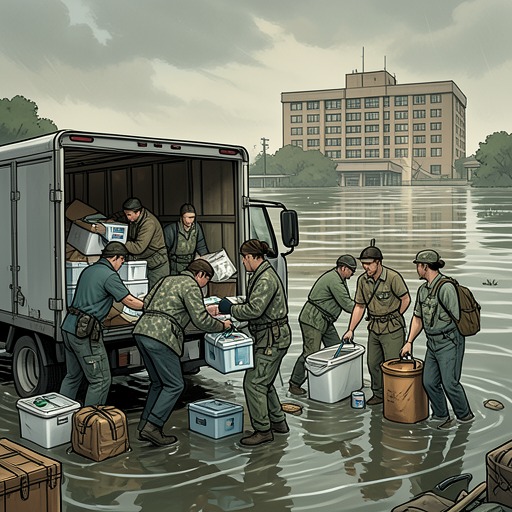
As the crisis developed, the hospital’s familiar role as a place of refuge became harder to sustain. Memorial employees reported that people waded through deep water toward the building seeking shelter, and staff secured its entrances. A stabbing victim who reached the emergency-room ramp needed air evacuation, while the visible helicopter activity drew other desperate people. At another point, a woman lying on a mattress was propelled through the floodwater toward the hospital, where people called out that it was closed. A couple who rowed there with young children were also told to leave. Bryant King, a young hospital-based physician, protested to CEO René Goux that people had to be helped. These encounters turned the hospital’s boundary into a stark divide: its limited capacity and evacuation effort existed alongside the community’s need for protection.
Within the hospital, evacuation order was itself a consequential decision. Doctors had agreed that patients with do-not-resuscitate orders would be evacuated last, departing from the usual priority accorded to the sickest patients and those dependent on machines. Four DNR patients were in the intensive care unit, among them Helen Breckenridge and Jannie Burgess. Later, staff used a three-part system for more than one hundred remaining Memorial and LifeCare patients: patients able to sit up or walk were classified as “1’s” and prioritized first; those needing more assistance became “2’s”; and the very ill, including patients with DNR orders, were assigned “3’s” for last evacuation. The categories offered a practical way to organize movement, but their consequences depended on judgments about illness and the meaning of a DNR order in an emergency.
That distinction became painfully clear when a nurse was told to leave a DNR patient behind. Michelle Pitre-Ryals and her colleagues resisted being ordered off the floor without the patient. The patient’s daughter explained that she had agreed to the DNR because resuscitation after cardiac arrest would not make sense for her ninety-three-year-old, oxygen-dependent mother; she had not understood it to mean that her mother would not be rescued. Her objection exposed the gap between a decision about resuscitation and a rule that affected evacuation. The patient’s DNR status, intended to govern treatment in a particular medical circumstance, had become a marker in the hospital’s broader triage system.
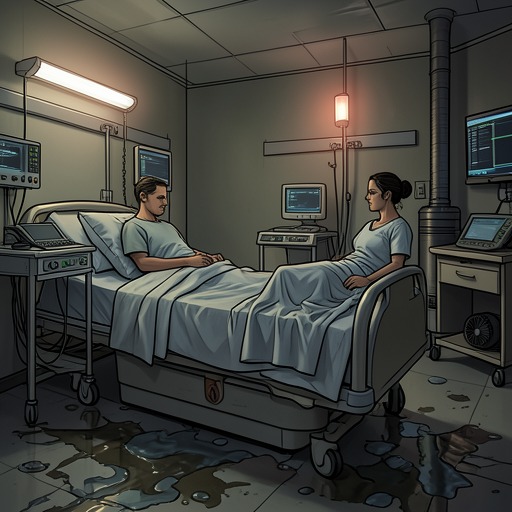
Memorial’s own patients were only part of the evacuation burden. Its census fell from 187 to about 130, while 460 Memorial employees, 447 family members, and 52 LifeCare employees remained in the building. All 52 LifeCare patients were still on the seventh floor, including seven who depended on ventilators. LifeCare staff sought to have their patients included in Coast Guard transport, but permission was to be requested from Tenet’s corporate leadership; the reason that corporate approval was required for access to federal rescue assets was unclear. On the seventh floor, Mark LeBlanc was told that intravenous fluids could no longer be provided to his mother, a LifeCare patient with a urinary infection whom he believed needed fluids and antibiotics. An administrator explained that the hospital was operating in survival mode, not treatment mode. The encounter put the changed function of the institution into a single practical question: what did it mean to remain a hospital when ordinary care could no longer be supplied?
Deaths, Investigation, and the Building as Evidence
After the last living patients and staff had departed, the hospital remained central to the unfolding crisis. Families searched for loved ones while recovery of the dead was delayed amid disputes over governmental responsibility. On September 6, MSNBC cameraman Tony Zumbado reached Memorial by kayak and followed the smell of death to the Myron C. Madden Chapel. A yellow note marked the door as off limits. His camera showed more than a dozen bodies lying on low cots or the floor beneath white sheets. A chaplain who entered while searching for survivors later compared the scene to Dante’s The Divine Comedy. When a disaster mortuary team arrived on September 11, it recovered forty-five bodies from the chapel, morgues, hallways, the LifeCare floor, and the emergency room.
The site then became the focus of a formal investigation. A government investigator requested a list of deceased patients and Memorial’s disaster plan. Investigators later sought a warrant, with Virginia Rider preparing an affidavit based on accounts from LifeCare and hospital witnesses. A judge granted the warrant, and on October 1 Rider and Butch Schafer returned with a large team of state and federal agents and Louisiana State Police crime-scene investigators. The investigation treated the hospital not just as the setting of disputed decisions but as a place where records, medications, and physical evidence might establish what had happened.
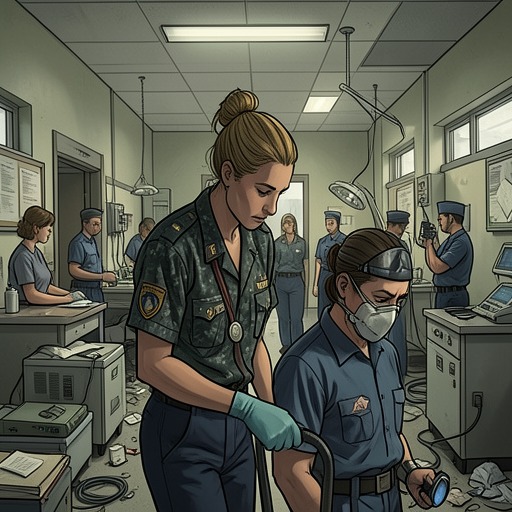
Three months after the storm, investigators returned with LifeCare pharmacist Steven Harris. Restoration workers were removing stained carpet, pumping out elevator wells, replacing corroded wiring, and cutting away mold-damaged drywall. Tenet warned those entering that the property was unsafe and that entry could expose them to serious injury or death. A fence now surrounded the old hospital; DynCorp guards patrolled its perimeter, initially assigned to help anyone who might have been left alive and later tasked with securing the property. Inside, Pou revisited locations with Rick Simmons and nurses Cheri Landry and Lori Budo. In Room 7312, the crash cart, ventilator, and monitor remained as evidence of a code response during the disaster. The equipment, disconnected and still, made the hospital’s recent working life seem remote even as its material traces remained.
Memorial’s spaces also carried the practical traces of disaster command. The hospital’s written incident-command policy described an intended leadership structure, while interviews indicated that the plan was not followed exactly as written. The book’s account draws on interviews, documents, and other primary sources rather than a single witness’s view: its author reported conducting more than five hundred interviews and noted that memories could conflict, and that later publicity and discussions among witnesses could affect recollection. That method matters to the hospital’s story because its rooms became the setting for events remembered from different positions, and the evidence was gathered after the physical scene had already begun to change.
Reopening and the Hospital’s Altered Meaning
In 2006 Tenet agreed to sell Memorial and two other New Orleans hospitals to Ochsner Health System. Ochsner later completed the purchase and partially reopened the institution under the Baptist name. For Richard Deichmann, a letter thanking the medical staff for their work prompted a dispute over how disaster service should be remembered. Horace Baltz, who had worked at Baptist through every hurricane except Betsy, objected to praise that presented service in a disaster as exceptional or heroic; to him, it was part of the work. The exchange showed that even after reopening, the hospital’s past remained contested—not only over responsibility for deaths but also over the language used to describe staff conduct.
The building’s return to use did not mean a simple restoration of its former meaning. A later hurricane season brought a changed facility: by 2013, improvements included new and restored generators and power-transfer switches, elevated central-plant infrastructure, a new well to support cooling if city water failed, and a restored heliport with an additional elevator stop serving the neonatal intensive care unit. These modifications translated experience into physical safeguards. The hospital that had once relied on its reputation and improvised routines now carried visible reminders of what had failed.
Memorial thus remains both a place and a test of institutional promises. Its founding language emphasized relief of suffering; its hurricane reputation made it a civic shelter; corporate changes altered the pressures under which care was organized; and Katrina forced decisions about which patients could be treated, moved, or left waiting. The chapel, the seventh floor, the emergency room, and even the repaired route to the helipad became part of a public argument over what happened and how it should be understood. Its history does not resolve that argument. It shows why the hospital’s identity could not be separated from the patients who depended on it, the community outside its doors, and the systems expected to sustain it.