Memorial Medical Center emergency power system
Five Days at MemorialMemorial Medical Center emergency power system was more than a bank of backup generators: it was a vulnerable chain of engines, fuel, electrical circuits, transfer switches, and patient-support equipment. Its collapse during Hurricane Katrina exposed how known flood risks and deferred improvements could turn backup power into a point of cascading failure, just when patients and staff depended on it most.
Design and Known Vulnerabilities
After Hurricane Ivan narrowly missed New Orleans in September 2004, Memorial’s leaders reviewed hurricane plans. Eric Yancovich studied government storm-surge models that estimated twelve to fifteen feet of water could surround the hospital if a major storm flooded the city. Memorial sat three feet below sea level. After an engineering meeting, Yancovich sketched hospital entrances and outdoor equipment against the elevation of Magnolia Street. His calculations showed that less than four feet of street flooding could send water over the loading dock and into the hospital.
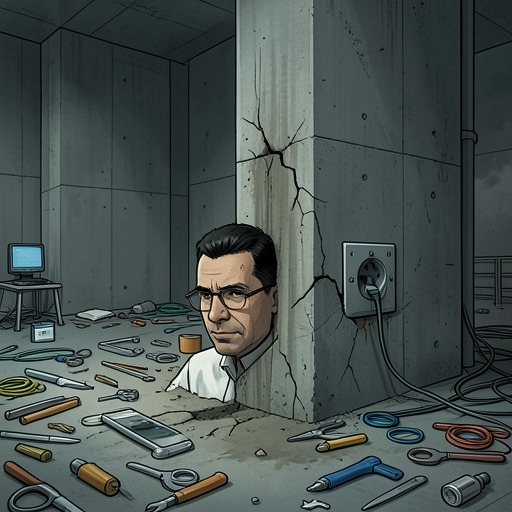
The generators themselves were on the second floor, but that elevation did not protect the system that distributed their power. Some emergency transfer switches and other critical components were below ground or only inches to a few feet above it. Yancovich warned his supervisor that “it won’t take much water in height to disable the majority of the Medical Center.” He expected the main hospital to lose power and thought patients might have to move to the newer Clara Wing, where he believed the electrical circuitry was better protected.
The hospital made limited preparations, adding floodgates and raising a vent for underground diesel tanks. Yancovich also recommended raising basement and ground-level transfer switches, along with pumps supplying most of the hospital’s medical air and vacuum suction—services needed by patients with respiratory problems. A partial bid for electrical work exceeded a quarter of a million dollars. Citing a lack of capital, he expected no approval at the time and left the proposal on file. The system’s weakness was therefore not simply that floodwater might reach the hospital; it was that essential links in its power and patient-support network were already known to be exposed.
A System Built for Backup, Not Prolonged Operation
Memorial had three teal-colored generators, each rated at 750 kilowatts. Each could produce roughly the power of six engines from a Toyota Camry. An outside company normally serviced them; the hospital’s maintenance staff mainly changed oil and ran brief monthly tests. National codes treated hospital generators more like heart-lung bypass machines meant to sustain vital functions for minutes or hours than equipment for continuous operation. Yet Memorial’s disaster plans expected them to support the hospital for at least three days.
By the time the crisis reached its second night, the generators had already been running for two days. None of the electricians or engineers on site was a generator mechanic. The system’s many additions and overlapping circuits, accumulated as the original 1926 hospital expanded, made its electrical layout unusually complex and difficult to diagnose. Its practical reliability depended not only on the engines but on switches, distribution panels, fuel, and other components that could fail together or disable power even while a generator remained intact.
The Cascading Failure
One generator shut down and left parts of the hospital dark. Workers initially suspected overheating, added water to its radiator by flashlight, and managed to restart it. Later, low oil pressure appeared to be a problem; staff brought diesel barrels to prime the motors and retrieved more fuel from a generator in the surgery building. Meanwhile, sections of the hospital lost power, and the lights in areas that remained lit seemed to dim.
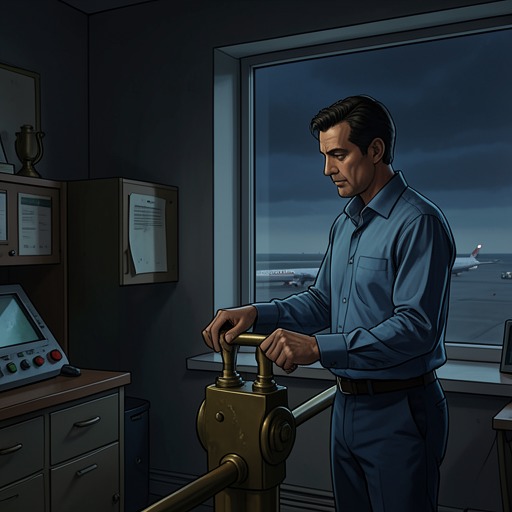
As water rose in the basement, workers in rubber boots waded through knee-deep flooding to investigate. About a third of the automatic transfer switches were on a low level of the electrical building, and the water suggested that switches and associated distribution panels might be submerged—the vulnerability Yancovich had predicted. In a narrow hallway lined with electrical panels and a warning sign, a worker found the yellow rubber-coated bypass handle and used it to connect the load of a failed generator to a working one.
The workaround created another danger. A gauge showed that the operating engine was drawing too much current, suggesting a short circuit. Workers tried to separate the loads to prevent a fire, especially dangerous because the sprinkler-system pumps were underwater and fire trucks were presumed unavailable. They reduced demand by shutting off scattered circuits serving unused equipment and fixtures. Another generator failed; the staff had no spare parts, and attempts to salvage parts from the disabled engine did not succeed.
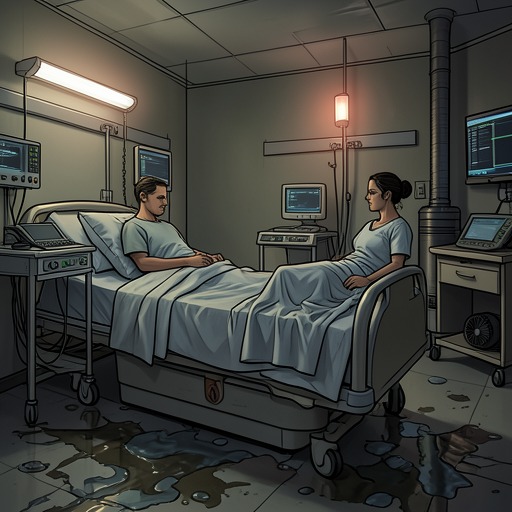
The struggle lasted about two hours. At approximately two in the morning on August 31, 2005, nearly forty-eight hours after Hurricane Katrina made landfall near New Orleans, the last backup generator surged and died. The sudden silence reached Ewing Cook, trying to rest in his second-floor office, as an unmistakable sign that the hospital’s remaining electrical lifeline was gone. Alarms flashed and sounded on the eighth floor until nurse manager Karen Wynn climbed onto a chair and struck an alarm panel with her shoe to quiet it.
Consequences and Significance
The final failure made the system’s hidden dependencies immediately visible: the backup engines could not sustain hospital operations when flooding threatened the circuitry that connected them to the building. Nor was electricity separable from other forms of care. The low-lying pumps Yancovich had recommended raising supplied medical air and vacuum suction, while the submerged sprinkler pumps added fire risk to the blackout. The system was a network of interdependent equipment, not a set of independent generators that could simply be relied on in turn.
The episode also set prior knowledge against deferred action. Yancovich had measured how little street flooding could reach the hospital, identified vulnerable components, forecast a loss of power, and proposed specific improvements; the electrical work remained unfunded. During the emergency, staff improvised with fuel, a bypass handle, and circuit shutoffs, but those measures could not overcome submerged infrastructure, failing engines, and the absence of repair parts. The generators’ death was both a mechanical breakdown and the exposure of a preparedness gap: backup power had been planned to last three days, while the system’s weakest components had not been protected against the flood risk the hospital had already studied.