Memorial's survival mode
Five Days at MemorialMemorial's survival mode was the hospital's emergency posture during the Katrina crisis, when its role shifted from treating patients toward managing evacuation and offering comfort. The change was not merely a label: it shaped which interventions staff could provide, where patients waited, and how care continued when ordinary treatment was restricted.
From Treatment to Survival
As Memorial moved into survival mode, a Memorial administrator explained to Mark LeBlanc that the hospital was no longer in a treating mode. LeBlanc had sought intravenous fluids and antibiotics for his mother, a LifeCare patient with a persistent urinary infection, and was distressed to learn that intravenous fluids were no longer available. His question about whether a hospital could simply switch off its ordinary role captured the rupture between the expectations patients and families brought to the institution and the emergency conditions governing care.
The change also reached routine medication and nursing practice. Nurses were told not to give intravenous fluids or even patients' usual medicines because the hospital was in emergency mode; dim lighting was cited as a safety concern. Anna Pou and other staff members understood their immediate priority as keeping patients comfortable, while recognizing how little else they could do for many of them. The distinction between comfort and treatment thus became a practical boundary imposed in the crisis, not simply an abstract medical principle.
Numbered Evacuation and Limited Care
Patients were sorted into numbered evacuation groups. The group designated 2s, perhaps seventy patients over the course of the day, was generally placed along a corridor leading through a hole in the machine-room wall, a shortcut to the parking garage and ultimately the helipad. About eighteen group 3 patients were moved to a corner of the second-floor lobby, near a Hibernia Bank ATM and a planter of striped green dieffenbachia. The numbers organized the movement of patients toward evacuation, but they also made an individual's prospects legible as a category; neuroradiologist Bill Armington regarded the method as efficient but distasteful.
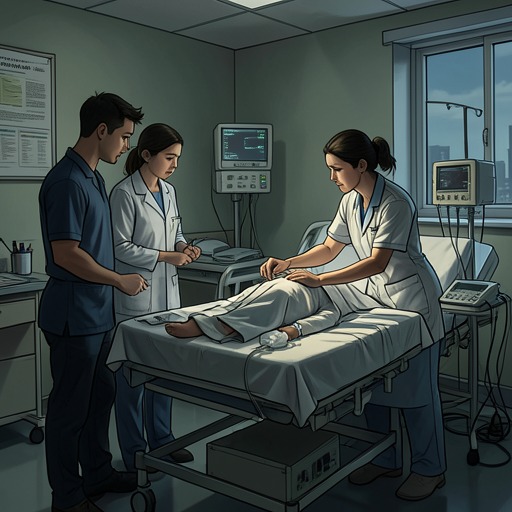
Patients waiting to be evacuated continued to receive some care. Staff changed diapers and fanned them, sometimes with help from employees' family members, and offered sips of water to those able to drink. But after patients were moved from their rooms on Wednesday, most other medical interventions were limited. The system therefore combined continued hands-on attention with a contraction of treatment: patients were not simply left without care, yet the care available was narrowed by the emergency's demands and constraints.
Care Within the Constraints
The limits of the institutional response did not eliminate personal acts of care. Angela McManus, exhausted and anxious about a sibling living near the levees, cared for her mother, Wilda, herself. She provided nourishment through Wilda's feeding tube, changed her colostomy bag, and sought help from a nurse to clean her mother and change her wound dressing. With no running water available for bathing, even this basic care required time and assistance. Angela continued to talk, sing, and pray with her mother; before the storm, LifeCare staff had joined Wilda's prayers in informal sessions they called church.
John Thiele's own moral frame emphasized comfort when the surrounding situation left him with almost no control. He drew on the Golden Rule and a medical-school motto about curing when possible and always offering comfort. That conviction helps explain the emphasis on comfort within survival mode, while also showing that individual efforts to respond humanely took place inside a system where ordinary interventions had been restricted.
What the Emergency Left Behind
Survival mode describes an immediate institutional response, but the evidence also follows staff members into the aftermath. Gina Isbell left Memorial by small flatboat, physically and mentally drained, and discovered that her home and community in St. Bernard Parish had been devastated. She slept poorly, had nightmares about patients, and felt guilty about the staff she had chosen to work during the hurricane and the patients who died. Her later account makes the crisis's consequences visible beyond the hospital's evacuation corridors: the emergency did not end for those who carried its decisions and losses away with them.
Karen Wynn's preparations for a possible grand-jury appearance similarly brought the events back into the present. Her lawyer helped her anticipate questions and keep her account consistent, but speaking about what had happened could feel like reliving it; after meetings, Wynn sometimes needed weeks to recover her sense of stability. These accounts do not make every later difficulty reducible to the hospital's operating posture. They show instead that the extraordinary conditions of survival mode formed part of a crisis whose effects continued in memory, grief, and the struggle to move forward.