Richard Deichmann
Five Days at MemorialRichard Deichmann was Memorial Medical Center’s internal-medicine chairman and, during Hurricane Katrina, one of the doctors responsible for organizing care and directing evacuation. As absent physicians left patients without regular medical attention, he took the lead in coordinating the hospital’s doctors; as rescue plans faltered, he helped manage the crowded helipad. He also drew a firm boundary around the question of euthanasia: in his account, DNR patients might go last, but they were still to be evacuated. The later disputes over what was said and done at Memorial made his leadership consequential and, at points, contested.
Identity and Clinical Role
Deichmann chaired internal medicine, one of Memorial’s three clinical departments, and became the principal organizer of its physicians when medical staff president Reuben L. Chrestman III was away on vacation. Many of the doctors with hospital privileges were university doctors or private contractors, not Memorial employees; the hospital did not generally require its specialists to remain present during hurricanes. Doctors had stayed for different reasons: some were on call, like Anna Pou, while others, including John Thiele, had become accustomed to riding out storm warnings in their offices.
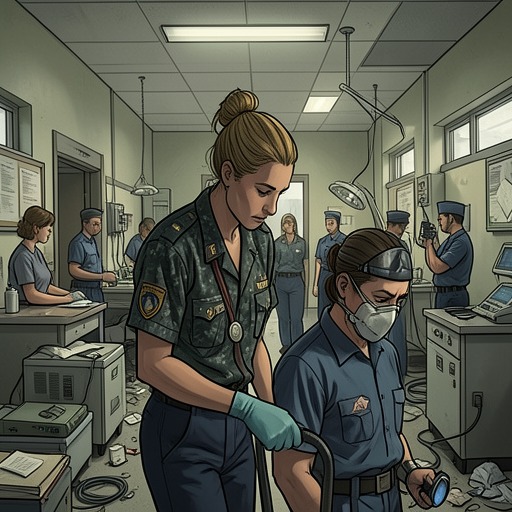
More doctors were on site than in some earlier hurricanes, and their specialties ranged from internal medicine and pulmonology to kidney medicine, infectious diseases, emergency medicine, neonatology, surgery, and anesthesiology. Deichmann assigned clinical doctors to nursing stations so that every one of the fifteen patient units had someone in charge. Later, when evacuation became the plan, he took stock of the physicians again and assigned two to each ward. At Horace Baltz’s suggestion, doctors were to avoid duplicating work by visiting their own private patients only when those patients were on the ward assigned to them. The teams had to classify patients by the kind of destination they needed, count them by four o’clock, prepare transfer orders, and ready patients for movement. Those suitable for discharge could receive a week’s supply of medication and go to an evacuation center.
Organizing the Evacuation
The instruction to evacuate arrived as the hospital remained hot and the water outside continued to rise. Deichmann told the doctors to transfer patients, beginning with the sickest. The practical work was not simply to name priorities: the teams had to determine whether each patient belonged in an intensive-care unit, a general hospital ward, a rehabilitation facility, or a nursing home, while also preparing patients and paperwork for transport. On the fourth floor, Anna Pou and Kathleen Fournier assessed a full complement of roughly two dozen patients, many gathered in wheelchairs near a central nurses’ station with fans blowing on them.
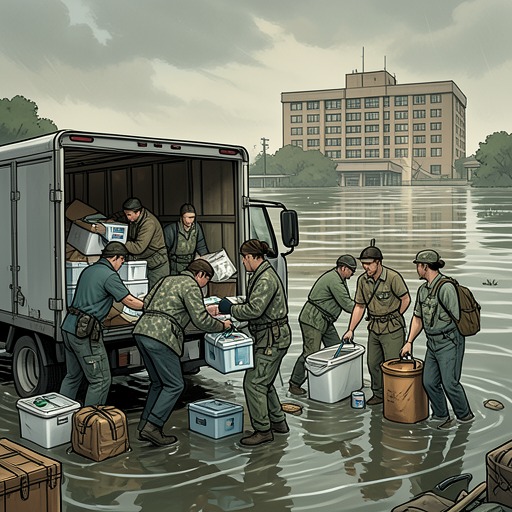
The evacuation depended on several kinds of transport and outside coordination. A hospital in Baton Rouge agreed to receive Memorial’s babies, including sixteen critically ill infants, while Coast Guard helicopters were expected to carry them and some adult intensive-care patients. The National Guard promised trucks for thirty-five medical and surgical patients bound for a Tenet hospital in Texas. Deichmann’s role extended onto the helipad: he used a two-way radio to communicate while small private helicopters landed, among them one that delivered the long-awaited drug supplies. Some pilots were willing to take sick elderly patients but not neonates, whose care required more specialized support.
The neonatal transfers exposed how little control the hospital had over the rescue operation. When the babies’ helicopter arrived with a flight plan for a hospital west of Baton Rouge rather than the facility that had agreed to receive them, neonatal nurses objected because they did not know whether the destination could sustain the infants’ lives. Deichmann told them that the babies could go wherever the pilot was headed, calling the situation a disaster. The nursing director answered over the radio that the pilot had to fly to Baton Rouge or she would not permit the babies to leave. The destination was changed, and a later message confirmed that all the babies had arrived safely.
The record also preserves uncertainty about particular moments on the helipad. Juan Jorge Gershanik later recalled asking Deichmann to find a helicopter for the waiting babies; he remembered Deichmann turning toward another arriving aircraft and giving him a pointed look, which sent him rushing forward with an incubator. When asked about that recollection in 2013, Deichmann did not remember the scene, the conversation, or the look. The episode therefore appears through two different kinds of evidence: Gershanik’s remembered scene and Deichmann’s later inability to recall it.
Rescue Delayed and Patients’ Place in the Plan
The dispute over whether to continue rescue flights overnight showed the strain between urgency and perceived danger. Coast Guard personnel were prepared to keep rescuing people after dark, particularly after learning that seven LifeCare patients were on ventilators, that water was rising, and that power might fail. A doctor sent a security guard to wake Deichmann and ask what to tell a Coast Guard officer seeking permission to send more helicopters. Deichmann said to tell the officer to send them in the morning. He considered reopening the helipad too dangerous and believed the staff needed rest. Susan Mulderick, Memorial’s incident commander, and Diane Robichaux, LifeCare’s incident commander, also agreed to wait until daybreak; Robichaux wanted extra hands to carry patients down now that the elevators were out of service and hoped LifeCare ambulances could transport its patients to other LifeCare hospitals.
Doctors later objected that the opportunity to continue the helicopter evacuation had been refused, while few patients had left since then and a prompt government rescue seemed unlikely. One account of the earlier exchange came from Paul Primeaux, who said he carried the Coast Guard’s offer to Deichmann and found him unwilling to continue. Deichmann did not remember that exchange, but his memoir described making the same decision later that night. The distinction matters: the book’s later account supports that he made such a decision, while the earlier conversation remained a disputed memory rather than an event he recalled.
Deichmann’s position on patients with do-not-resuscitate orders was not, as he described it, that they should be left behind. He thought they should go last, while remaining part of the evacuation plan. He recalled a quiet hallway conversation in which Mulderick asked whether euthanizing the hospital’s DNR patients would be humane. Mulderick later denied, through her attorney, that she had discussed euthanasia with Deichmann or anyone else at Memorial. In Deichmann’s recollection, he answered, “Euthanasia’s illegal.” He also recalled telling her, “There’s not any need to euthanize anyone,” and that he did not think they should do anything of that kind. The disagreement was sharper than their earlier differences about the sequence of evacuation: he understood the plan as eventually moving the DNR patients, not hastening their deaths.
Disagreement, Authority, and Recollection
The debate was not confined to the hallway conversation. A radiologist proposed bringing staff together to discuss euthanasia openly, rather than leaving the decision to a few people, but Deichmann refused, saying the idea should not even be considered. Other staff interpreted remarks differently. Emergency physician Karen Cockerham believed euthanasia was being proposed and thought it might be the humane option under the circumstances; another physician considered the idea dangerous and worried that a doctor might go to jail for an illegal act undertaken in an effort to help a patient. These contrasting interpretations place Deichmann’s refusal within a hospital where people were trying to respond to suffering without agreed guidelines, and where words about what was humane could carry very different implications.
The surviving accounts also show that authority at Memorial was neither simple nor uniformly obeyed. Deichmann directed doctors and helipad movements, but the neonatal nursing director openly rejected his instruction to send babies to an unconfirmed destination, forcing a change in the flight plan. In another discussion, he closed off a proposal for a formal euthanasia meeting; in the hallway conversation he later described, he opposed euthanasia directly. Those episodes do not erase his role in decisions that delayed transport, but they make the structure of responsibility visible: clinical leadership, nursing authority, pilot judgment, and the need to move patients all met under conditions in which no single person controlled the whole operation.
Aftermath and Professional Judgment
After the disaster, Deichmann published Code Blue: A Katrina Physician’s Memoir, a book that revealed his key role in organizing evacuations. That role became directly relevant to a civil lawsuit: Karen Lagasse sued Roy Culotta, Memorial, its chief executive René Goux, an unnamed defendant, and Deichmann. Deichmann had been Lagasse’s own internist, and she was initially surprised to learn that her lawyer had named him in the suit. Her action reflected a family’s unresolved questions about what had happened to Merle Lagasse and the hospital’s conduct, as well as the consequences of Deichmann’s prominence in the evacuation story.
His place in the hospital’s post-disaster memory was also challenged by Horace Baltz. When the nonprofit Ochsner Health System completed its purchase of Memorial and partially reopened it under the Baptist name, Deichmann sent a letter of appreciation to the medical staff. Baltz, who had worked at Baptist through nearly every hurricane except Betsy, replied that the praise was “kind, but inappropriate.” He objected to treating disaster service as valorous or uncommon and argued that real valor would have meant opposing euthanasia, securing narcotics and sedatives, removing DNR orders, ensuring safe destinations before dispatching patients, guarding against staff misconduct, and holding senior leadership visibly responsible.
Baltz’s criticism widened the question beyond individual decisions. He wrote that Memorial’s situation was not unique to the Central Gulf Coast, but that its reactions and responses were regrettably different from those of hospitals that had managed similar stress more successfully. He warned against blaming government abandonment while ignoring corporate neglect, and against invoking the threat of lawlessness outside the hospital while disregarding a possible internal disregard for law and ethics. His letter makes Deichmann’s post-storm recognition part of a larger argument: whether the hospital’s conduct should be remembered as necessary action under extraordinary pressure, as a failure of leadership and professional safeguards, or as a combination of both.
Narrative Significance
Deichmann’s trajectory joins practical command to a lasting struggle over interpretation. During the crisis, he organized physicians, set up ward coverage, classified patients for transfer, and directed activity at the helipad, yet the rescue effort remained dependent on pilots, outside agencies, and staff who sometimes overruled one another. His decisions about overnight flights had consequences for how long critically ill patients waited; his remembered distinction between DNR status and euthanasia made clear that, in his account, a patient’s priority could be lowered without making that patient disposable.
The narrative does not give Deichmann’s memory final authority. His recollections are set beside Mulderick’s denial, Gershanik’s vivid but unremembered helipad scene, and Baltz’s pointed critique of the post-disaster praise. Even the accounts of the overnight rescue distinguish between a conversation Deichmann did not recall and a decision he later described in his memoir. That pattern makes him more than a logistical figure: he is one of the people through whom the book examines how emergency decisions are made, how professional boundaries are defended, and how a contested event keeps returning in memoir, testimony, lawsuits, and colleagues’ judgments.