Rodney Scott
Five Days at MemorialRodney Scott is a sixty-three-year-old licensed practical nurse whose evacuation from Memorial Medical Center exposes the human consequences of turning a patient’s body into a logistical problem. Weighing more than three hundred pounds, recovering from a heart attack and multiple surgeries, and unable to walk, he was repeatedly treated as someone difficult to move. Yet he survived, became the last living patient to leave the hospital, and later argued that his ordeal proved the need to pursue evacuation rather than decide that a patient’s death should be hastened.
Identity and Place in the Crisis
Scott had once worked as a nurse at Baptist, the hospital that became Memorial Medical Center. During the hurricane emergency, he was himself an ICU patient, recovering from a heart attack and multiple surgeries. His professional background and his dependence on others therefore met in an especially stark way: he was a former caregiver who could no longer walk out of the hospital and needed a team to move him.
The physical details of his case shaped his place in the evacuation. A doctor feared Scott might get stuck in the narrow passage being used to funnel patients into the garage, backing up the line. The doctor decided that Scott should be the last patient to leave and sent him to wait on a fourth-floor patient unit. The decision was explained through the practical constraint of his size, but its consequence was that a critically ill, immobile man was made to wait while the hospital’s rescue operation proceeded around him.
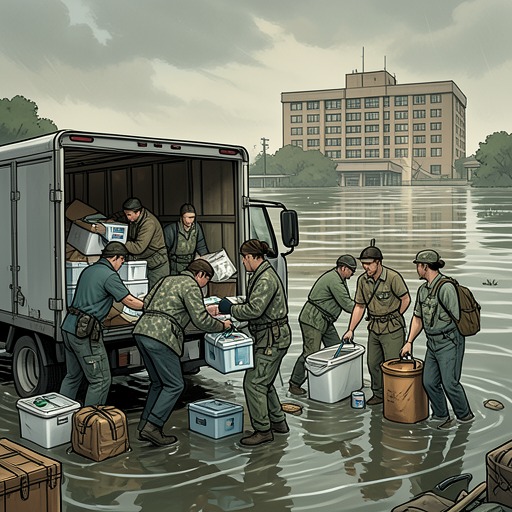
Scott’s experience belongs to the wider breakdown at Memorial, where nearly two hundred patients needed safety and staff were working amid heat, crowding, and limited means of transport. An earlier command-room decision had placed patients with Do Not Resuscitate orders last, a separate policy from the decision about Scott, which was tied to the fear that his body would impede passage through the evacuation route. The distinct reasons matter: both policies could leave vulnerable patients waiting, but Scott’s story shows how the mechanics of moving bodies through a building could themselves determine who was deferred.
Mistaken for Dead
In the hospital’s crowded second-floor staging area, cots and stretchers covered almost every inch of floor space. Patients lay in the heat while workers tried to care for them and organize the next steps. Ewing Cook approached Scott, who was motionless on a stretcher and covered in sweat, and thought he was dead. Cook touched him to check. Scott turned over and answered, “I’m OK, Doc,” then told him, “Go take care of somebody else.”
The exchange reverses the apparent arrangement of care. Cook, a physician moving among patients in a desperate environment, had to establish whether Scott was alive; Scott, despite his own vulnerability, responded by directing the doctor toward someone else. His words are not evidence that he had been safely assessed or did not need rescue. They make visible instead the compressed conditions in which even a living patient could be mistaken for a corpse.
That moment occurred against the background of Cook’s despair about the number of patients awaiting help. Cook had thought the choices were to abandon patients or quicken their deaths, and later said that he and John Kokemor had discussed euthanasia. Cook recalled that they did not act because there were too many witnesses; Kokemor remembered the conversation differently and said he had not been involved in hospital decision-making. Scott’s brief reply does not resolve that dispute or establish what Cook intended toward him. Its force lies in the contrast between the proposal to give up on patients and the living man on the stretcher, still capable of speaking and asking the physician to help others.
Scott later faced the fear created by his delayed evacuation directly. A nurse supervisor was called to him as he waited among patients and asked, “Am I going to make it out?” He had heard that his size might prevent rescuers from getting him through. The supervisor answered, “We’re going to get you out, just like everyone else.” She had not realized that patients feared they might be abandoned. His question makes the uncertainty of triage personal: what staff could regard as a difficult transport decision could sound to the patient like the possibility that no one would come.
The Final Lift
At about nine in the evening, Scott was hoisted up the open metal steps to the helipad. The route to rescue required a chain of improvised physical transfers. Eighteen people, many of them women, helped slide him through a machine-room wall, while six more received him on the garage side, discussed his oxygen needs, and loaded him into the back of a Ford F-150 pickup truck for the ride to the top. Scott was apprehensive about being carried through the narrow passage by inexperienced volunteers, but relieved to be outside the hospital’s dark, airless interior.
On the helipad, four men surrounded his wheelchair and shouted, “Push! Push!” as they rolled it into a Coast Guard helicopter. In the effort, an ICU nurse was pinned against the aircraft by the wheelchair; the others did not hear him call for them to stop. The nurse collapsed and appeared to have trouble breathing. Workers considered evacuating him instead, while Roy Culotta examined him and another helicopter prepared to carry him with a doctor ready to insert a chest tube if necessary. As this plan was being worked out, the helicopter carrying Scott lifted away.
Scott was alive when he left. His size had led to his being designated last through the wall, and Cook had mistaken him for dead the day before; nevertheless, he was successfully airlifted. He was the last living patient to leave Memorial. The rescue was not a clean passage from danger to safety, but it did overturn the expectation that his body made evacuation impracticable. Getting him out required volunteers to make the route work, carry him, and load him aboard despite the strain and risk.
Aftermath and Meaning
The flight did not bring Scott immediately to a place where he received sustained care. The next morning, Karen Wynn saw him in a wheelchair on the concourse at the New Orleans airport, shivering in a paper gown and without anyone attending to him. Many of the patients moved in Memorial’s final push had not traveled far after leaving the hospital. Scott had hit his head in the helicopter and was left at the airport for two days, in pain and in his own feces. The rescue from the building had saved his life, but the conditions of displacement continued to expose him to indignity and neglect.
The experience stayed with him the next time he had to enter a hospital: he refused to take off his street clothes. His continuing medical problems limited how much he could get around, placing him, as the narrative puts it, among people with disabilities. Even so, he did not regard survival as a mistake or an intolerable cost. He believed it had been worth enduring the suffering to live and reunite with his family.
Scott did not claim to know whether euthanasia had occurred at Memorial. Instead, he questioned how doctors and nurses could decide that it was better than evacuation when patients still had vital signs. He argued, “How can you say euthanasia is better than evacuation? If they had vital signs, you could evacuate them … get ’em out. Let God make that decision.” His position was grounded in the fact of his own survival, but it also extended beyond his individual case: if rescuers could get him out, he believed, they could get everyone out. He urged that every option be explored and put his conclusion plainly: “Every time you can save a life, save it.”