Severe dehydration among Memorial patients
Five Days at MemorialSevere dehydration among Memorial Medical Center patients emerged as a life-threatening consequence of the prolonged evacuation effort. The crisis exposed a painful mismatch between the urgent drive to move patients and the continuing care many needed to survive: patients who could not drink for themselves were losing vital fluids in the heat, while staff initially focused on stopping treatments that might slow evacuation.
Recognition of the Threat
As patients sweated and hours passed, dehydration became the most lethal danger for those unable to drink independently. The initial plan had been to discontinue treatments that could interfere with getting patients to the helipad quickly. By the time a day or two had passed, however, withholding liquids was undermining those patients’ chances of survival.
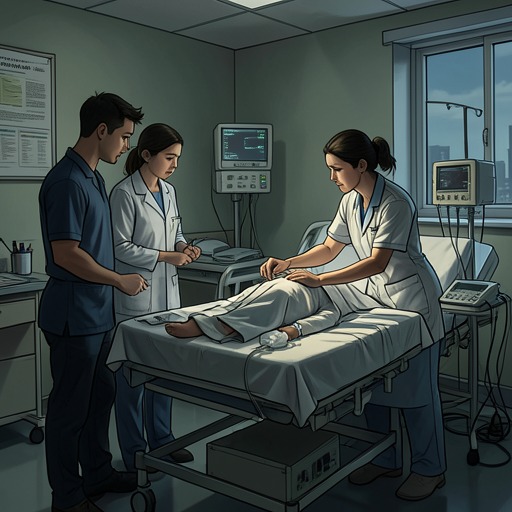
A nurse’s recognition came through an ordinary bedside detail: a colleague was giving a familiar patient fluids. The nurse realized that the team could still run an IV without an electric pump by hanging a bag above the patient and letting gravity carry fluid through suitable tubing. Exhaustion and nights without sleep had narrowed staff members’ awareness of what remained possible; the basic method made the need, and the missed opportunity, newly visible.
Essie Cavalier in the Lobby
The nurse then noticed that Essie Cavalier was not receiving IV fluids. Seventy-nine years old, Cavalier had been unable to walk or speak more than a few words since a stroke in her sixties, but she had no acute condition that meant she could not survive. She had been due to return to her nursing home after treatment for a urinary infection; the home was evacuating and could not take her back.
Cavalier was a familiar patient at Memorial Medical Center. A tall woman who had once played semiprofessional basketball, she had grown up picking cotton and sweet potatoes and had worked as a Rosie Riveter on Higgins amphibious boats during World War II. During hospital stays, difficulty communicating could frustrate some staff. She made her needs known by calling out, repeating the few words she could form, and nodding or shaking her head when she was uncomfortable or needed to be moved. In the open lobby, those outbursts unsettled people around her.
After Cavalier was carried downstairs, Anna Pou ordered medicine to relax her, and a nurse administered it. Bryant King had also done so twice, most recently early that morning. He worried that patients were becoming delirious and starting to yell, and, like Karen Wynn, believed fear could spread among those present. When the nurse saw Cavalier again, her eyes were open and she appeared calm and silent; the colleague’s shake of the head indicated that the treatment she was receiving was not fluids. The passage does not identify what she was receiving at that moment.
The Evacuation’s Aftermath
The danger did not end when patients left the hospital. The following morning, Karen Wynn flew by helicopter to the New Orleans airport and saw Rodney Scott on the concourse, in his wheelchair and a paper gown, shivering without anyone caring for him. Many of the patients evacuated from Memorial Medical Center the previous evening had not been taken far. Scott’s condition made visible how evacuation could relocate a patient without ensuring that basic needs, including warmth and ongoing attention, were met.
Heat and exertion also left an injured intensive-care nurse severely bruised and dehydrated after days spent moving patients. He was flown directly to a Baton Rouge hospital at the insistence of Roy Culotta and another doctor; a Coast Guard pilot stood ready with a knife in case one of them needed to improvise a chest-tube insertion. It proved unnecessary, and X-rays showed severe bruising to the nurse’s ribs and the area around his spleen. He remained hospitalized for three nights, receiving treatment for dehydration. The episode widened the crisis beyond patients alone: the same conditions that made fluid loss dangerous for those being evacuated also compromised the people carrying them.