Tenet Healthcare Corporation
Five Days at MemorialTenet Healthcare Corporation was the for-profit chain that owned Memorial Medical Center during Hurricane Katrina. Its role in the crisis was not simply that of an absent parent company: before the storm, its financing helped shape Memorial’s relationship with Louisiana State University, while during the disaster its distant headquarters became the focus of increasingly urgent requests for patients, supplies, and transport. The contrast between those arrangements and the company’s limited emergency infrastructure makes Tenet a central institutional presence in the book, even when frontline medical decisions remained with local staff.
Corporate Structure and Financial Pressures
Tenet’s influence at Memorial included financial arrangements that connected the hospital to Louisiana State University. When surgeon Anna Pou accepted a university faculty position in New Orleans, Memorial advanced the university more than $350,000 toward her first-year salary and expenses, to be repaid against her future earnings. In return, Pou joined Memorial’s medical staff and took emergency-room call there without additional pay. The university’s repayment obligation and the presence of university physicians also helped Memorial qualify as a teaching hospital and receive additional Medicare funds. The arrangement served a practical staffing purpose, but the account also presents it as advantageous to a profit-conscious owner: the university supplied physicians while Memorial gained the status and associated funding of a teaching hospital.
The company’s prosperity was not assured. At a January 2005 medical-staff banquet, Memorial’s doctors celebrated new facilities and favorable employee-satisfaction rankings, while Tenet faced a much more troubled corporate picture. The company owed hundreds of millions of dollars in fees and settlements connected to allegations involving fraud and unnecessary surgeries at other hospitals; it was also confronting falling stock prices, multibillion-dollar operating losses, a federal lawsuit alleging Medicare overbilling, and a shareholder class action alleging that investors had been misled. Tenet had moved its headquarters from California to Dallas as part of a shift toward the Gulf South and was selling twenty-seven hospitals that failed to meet financial goals. The banquet’s confidence and the parent company’s difficulties thus occupied the same moment, without erasing Memorial’s local investment or the optimism of its staff.
Emergency Planning and the Corporate Response
Before the flood crisis, Memorial’s chief executive, René Goux, asked community-relations manager Sandra Cordray to relay concerns to executives in Dallas. The immediate issues were patient care if floodwaters rose and power continued to fail; evacuation was being considered as an option, not yet treated as inevitable. As conditions worsened, Cordray’s messages, with Memorial chief operating officer Sean Fowler assisting, pressed the headquarters for evacuation, medicines, blood products, water, food, and information about air and ground transport. The requests became more urgent as the hospital needed patients moved and basic supplies delivered.
The corporate response exposed a gap between responsibility and readiness. Tenet executive Michael Arvin replied that access to the city was not expected to be possible and asked whether Memorial had contacted the United States National Guard, although Cordray had already told him that Guard members were at the hospital. Arvin normally directed business development in the Gulf Coast region, not emergency management; his duties had shifted abruptly as several of Tenet’s hurricane-affected hospitals faced evacuation needs. The company had no preexisting contracts with medical-transport firms and no incident-command system for emergencies. An executive with National Guard experience, who was on vacation in Oregon, provided advice by telephone. The account does not present these failures as a single individual’s decision: it shows a corporation whose emergency responsibilities had outgrown its planning and coordination arrangements.
Tenet eventually dispatched leased helicopters on Thursday morning. They joined aircraft from the Coast Guard, Air Force, and Navy waiting for turns at Memorial’s helipad, while airboats also transported people. That eventual response matters, but it followed the hospital’s requests for help and did not eliminate the larger problem of coordination. Earlier, John Thiele had wondered why the Texas-based chain had sent no means of rescue. The contrast between the expectation that a large hospital owner could mobilize resources and the delay in doing so sharpened the staff’s sense of abandonment.
Local Decisions and the Limits of Attribution
The evacuation’s most consequential clinical policies were made within Memorial, and the book distinguishes those decisions from Tenet’s corporate response. Memorial doctors placed patients with do-not-resuscitate orders last in the evacuation sequence. That policy was not simply a corporate directive: the account describes it as a decision by the doctors, with medical chairman Richard Deichmann explaining his understanding of the orders and of which patients had least to lose. Its effects became concrete when staff moved other patients around a woman whose DNR status had stopped her transfer. Her daughter said she had not understood the order to mean that her mother would not be rescued, rescinded it, and the patient was moved toward evacuation. This episode reveals the consequences of the hospital’s triage rule; it does not establish that Tenet designed or imposed it.
Other moments likewise show local authority operating within a strained institution. When a family with young children arrived by boat, CEO Goux told them to go away. Physician Bryant King objected that the hospital had to help people, while nurse Karen Wynn judged that Memorial could take no more. The account notes that those turned away were nearly all African American, but Wynn did not perceive the refusals as racist; King was troubled by the racial dimension and advocated for the family, which was nevertheless refused. These events illuminate the pressure on Memorial’s leadership and staff rather than proving a corporate policy by Tenet.
The hospital’s deeper institutional history also predates Tenet’s ownership. Memorial had opened in 1926 as Southern Baptist Hospital, which resisted integration for decades and refused to join federal hospital programs in the mid-1960s because of their nondiscrimination requirements. That history belongs to the hospital and its former institutional identity, not to Tenet. It nevertheless places the crisis within a longer history of who could receive care at the institution and how rules governing access were contested.
Comparisons and Aftermath
The book’s comparison with public Charity Hospital makes the organizational question harder to reduce to ownership alone. Charity faced flooding, loss of power and basic services, no helipad, and an evacuation that lasted until September 2, a day after Memorial’s was completed. It had more than twice as many patients across its campuses and fewer staff per patient, yet fewer than ten patients died. Staff maintained care in patient rooms, held regular meetings, improvised morale-building activities, and used portable generators to power critical equipment. The account associates these practices with preparedness: Charity had drilled for a major hurricane and levee failure, acquired emergency equipment with federal preparedness funds, and trained security officers. At Memorial, by contrast, two similar generators were later used for lights and fans in common areas and at the helipad, while patients were ventilated by hand after the power failed. This contrast does not show that corporate ownership alone determined outcomes, but it highlights how planning, equipment, leadership, and working culture shaped what institutions could do.
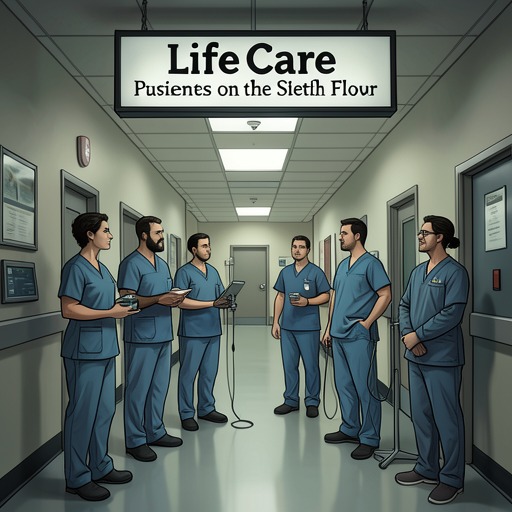
Afterward, staff carried the consequences of the crisis into interviews, legal preparation, and private life. LifeCare nurse Gina Isbell believed that her company had resources to evacuate its patients and employees, and blamed government officials for discouraging executives from sending help; this was her account of the failure, not an established finding about Tenet’s actions. She described poor sleep, nightmares about patients, guilt over staffing choices, and the loss of her home and community in St. Bernard Parish. Karen Wynn’s preparation for possible grand-jury testimony made recounting the events feel like reliving them, and she recognized lasting trauma in herself and colleagues. Thiele, too, later distinguished his own potentially reversible critical illness from the conditions of some patients he had treated at Memorial. These accounts do not assign every injury of the disaster to the corporation. They show instead how an emergency system’s shortcomings could persist in the memories and judgments of the people who had worked inside it.
Tenet’s significance therefore lies in the distance between corporate scale and practical capacity. It could finance staffing arrangements, pursue hospital sales, and benefit from a teaching-hospital relationship, yet it lacked transport contracts and an emergency command structure when multiple hospitals needed help. Memorial’s local clinicians, executives, and nurses made consequential decisions under extreme pressure, and other institutions in the book faced different conditions and prepared differently. The resulting picture is not a claim that every clinical choice originated at headquarters; it is an account of how ownership, resource coordination, institutional preparedness, and frontline responsibility met—and failed to align—during the disaster.