United States Coast Guard
Five Days at MemorialThe United States Coast Guard was a central rescue organization during the New Orleans emergency after Hurricane Katrina, flying patients from Memorial Medical Center and other locations while coordinating helicopter and boat operations amid failing communications and uncertain command. Its response brought urgent assistance to people who could not readily leave on their own, but the effort was not a single, uninterrupted operation: patients were omitted from evacuation counts, aircraft were waved away, and one helicopter departed Memorial after being told no patients remained. The account presents a service capable of improvisation under pressure, while showing how rescue depended on accurate information and cooperation at the landing site as much as on aircraft and crews.
The evacuation setting
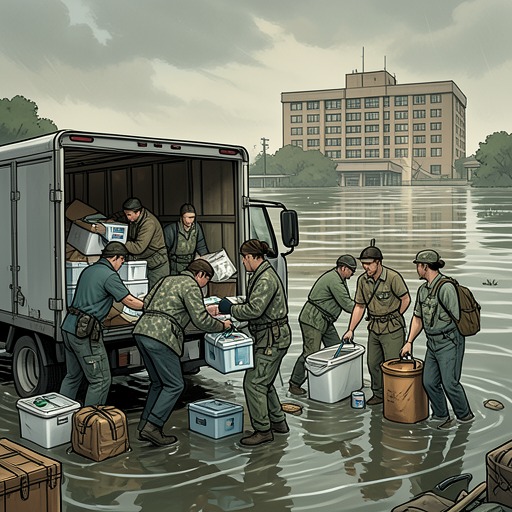
Before the storm, city officials ordered residents to leave, but many people had neither cars nor another means of escape. Transport plans had significant gaps, including too few drivers, while traffic already clogged the interstate. The New Orleans Superdome was designated a shelter of last resort, and officials specifically urged people with medical conditions to go there without explaining what help would be available. Acadian dispatchers were overwhelmed by requests to move patients from hospitals, nursing homes, and homes; some of the roughly two dozen ambulances made available were immobilized in traffic, and some began taking patients to the Superdome rather than out of the city. This broader shortage of transport shaped the setting in which the Coast Guard’s aircraft became essential to hospital evacuation.
At Memorial Medical Center, that need was intensified by a power system whose vulnerabilities had been identified before the storm. Eric Yancovich had calculated that less than four feet of water on Magnolia Street could send floodwater over the loading dock, while critical parts of the emergency power distribution system lay below ground or only a short distance above it. He warned that relatively little water could disable much of the medical center and predicted that patients might have to be moved to the newer Clara Wing. During the crisis, the hospital’s three large generators were not designed for sustained operation; one failed, engineers tried to reconnect some of its lines in a flooded basement, and the final generator died at about two in the morning on August 31. The Coast Guard’s patient flights therefore took place as the hospital’s ability to maintain ordinary care was deteriorating.
Air rescue and the first lifts
Memorial began arranging air evacuation through its helipad and Tenet’s regional contacts. Sandra Cordray reported that the helipad was operational and the hospital could receive aircraft. A Baton Rouge hospital agreed to accept Memorial’s babies, including sixteen critically ill infants, and Coast Guard helicopters were expected to carry them and several adult intensive-care patients. The National Guard separately promised to move thirty-five medical and surgical patients by high-water trucks to a Tenet hospital in Texas. These arrangements depended on several agencies and destinations, not on the Coast Guard alone.
The initial helicopter plan encountered practical obstacles before the infants could be moved. When staff brought the babies to the roof, the expected Coast Guard aircraft had not arrived. Pilots from outside the area were having trouble finding Memorial: the helipad had not been certified for years, and its old Southern Baptist markings could mislead them. Memorial later sent approach maps and coordinates. Private helicopters also landed, including one carrying delayed drug supplies, but some pilots were willing to take elderly patients and not neonates, whose specialized needs made transport more demanding.
The helipad became a crowded and poorly controlled working space. Remaining neonatal intensive-care nurses waved down passing aircraft, while staff and other onlookers gathered to watch. An Acadian coordinator, traveling between hospitals with small medical helicopters to evacuate critical patients, found Memorial less organized than other sites. A cooler of sandwiches intended for flight crews was quickly emptied by hospital staff and people on the tarmac. In another encounter, a disagreement over how many patients could fit aboard a Coast Guard helicopter ended with the pilot flying away to rescue people elsewhere. A nurse who was also an Air Force captain then offered her flight-line experience. Richard Deichmann put her in charge; she cleared the landing area, sent people to a wind-protection tunnel, and moved rooftop spectators so pilots could continue landing.
The infant evacuation also required staff to insist on a suitable destination. When a pilot’s proposed flight did not provide the intended route to Baton Rouge, the nursing director responsible for the neonates told Deichmann by radio that she would remove the babies from the helicopter unless the pilot found a way to fly there. Approval for the Baton Rouge flight followed within minutes. The episode showed that aircraft availability alone did not settle how a medically complex transfer should proceed: the destination and the receiving care arrangements mattered too.
A disputed overnight opportunity
The Coast Guard’s coordination with Memorial was further complicated by the patient count. Susan Mulderick requested transport for two hundred people through an air-evacuation coordinator at the Coast Guard emergency command center in Alexandria, Louisiana. Memorial’s representative assumed that LifeCare patients were included, but they were not. A message sent to colleagues in Shreveport emphasized that the LifeCare patients had not been counted. The omission left patients in a hospital unit sharing the site outside the number on which the request had been based.
Before eleven at night, the Coast Guard offered to continue sending helicopters and boats, with as many as five helicopters in a renewed attempt to evacuate all patients that evening. Paul Primeaux, the only clinical employee in Memorial’s command center at the time, supported continuing and carried the offer to the helipad. The aircraft that arrived around eleven was a Coast Guard Jayhawk helicopter, redirected to Memorial by a C-130 relaying search-and-rescue requests from the air. Its crew had been assigned to begin evacuating the remaining patients. Instead, someone on the helipad said no patients still needed to leave and that the Coast Guard should return after daylight. The crew relayed that message, received permission to fly to Tulane Hospital with the Acadian coordinator and medical equipment, and departed without evacuating Memorial patients on that flight.
Accounts of the decision differ in an important respect. Primeaux later recalled carrying the Coast Guard’s offer to Deichmann and said Deichmann did not consider continuing the evacuation advisable. Deichmann did not remember the exchange with Primeaux, although in his memoir he described making the same decision later in the night. The disagreement in recollection does not change the operational consequence: the helicopter that had been sent to begin the remaining evacuation left Memorial, and another effort to reach the hospital followed hours later.
Return to Memorial and patient transfers
At the Coast Guard emergency command center in Alexandria, Lieutenant Shelley Decker had been trying to get aircraft back to Memorial for LifeCare patients who depended on ventilators. She learned that at least three helicopters had reached the hospital and been waved away. She pressed a contact at the air station to send them back. Michael Richard, a member of the Coast Guard Auxiliary beside her, spoke by cell phone with a nurse leader on the helipad. The nurse appeared to be waving her arms in a way that she understood as signaling pilots but that could instead send them away; Richard told her to stand clear when the helicopters arrived.
The Jayhawk that had carried the Acadian coordinator to Tulane was redirected by the C-130 to Memorial to rescue critically ill LifeCare patients. In the intervening hours, its crew had rescued people from flooded rooftops and delivered them to a highway interchange west of New Orleans. The rescue swimmer also saw thousands of people camped beside the highway amid refuse, with no buses in sight. At Memorial, a doctor threatened to leave a patient unattended on the helipad if she could not board. The crew arranged to fly her and a LifeCare nurse to the Coast Guard New Orleans Air Station, battered by the hurricane, for transfer to another aircraft. They departed Memorial at 5:15 in the morning.
The swimmer’s later landing at Memorial required a different approach from the rooftop rescues. The LifeCare patients were too fragile and required too much equipment to be placed in the litter used to hoist people from rooftops. The Jayhawk remained aloft while the swimmer descended onto the helipad; the flight mechanic lay on the deck to help the pilot judge a light landing and maintain lift on the rotors. After the aircraft landed, staff rushed two patients aboard, and the swimmer rearranged troop seats to make room. He left bottled water and ready-to-eat meals for hospital personnel, a small but concrete provision for staff working through the emergency. In another transfer, four men pushed Rodney Scott’s heavy wheelchair into a Coast Guard helicopter. One male intensive-care nurse collapsed after being pinned against the aircraft by the chair; another helicopter hovered overhead and could take the injured nurse, accompanied by Roy Culotta, who was prepared to insert a chest tube during flight if necessary.
Initiative, limits, and institutional significance
The Coast Guard’s response did not proceed through a fully functioning chain of command. A lieutenant later told Mulderick that colleagues had struggled to connect Memorial staff with state emergency officials and had difficulty reaching people at the hospital. The overnight operation drew criticism from at least one Coast Guard commander because junior officers and the local sector had responded directly to Memorial, taking initiative without answers from higher officials or the state Emergency Operations Center. Those direct actions helped make rescue possible, but they also exposed tensions over who had authority to coordinate it.
The account sets that initiative against the uneven organization at Memorial and the wider transport crisis. A contemporaneous operational note recorded Coast Guard shuttling by three HH-65 aircraft, with five lifts moving ambulances, children, and women to a ground site near the Superdome, roughly five or six passengers per lift; another note described lifts about every fifteen minutes at that capacity. This activity connected air rescue to ground transport and to the Superdome rather than treating evacuation as a simple flight from danger to safety.
The Coast Guard’s actions therefore appear in two registers: as repeated, sometimes hazardous rescues of patients and civilians, and as a test of information-sharing among rescuers, hospital staff, and public authorities. Memorial’s difficulty was not just finding aircraft; pilots needed usable location guidance, crews needed accurate patient counts and landing signals, and patients’ specialized needs shaped whether and where they could be carried. Later accounts also noted that nighttime rescue flights after Katrina were extensive and conducted at considerable risk. The hospital evacuation was thus neither a seamless institutional success nor a story of absent help: it was a shifting operation in which individual Coast Guard personnel repeatedly acted, while fragmented communication and decisions on the ground altered who could be reached and when.