Utilitarianism
Five Days at MemorialUtilitarianism is the ethical approach of judging choices by their consequences and seeking the greatest net good for the greatest number. In the book, that goal offers an urgent rationale for allocating scarce help during a disaster, but it does not settle what “good” means, whose interests count, or who should decide. Memorial Medical Center’s evacuation turns the abstraction into a life-and-death problem: the effort to save as many people as possible could coexist with rules that delayed rescue for patients whose vulnerability made them especially dependent on others.
Definition and Moral Arithmetic
The account traces utilitarianism to the philosophy developed by Jeremy Bentham and John Stuart Mill in the eighteenth and nineteenth centuries. Its population-level aim is to maximize net good. In disaster medicine, however, even agreement on that aim leaves its measure unsettled. Should a decision maximize the number of lives saved, the years of life saved, the quality of those years, or some other good? The answer matters because different measures can favor different patients and different distributions of limited assistance.
Anna Pou later described disaster medicine as aiming for “the greatest good for the greatest number of people.” The phrase also has a civic precedent in New Orleans: in the 1920s, George G. Earl used the same formulation when deciding which parts of the city to protect from flooding with a limited budget. In both settings, scarcity makes selection unavoidable; the formula makes the selection sound collective and rational, but it does not make its costs disappear for those left with less protection.
Competing Principles of Triage
The book sets utilitarian calculation against approaches that give priority to need rather than aggregate benefit. A justice-based approach gives the strongest claim to aid to people in the most imminent danger of dying without it, even if treating them inconveniences a larger number of less urgent patients. This principle resembles ordinary American emergency-room triage outside disasters. It shifts the question from how many people might benefit to who most needs help now.
Other philosophers argue for random allocation of potentially lifesaving resources. They contend that everyone deserves an equal chance and that it is dangerous to give any group the power to assign who lives and who dies. John M. Taurek’s influential argument rejects the assumption that one person’s suffering can simply be added to another’s: many people with lesser pain do not, by arithmetic alone, equal one person with greater pain. This challenge does not provide an easy operational rule for a crowded hospital, but it identifies what utilitarian accounting can obscure: suffering belongs to individuals, not to a collective total experienced by nobody.
Scarcity Inside Memorial Medical Center
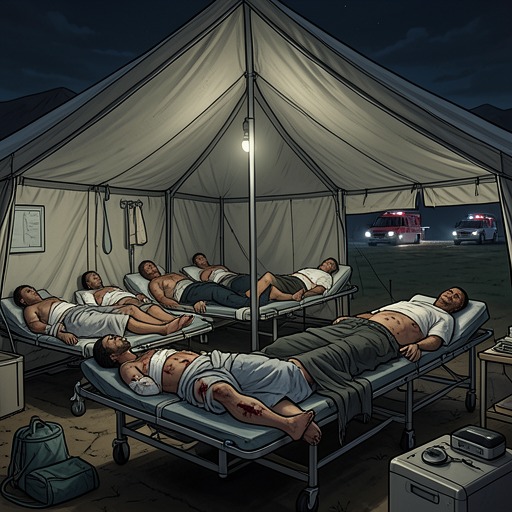
When Susan Mulderick announced that floodwaters were approaching Memorial, the command room’s task became immediate: move nearly two hundred patients to safety before power failed. The initial proposal was to evacuate first those most dependent on life support or mechanical assistance, including intensive-care patients, newborns, high-risk pregnant patients, dialysis patients, and two vulnerable bone-marrow-transplant patients. That ordering treated medical need and dependence as urgent claims on rescue.
The doctors then made an exception: patients with Do Not Resuscitate orders would be evacuated last. Richard Deichmann explained that he thought such patients had certified terminal or irreversible conditions and therefore had the least to lose if disaster struck. But a Do Not Resuscitate order meant that a patient whose breathing or heartbeat stopped should not be revived; it did not mean that the patient had consented to forgo rescue. At Memorial, a category intended to guide resuscitation was made to determine evacuation priority, turning a limited medical instruction into a judgment about comparative claims to survival.
That distinction became concrete when a ninety-three-year-old patient’s daughter learned that her mother’s DNR status was keeping her from being evacuated. She asked for the order to be canceled, explaining that she had not understood it to mean “do not rescue.” Staff found a doctor to remove the order, and the patient was moved toward the helipad. At LifeCare Hospital, Angela McManus likewise tried to rescind the order for her mother, Wilda, but was told that no doctor was available. These episodes show that a rule framed as collective prioritization could leave patients and families without meaningful information or a timely way to challenge how the rule was applied.
Who Decides, and What Counts as Fairness
The organ-transplant debate offers a comparison outside the immediate disaster. The United Network for Organ Sharing invited doctors and members of the public to help design allocation policies through an ethics committee. According to medical ethicist Robert M. Veatch, members of the public generally favored giving organs to people in the direst need, even when those patients were less likely to survive or lived farther from the available organs. Medical professionals more often favored directing organs to those most likely to benefit, accepting that many of the sickest patients might die without transplants. Such systems could also disadvantage ethnic groups with greater need or lower donation rates, and people whose outcomes were poorer, including some lower-socioeconomic-status kidney patients; newer antirejection drugs mitigated one part of this problem.
No allocation method could command universal agreement, but the process could be made more just. Including both clinicians and laypeople produced policies that combined justice with efficiency. The contrast matters at Memorial, where only medical professionals participated in categorizing patients and no system was established to explain the decisions to the people most affected. In some cases, staff were actively instructed not to disclose why a patient was being left behind. Allocation is therefore not only a question of which outcome is most beneficial; it is also a question of who holds authority, who receives an explanation, and whether those subject to a decision can contest it.
Limits of Aggregate Outcomes
The account’s comparison with Charity Hospital complicates any simple claim that maximizing numbers dictates one inevitable course. Charity had flooded, lost power and basic services, lacked a helipad and corporate assistance, and took until September 2 to transfer its patients—one day later than Memorial. It had approximately twice as many patients across its two campuses and fewer staff relative to patients, yet fewer than ten patients died. Staff described continuing care in patients’ rooms amid severe danger, and they held meetings every four hours, staged a talent show by flashlight, and painted and laughed. Those facts do not establish a controlled comparison or prove that one ethical formula caused the difference. They do show that outcomes and practices cannot be read off a maximizing slogan alone.
Across these examples, utilitarianism remains a compelling response to genuine scarcity, but its arithmetic is not self-interpreting. A decision can claim to serve the greatest number while embedding disputed assumptions about need, prognosis, quality of life, and the value of rescue. The book’s emphasis on public participation, patient understanding, and the treatment of those most at risk does not erase the necessity of hard choices. It makes visible the moral and institutional choices concealed inside them.