Vera LeBlanc
Five Days at MemorialVera LeBlanc’s ordeal at LifeCare Hospitals, inside Memorial Medical Center, shows how an evacuation category could obscure the person it was meant to describe. At eighty-two, she was among the patients left waiting in a hot hospital as rescue efforts faltered. Her family found her alive, thirsty, and eager to leave. Although her longstanding Do-not-resuscitate status helped place her far back in the evacuation line, it had not been a recent request to stop caring for her. Mark and Sandra LeBlanc eventually carried her out themselves, turning a stalled institutional rescue into a family-led escape by airboat.
Patient and Family
Vera was an eighty-two-year-old LifeCare patient and the mother of Mark LeBlanc. Sandra LeBlanc was her daughter-in-law and a paramedic. The available account identifies no diagnosis for Vera or explanation of why she had been hospitalized; it instead follows what happened to her as the hospital lost normal services and its evacuation became uncertain.
Before Mark reached the hospital, a sitter assigned to Vera called Sandra by cell phone in the early hours of Wednesday. The sitter described a crisis on the floor: nurses were becoming alarmed, people were dying, and there was nowhere to put them. Sandra, who was outside the city, said she was trying to get back to the hospital. The call brought the family’s private concern into the wider rescue effort: Sandra asked a state EMS worker to radio the command center so officials would hear the sitter’s appeal and pay closer attention to the people at Memorial.
The state’s initial logs had identified Memorial as a high-priority evacuation mission. But after rescue arrangements broke down, Sandra was told that the hospital had become a second priority. She was directed to go out with boats at sunrise, help find a launch point, and do what she could to empty the hospital. The shift left Vera’s family trying to help organize the very rescue on which Vera depended.
Finding Vera at LifeCare
On Wednesday morning, Mark and Sandra drove to a parking lot near the floodwaters, met airboat volunteers, and helped identify a route to Memorial. They explained where the boats could be launched and how the route led toward the hospital. When the boats reached the hospital, Mark borrowed a flashlight and climbed seven flights of stairs to LifeCare. The heat and stillness struck him first. He found nursing assistants at a desk and patients lying nearly uncovered; Vera was on a wet bed, covered in sweat.
Vera greeted her son with a smile and calmly told him she was in a mess. Mark was angered by what he saw and left to bring Sandra to the floor. The couple then met Diane Robichaux, the visibly pregnant senior leader there. Robichaux said she had little information and no way to contact the corporate office for ambulances. Mark and Sandra offered to arrange transport using their working cell phone. When they called an ambulance company and put Robichaux on the line, the company asked for an exact address for the boat drop-off. The absence of that detail left another link in the rescue chain unresolved.
DNR Status and the Waiting Line
By late afternoon, only a few patients had left Memorial. Helicopters had landed rarely, and ambulances had not arrived at the airboat drop-off. Sandra found Mark caring for Vera in the second-floor lobby and was surprised that his mother had not already been rescued. Vera had been placed far from the head of the line. Her hospital gown bore family names and telephone numbers that Mark and Sandra had written on it after being told she would leave by helicopter, but she was still beside an ATM and a planter of green-striped leaves.
Vera and the patients around her had Do-not-resuscitate status. In her case, the order reflected a request made more than a decade earlier: if her heart stopped, it should not be restarted. It was not a recent wish from a dying patient, and her heart was still beating. The distinction is crucial to the scene. A preexisting limit on resuscitation had become part of an evacuation sorting system, even though Vera was conscious, able to communicate, and asking for help. The text does not say that the order itself formally determined her place in line, but it makes clear that she had been placed among patients scheduled to leave late.
Water, Resistance, and Escape
The LeBlancs saw patients lying cot to cot, partly uncovered; most were very quiet. Vera was not. She demanded water. Mark found a five-gallon jug of Kentwood water that he thought belonged to hospital staff and filled a cup for her. He knew she had difficulty swallowing and might choke, but decided that keeping her hydrated mattered more. Vera said the water tasted good and asked for more. A doctor called for a nurse to give her medicine to quiet her, but no nurse came.
The family weighed what to do as the boats ran low on fuel and their pilots heard reports of shooting at rescuers. The volunteers were not planning to return the following day, although hundreds of people remained at Memorial. Sandra had also been told that no more helicopters would come that day. With another night in the hospital seeming worse than the uncertain alternative, Mark and Sandra decided to carry Vera downstairs and put her on an airboat.
Their attempt met resistance. As they lifted Vera’s cot, it bent in the middle and began to fold around her, forcing them to adjust their grip. Several doctors told them they could not take her. Sandra insisted that they would take her and told the doctors either to help or to move aside. She later considered the contradiction: staff appeared to protect Vera from being taken even though, in her view, they had decided there was little more they could do for her. The scene leaves the conflict unresolved as a question of professional protection, control of the evacuation line, or both; what is clear is that the family continued.
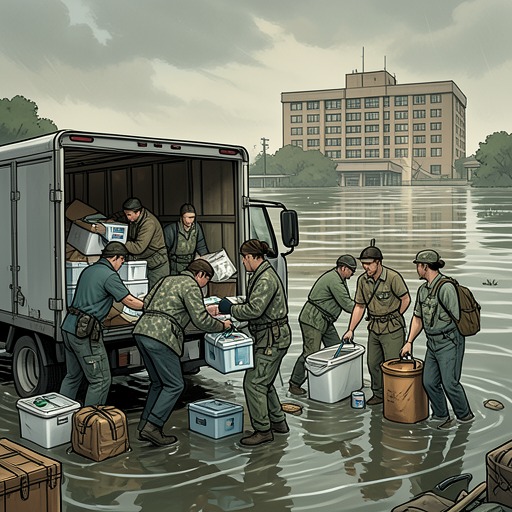
With help from two volunteers, Mark and Sandra carried Vera down to the ambulance ramp. Hospital workers had removed a pane of Plexiglas to make an opening. They lifted her over the edge, fitted her with earmuffs, and placed her aboard. Vera announced that she was on a boat, a striking contrast to her earlier position on a wet bed, waiting among patients far from rescue. Before leaving, Sandra turned back and helped a hospital security guard onto the boat as well.
Significance and Limits of the Account
Vera’s escape depended on more than the arrival of boats. The LeBlancs helped find a route, brought the boats to Memorial, tried to arrange ambulances, challenged a barrier to patient access, and finally carried her themselves. Their efforts expose the distance between a hospital’s stated evacuation process and what happened to an individual patient when helicopters and ground transport failed to arrive as expected.
The account ends with Vera’s removal from Memorial; it does not report where she was taken afterward or what became of her. Her final scene is therefore not a recorded recovery but a change in circumstance: from a patient waiting in a hot hospital, thirsty and assigned a late place in the evacuation, to a passenger carried out by family members who refused to leave her there.