Wilda McManus
Five Days at MemorialWilda McManus’s story at LifeCare is one of a patient whose need for care was unmistakable but whose DNR status helped determine that she would wait for rescue. Her daughter Angela stayed beside her, advocating for her and providing intimate care as conditions deteriorated. When Angela was made to leave, Wilda was given Ativan, a drug she had previously reacted to badly. Her later death became part of the investigation into deaths at Memorial Medical Center, where a forensic reviewer classified her death as homicide.
Identity and Life Before the Storm
Before Hurricane Katrina, Wilda had worked for years as the patient information manager at Charity Hospital. She occupied a role at the public entrance to care: visitors saw her first as they passed through the hospital’s Art Deco entrance and its ornate metallic screen. The account remembers her not simply as a patient but as someone who had spent her working life helping other people navigate a hospital.
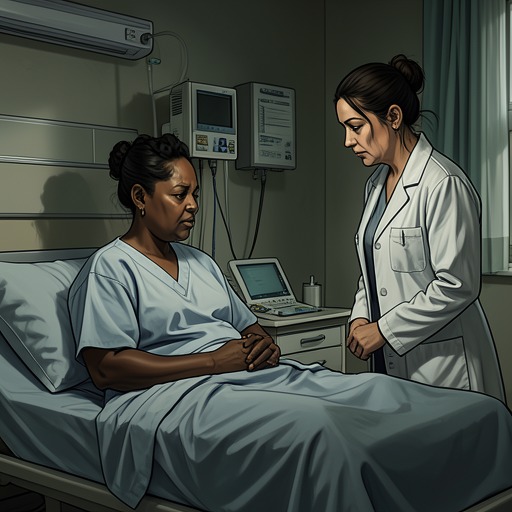
A stroke and the effects of some medicines made it difficult for Wilda to make herself understood. She could still smile sweetly, but her impaired communication meant her daughter often had to speak and act for her. Angela had quit her job and spent more than a year as Wilda’s caregiver. The note in Wilda’s admission paperwork, “daughter stays with patient at all times,” formalized a relationship that was already central to her daily care: Angela accompanied her, interpreted her needs, and worked to protect her dignity.
The account’s description of Wilda is concrete about dependency without reducing her to it. At LifeCare, Angela fed her through a tube, changed the colostomy bag that collected her feces, and tended to her skin and wound. Wilda’s fever broke, leaving sweat and wound discharge on her body; with no running water available, even cleaning her required hours of effort and help from a nurse. Her care depended on supplies, staff, and Angela’s continuing presence—resources that became increasingly difficult to obtain as the hospital’s conditions worsened.
DNR Status and the Deferred Evacuation
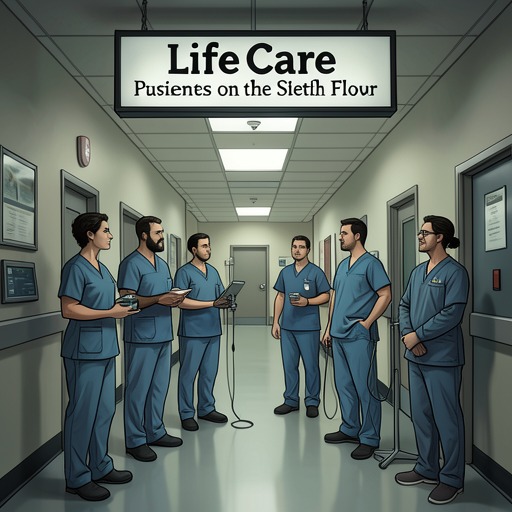
Wilda had a DNR order, and during the evacuation crisis DNR patients were placed last. On LifeCare’s seventh floor, Angela overheard staff discussing the decision and begged to rescind the order. She was told that no doctor was available to do so. Doctors in a second-floor staging area then instructed LifeCare staff to stop sending patients down because there was no more room. Wilda remained upstairs, not because Angela had stopped seeking help, but because the evacuation process had categorized her and then halted the movement of patients.
The distinction between refusing resuscitation and being left without rescue becomes central to Wilda’s account. The book describes Angela as expecting that her mother would soon be evacuated, while the DNR designation instead put her among those whose transfer was deferred. Throughout Wednesday, Angela watched other LifeCare patients wrapped in sheets and carried into stairwells ahead of her mother. Nurses returned crying after some patients died in transit. Each departure gave the impression that evacuation was continuing, yet Wilda remained in place.
A chart note recorded that Wilda was “en route” “to the heliport.” The phrase suggests a transfer in progress, but the book stresses the gap between that entry and what happened: Wilda never made it off the floor. Angela remained beside her, asking in vain for a doctor to rescind the DNR order. When staff later told Angela that the remaining patients would soon be on their way and that she should leave by boat, she asked where Wilda would be taken. The nurse executive Therese Mendez could not tell her. They tried to write Angela’s contact information on Wilda’s skin, but it was too wet, so they wrote it on gauze and wrapped it around Wilda’s right arm and right leg below her gown: “DAUGHTER—ANGELA MCMANUS, ASAP.” The improvised labels made Angela’s role visible even as the evacuation separated them.
Angela’s Care and Separation
Angela’s advocacy extended well beyond asking for a change to the DNR order. Exhausted, dizzy, and anxious about a sibling living near the levees, she continued to feed and clean her mother, replace the colostomy bag, and seek assistance with wound care. For hours she tried to recruit a nurse to help wipe Wilda down with alcohol, dry her, and change her dressing. In the meantime, Angela talked, sang, and prayed with her.
Prayer was part of their shared routine and part of Wilda’s history at LifeCare. She had been fond of reciting the Lord’s Prayer and the Twenty-Third and Ninety-First Psalms. Before the storm, staff members bowed their heads while she prayed in gatherings they called “church.” During the crisis, Angela continued that familiar practice, speaking and singing to her mother amid shortages and uncertainty. Her caregiving was physical and devotional at once: she managed bodily needs while trying to keep Wilda company and reassure her.
Angela took hope from staff members lamenting that they could not leave until every patient was gone; she understood this to mean that no patients would be left behind. Instead, she was ordered to leave Wilda. Later, men who looked like police and held sawed-off shotguns demanded that Angela leave her mother’s bedside. When she returned to the seventh floor, she found Wilda in the hallway by the nursing station, receiving a cooling alcohol rubdown. Angela asked why her mother was so lethargic and was told that patients had been given Ativan. She warned the staff that Wilda could not take it. This time, however, the drug appeared to calm rather than agitate her.
Ativan, the Final Encounter, and Death
Just before midnight, a nurse pushed Ativan through a syringe into Wilda’s IV line. The drug was not part of her usual medication, and Angela had ensured that it was avoided because Wilda had previously become more agitated, not calmer, after taking it. The chart recorded that 2 mg of Ativan had been given intravenously for anxiety and yelling out. Angela was not at Wilda’s side when it was administered and could not warn the nurse about the earlier reaction.
The narrative sets the medication against the loss of Angela’s presence. Even if Ativan calmed Wilda, it could not provide the comfort and reassurance of her daughter, who had been told to leave. When Angela returned, Wilda did not awaken as Angela expected. She was alarmed by her mother’s lethargy and wondered whether Ativan was responsible. The account does not establish, in that moment, what caused Wilda’s condition; it preserves Angela’s observation and uncertainty rather than converting them into a settled medical explanation.
Wilda eventually asked what was happening. Unable to sit up, she raised herself a little, looked intently at Angela, and screamed. Her words were, “I’m going home.” She then asked her daughter to sing. Angela sang “Near the Cross,” the gospel song she had sung before, and Wilda shut her eyes. The scene returns to the closeness of their earlier routines, but under radically altered conditions: Angela could sing and remain with her mother in that moment, after having been ordered away and after Wilda had received a drug she was known to tolerate poorly.
Investigation and Narrative Significance
After the evacuation, Angela was among the family members eager to assist investigators. When she later spoke publicly about Wilda, she did not claim certainty about the cause of death. She said she thought her mother might have died from infection, but did not know; hearing the word euthanasia left her unsure where to turn. Her uncertainty is an important part of the account: the circumstances raised questions that the family could not answer from what they had witnessed.
The investigation placed Wilda among the seventh-floor patients whose deaths were reviewed by forensic pathologist Cyril Wecht. He classified her death as homicide, as he did the deaths of seven of the other eight seventh-floor patients he reviewed; Michael Baden considered all nine homicides. These were forensic judgments within a contested investigation, not a resolution of every question about Wilda’s individual medical course. Separately, toxicology discussions reported results across groups of patients; those aggregate figures do not by themselves establish a specific result for Wilda.
Wilda’s account connects several different failures of care without making them interchangeable. Her DNR status affected evacuation priority; a lack of space stopped patients from being sent down; Angela’s removal interrupted the patient’s strongest advocate; and a medication with a documented history of causing Wilda a bad reaction was administered in her absence. The chart’s “en route” notation sits beside the gauze bearing Angela’s phone number, one indicating transfer and the other trying to preserve contact when transfer remained uncertain. Together, those details make Wilda’s story a record of how a patient could remain surrounded by people and medical procedures yet still lose access to rescue, advocacy, and the familiar care her daughter had provided.