Al Qa'im civilian casualty incident
Fool Me OnceThe Al Qa'im civilian casualty incident is both a battlefield strike and a delayed moral revelation. What first appears to be an authorized attack that saves two soldiers is later exposed as Maya Stern’s deliberate decision to fire despite an order to hold off and uncertainty that the SUV’s occupants were combatants. The strike leaves five noncombatants dead, and its deepest consequence for Maya is not simply remorse for those deaths: it is her recognition that, given the same choice again, she would act the same way.
The rescue mission and the strike
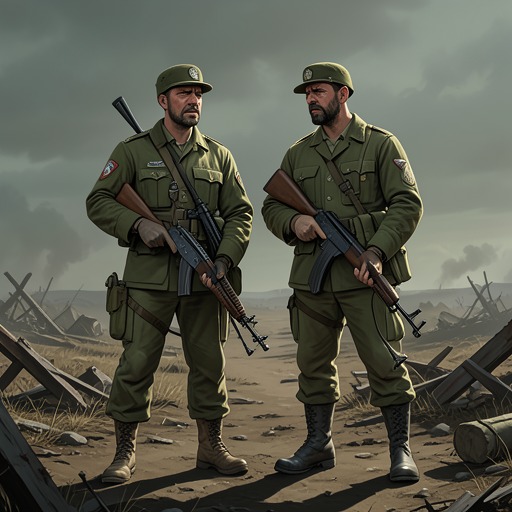
The operation began after an ambush in Al Qa'im, near the Syrian-Iraqi border. Four soldiers had already been killed, including three whom Maya knew and loved. Two others were still alive, pinned down by enemy fire, while a black SUV moved toward them. Maya and Shane were flying a Boeing MH-6 Little Bird light helicopter gunship at full speed. They could hear the survivors’ terrified calls for help, and Maya understood that the dead soldiers, too, would have sounded young and frightened.
Once the helicopter crew had the target in view, Maya and Shane waited for confirmation from Joint Operations Command at Al Asad. The radio signal kept cutting in and out. The survivors’ calls, by contrast, came through clearly; the two pilots heard them scream while they were still demanding a reply from command. Maya then fired an AGM-114 Hellfire missile at the SUV. It exploded high into the air, and infantry moved in to reach the soldiers. Both had been hit, but both survived.
At the time, Maya experienced the action as righteous: the strike appeared to answer an immediate plea for help and prevent the deaths of the two remaining soldiers. A video of the operation was later leaked to Corey Rudzinski. Maya retrieves it from his site even though versions are readily available on YouTube, feeling that it matters to obtain the footage from its source. The choice places the incident in public view before its decisive hidden fact has been fully confronted.
The civilian deaths and the account Maya repeats
In a later conversation with Ricky Wu, Maya recounts the familiar sequence in clipped terms: the distress call, the cornered soldiers, her flight in, and her firing. She tries to move past the moment of impact, but Ricky points out that she always stops there. Five noncombatants were killed. One was a mother of two, a description Maya resists—not because the deaths are in dispute, but because she objects to the way the victims are framed. A civilian is a civilian, she argues; calling one a mother and a woman makes her death sound more significant than the deaths of men who were also fathers.
Ricky interprets Maya’s anger at that language as a way of avoiding the truth. He calls the strike a mistake and connects her guilt to the auditory flashbacks that sometimes return. Maya rejects his account. The disagreement separates the visible symptom from the wound’s actual source: Ricky sees guilt over the dead civilians, while Maya has not yet disclosed what she chose or what, precisely, continues to haunt her.
The order she concealed
When Maya finally explains the radio exchange to Shane, the apparent authorization collapses. Joint Operations Command had radioed them to hold off. Command believed at least one person in the SUV was a civilian, possibly underage, and assessed the chance that the people inside were the enemy as only about fifty-fifty. The instruction was not confirmation to fire; it was a warning against proceeding while the target’s identity remained uncertain.
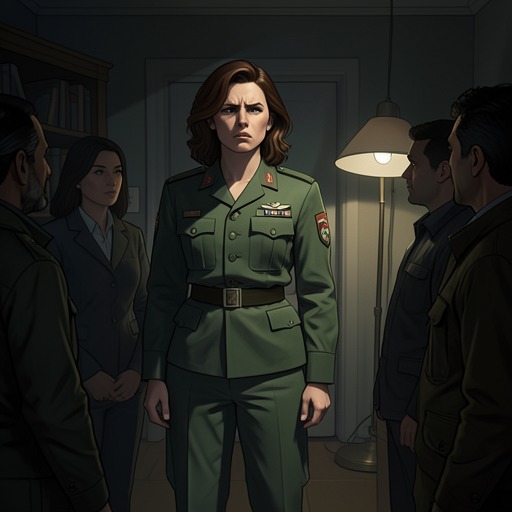
Maya tells Shane that they never received authorization and admits that she turned his signal off. When he insists that he heard the order, she challenges his recollection: she had relayed the message to him. Her disclosure revises the action from a strike made after an unreliable radio delay into a choice she controlled and then misrepresented to her fellow pilot. The soldiers’ danger was real, but so was the possibility that the people in the SUV were civilians. Maya knew that uncertainty and fired anyway.
Her explanation is starkly selective. She says she did not care about the civilians; she cared about their soldiers. She had decided she would not lose another one of their own if she could prevent it, even if civilians died as collateral damage. This is not an assertion that the civilian deaths were justified by authorization or certainty. It is Maya’s account of the priority she chose under pressure—and of the fact that she would make that choice again.
The incident’s continuing consequences
That admission changes the meaning of Maya’s flashbacks. She tells Shane that the civilians’ deaths do not haunt her because she feels guilty about them. What haunts her is the knowledge that, if she were back in the helicopter, she would do exactly the same thing. The trauma lies in the persistence of her decision: she cannot reassure herself that she has become someone who would choose differently.
The event also becomes entangled with Maya’s understanding of Claire Walker’s death. Among laughing children and families on an apparently ordinary day, Maya thinks that the consequences of what she did in the helicopter over Al Qa'im began an echo that eventually reached her sister. She concludes that if she had not made those mistakes, Claire would still be there with her children, Daniel and Alexa. This is Maya’s painful attribution of responsibility, not independent proof that the strike directly caused Claire’s death. In her mind, however, the battlefield decision does not end with the explosion: its reverberation crosses into the family life she failed to protect.
The incident therefore turns on two kinds of rescue that cannot be reconciled. Maya saves the two soldiers who survive the ambush, yet the attack kills five noncombatants and is carried out against command’s hold-off instruction. The story first lets the strike appear righteous, then reveals the uncertainty and concealment beneath that appearance. Its final moral pressure comes not from a simple reversal in which Maya disowns her action, but from her refusal to claim that remorse would make her choose otherwise.