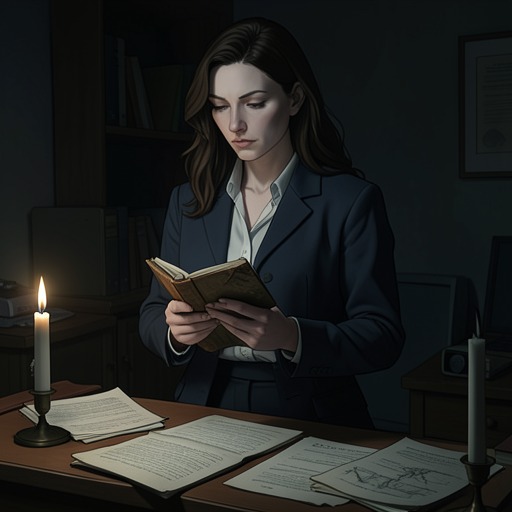
Caroline Burkett’s grief and denial
Fool Me OnceCaroline Burkett’s grief and denial turn on a stark absence: she never saw the bodies of either of her brothers, Andrew Burkett or Joe Burkett. Although she can say that Andrew died in an accident and that Joe is dead, the lack of physical confirmation leaves those facts emotionally unsettled. Her experience gives the novel’s question of what a body means a personal force: it is not only evidence of death, but something the bereaved may need in order to begin accepting it.
The Need for a Body
In conversation with Maya Stern, Caroline asks why soldiers insist on bringing their dead home. Maya answers with the principle that no one is left behind. Caroline accepts that she has heard this explanation, but presses beyond honoring the dead: she argues that the body matters to the family waiting at home, because loved ones need to see the deceased and reach closure. The exchange shifts the focus from military duty to the needs of survivors. Caroline is not discussing that need abstractly. Her question leads directly to the absence that has shaped her own mourning.
Caroline says she was young when Andrew died and that his family never showed her his body; the casket was closed. She knows that he died in an accident, yet describes an enduring uncertainty that coexists with that knowledge. In recurring daydreams, he has not died: she sees him by a soccer net, smiling and making saves. At times she imagines that he survived the fall, swam away, and lives on an island, where she might one day find him. These are not presented as a settled alternative account of what happened. They show how, without having seen his body, Caroline can acknowledge the reported death and still imagine a return that would undo it.
Andrew’s Death and the Return of the Past
Caroline explains that Andrew’s closed-casket funeral left her unable to accept his death fully. The recurring image of him at the soccer net makes her loss return in a form that preserves his familiar presence: he is not an unknown figure, but her brother as she remembers him, still smiling and making saves. The imagined island gives the hope of survival a location, though Caroline knows that hope is not the same as proof. Her account holds these incompatible positions together: she knows Andrew died, and she cannot make herself feel certain that he is gone.
When Maya and Shane Tessier later consider Caroline’s response, they connect her difficulty accepting Joe’s death to the earlier loss. They recognize that Caroline never saw either brother’s body: Andrew died at sea, and Joe was murdered, but neither death came with the visual confirmation she had wanted. Maya concludes that Caroline is struggling to accept both deaths, not only Joe’s. The parallel makes the earlier loss more than background. Andrew’s absence supplies the pattern through which the second absence is experienced, and the family’s lack of a body becomes a repeated condition rather than a single failure of farewell.
Joe’s Death and the Family’s Silence
Caroline’s grief becomes visible in conflict. Isabella has told the family that Caroline fought with her and screamed about seeing Joe. When Caroline discusses the matter with Maya, Maya insists that Joe is dead; Caroline challenges her certainty. Her question does not establish that Joe survived. Instead, it exposes how little the assertion of death can settle for someone who has not seen the body and who has already lived through a similar uncertainty over Andrew.
Caroline says she asked to see Joe’s body and begged for the chance, even if his appearance might be upsetting, because she thought seeing him could help her accept that he was gone. She says she was not allowed to see him. Later, Judith Burkett tells Maya that none of the family saw Joe. This changes the scale of the denial: Caroline’s deprivation was not, according to Judith, an exclusion that only she suffered. Yet the contrast between Caroline’s account that they would not let her see him and Judith’s claim that nobody saw him leaves the circumstances of the missing body unresolved. The novel supplies no visual confirmation to close that gap, so the family’s silence about the body remains part of the uncertainty surrounding Joe’s death.
Judith’s Explanation and Its Limits
Judith tells Maya that Caroline cannot be disturbed, is not well, and needs rest. When Maya asks what trauma Caroline has faced, Judith rejects the idea that trauma belongs only to the battlefield. She links Caroline’s difficulties to having two brothers die young and tragically, and describes how their father sheltered and overprotected Caroline rather than letting her face adversity or stand on her own. In Judith’s account, the deaths removed the strong men on whom Caroline depended, and Caroline could not accept the loss of that support system.
Judith also describes the mind as capable of producing delusions, conspiracy theories, paranoia, and visions when desire and desperation become overwhelming. This is Judith’s explanation of Caroline’s condition, not an independent diagnosis supplied by the narrative. It helps account for why the family treats Caroline as vulnerable, but it does not erase the concrete circumstances around her grief: Andrew’s body was not shown to her, she says she asked for Joe’s and did not see it, and Judith confirms that no one in the family saw Joe. Caroline’s denial therefore belongs both to her response to loss and to a family history in which the deaths could not be made tangible to those left behind.
Grief Beyond Caroline’s Story
The novel’s closing reflections extend the question of whether death is final, without reporting a change in Caroline’s state. Shane sees Lily smile with a likeness to her mother, Maya, and recalls how Maya had understood death as an ending. When Lily says that she and Shane have named a newborn Maya, Shane considers whether that earlier certainty was wrong and feels that Maya is present. This later moment offers a contrast to Caroline’s need for a body: grief can also preserve connection through resemblance, memory, and a name. It does not give Caroline the confirmation she lacked, or resolve what she believes about her brothers.
That contrast clarifies the distinct shape of Caroline’s denial. The bond she describes with Andrew returns through visions of his survival; the body she asks to see would have provided a different kind of connection, one grounded in accepting that he was dead. Joe’s unseen body repeats the wound instead of closing it. Across the two losses, Caroline’s grief holds knowledge and doubt side by side, showing how the absence of a body can leave death acknowledged in words but still difficult to accept as real.