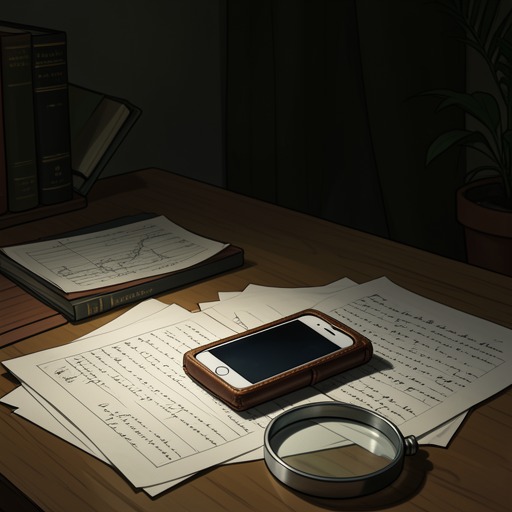
Claire Walker's hidden phone
Fool Me OnceClaire Walker's hidden phone is both a record of her secret communications and the surviving clue that gives Maya Stern a route into her sister's unfinished investigation. When Maya checks its history, the calls point to Leather and Lace; there, Corey Rudzinski confirms that Claire had been in contact with him shortly before her death and had found something potentially more consequential than drug-test tampering. The phone does not disclose what Claire discovered, but it makes her concealed work—and the silence surrounding it—impossible for Maya to ignore.
Discovery and Call History
Maya brings the phone to Leather and Lace and tells Lulu that her sister used to call the establishment. Lulu initially offers an ordinary explanation, suggesting Claire may have made table reservations. Maya rejects that suggestion. She identifies herself as Claire's sister and says Claire was murdered, then shows Lulu the phone's history: the only calls Claire made or received were connected to Leather and Lace. That pattern gives the device its immediate investigative force. It does not simply show that Claire kept a second phone; it identifies a recurring point of contact that Maya can follow.
The exchange also reveals how much the phone can establish, and how little. Its call history locates Claire's communications at the club, but does not explain their purpose or identify the person on the other end. Lulu does not look down at the displayed record, and her response offers no clarification. Maya therefore has a lead, not an answer: the phone turns a private pattern into a place she can investigate, while leaving the meaning of that pattern concealed.
The Link to Corey Rudzinski
Maya's inquiry at Leather and Lace reaches Corey Rudzinski. He tells her that Lulu informed him she had found Claire's burner phone. He explains that communications to the club could be rerouted through the dark web and ultimately reach him, without describing the mechanics in detail. The phone's apparent club connection thus conceals a more complicated route: Claire's calls were part of a protected channel linking her to Corey's work.
Corey says he and Claire had agreed to maintain radio silence. They would communicate only when she was ready to provide her final material or when an emergency arose. Yet Claire contacted him a few days before her death. She said she had found something and was still assembling it, but wanted to send him the first piece of evidence. Corey confirms that she did send it and says their conversation was the last time they spoke. The phone's history leads Maya to a meeting, but the account of that final contact changes the stakes: Claire was not merely keeping a secret line of communication; she was pursuing evidence she had not finished putting together when she was killed.
What the Phone Leaves Unresolved
Corey distinguishes Claire's earlier work on drug-test tampering from the discovery she had just begun to investigate. He thinks she found something bigger, but says he does not know what it was. The surviving account therefore preserves a crucial uncertainty. The phone helps reveal that Claire had resumed contact and that a first piece of evidence reached Corey, but it does not itself supply the evidence's contents or settle what larger wrongdoing Claire had uncovered.
That gap also shapes Maya's attempt to find her sister's killer. Corey refuses to disclose information that could identify or expose his sources, maintaining that the obligation survives even though Claire has been murdered. Maya challenges the principle: in her view, protecting an institution through secrecy resembles the conduct of the governments and businesses Corey condemns. She accuses the organization of getting Claire killed and helping her killer go free. The phone has brought Maya to the source of the hidden communications, but access to that source does not mean unrestricted access to what Claire knew.
A Record Against a Larger Web of Secrets
The phone's importance lies in its modest, concrete evidence: a call history, a recurring destination, and a link to a channel Claire and Corey had agreed to use sparingly. Those details allow Maya to move from suspicion to a person who can confirm Claire's final contact. At the same time, the device cannot recover the full investigation. Its record opens the door to a chain of testimony, protected sources, and undisclosed evidence rather than resolving the mystery by itself.
That tension echoes the larger conflict over who controls information. Claire's secret phone gave her a way to communicate outside ordinary channels; Corey's confidentiality agreement protected the people behind those channels, even when Maya believed that continued silence served the powerful. The phone therefore functions as more than a clue about where Claire called. It materializes the boundary between a dead woman's unfinished attempt to expose something and the living organization's insistence that some information remain protected. For Maya, following the calls begins the search; what the phone cannot tell her keeps that search open.