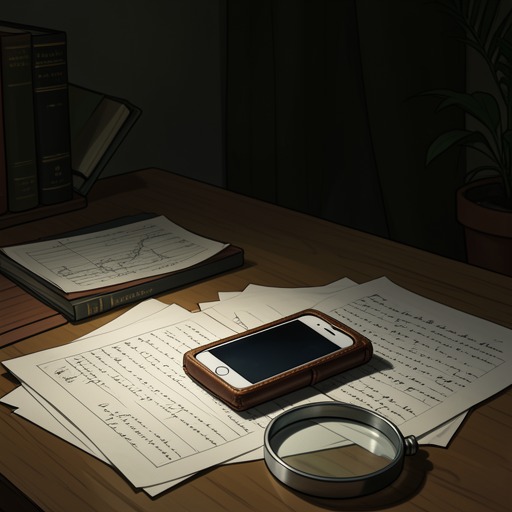
Claire's secret phone
Fool Me OnceClaire's secret phone turns a passing recollection into a physical clue in Maya's investigation of Claire Walker's murder. Hidden in a compartment in their grandmother's old trunk, the second handset preserves a narrow but consequential trace of Claire's private life: sixteen calls to one number, which Maya identifies as belonging to Leather and Lace. The device opens a new line of inquiry, but it does not disclose why Claire called or what the calls meant.
A Second Phone, Seen Before the Murder
Eileen first describes the phone through a small breach in what she thought she knew about her friend. At lunch at Baumgart's, roughly a week or two before the murder, Claire's phone rang. Eileen says Claire normally answered calls in front of her; the two did not keep secrets from each other. This time, however, Claire turned pale, took the call, and hurried outside. Through the window Eileen watched her become animated as she spoke for about five minutes, then return to the table.
What makes the episode more than an unusual call is Eileen's recognition that Claire had taken a different handset. Claire's ordinary phone, identifiable by its case bearing a picture of the children, remained on the table. The distinction turns Eileen's memory into specific evidence: Claire had a second phone and was careful to separate its use from the device visible to her friend. The contrast between their usual openness and this abrupt concealment gives the object its first meaning before Maya ever finds it.
Recovery from the Trunk
The handset remains unaccounted for after Eileen's revelation. Maya considers whether police might have recovered it if Claire had been carrying it when she died, but Shane's inquiries into the investigation have produced no mention of a spare phone or unexplained calls. That absence does not establish what happened to the device; it sharpens Maya's search for it among Claire's belongings, which have not yet been moved.
Maya recognizes the second phone as something bought to conceal whom its owner was calling. She eventually searches their grandmother's old trunk, using a small seam to locate a hidden panel. The phone is inside. Its concealment links the object to a family practice of hiding valuables: Maya remembers being taught that strangers might steal, and that valuables should not be left where others could find them. The trunk therefore holds both an inherited hiding place and a secret Claire chose to put there. Maya finds the phone with satisfaction, while imagining that her sister and grandmother might be looking down on her; her thought that the dead remain dead keeps the moment from becoming a supernatural explanation.
The Call History
The phone cannot immediately yield its information. Its battery is completely drained, consistent with its having lain untouched since Claire's murder, and Maya recognizes the charging socket as familiar. Back at home, she searches a crowded drawer of saved cords and finds an adapter that fits the handset's base. After about ten minutes of charging, the rudimentary phone turns on and reveals a call history.
Every recorded call is to the same number. Maya counts sixteen calls; the unfamiliar number has a 201 area code, placing it in northern New Jersey. A search identifies it as a business near the George Washington Bridge called Leather and Lace, a gentlemen's club. The online images confirm for Maya that it is a strip club. The sequence is unusually spare: a hidden device, one repeated number, and a searchable business listing. Each step makes the evidence more concrete while leaving its central question unanswered. The records establish a repeated connection between Claire's secret handset and the club's number, not the reason for that connection.
What the Object Reveals—and Withholds
The phone changes the shape of Maya's inquiry because it gives her evidence that is both personal and limited. Eileen's account establishes that Claire used the second handset before her death; its hiding place shows that it was deliberately kept out of ordinary view; and the call log supplies a destination for Maya to investigate. None of these facts identifies the caller's purpose or explains what Claire discussed. The object is a lead, not a complete account of her sister's actions.
Its secrecy also resonates with the larger conflict over who may keep information hidden and who has the right to demand it. Maya later challenges Corey for defending his organization's confidentiality even after a source has been murdered, accusing him of protecting an institution through the same logic used by the family and businesses he condemns. Claire's concealed phone is not identified as part of Corey's source relationship, and the story does not establish a direct connection between the two. Instead, the phone gives the broader theme a domestic, tangible form: even a close friendship that seemed to exclude secrets could contain an unseen channel of communication.
At the end of Maya's confrontation with Judith, Maya names phone calls among the pressures used to make her question her own judgment, alongside the nanny-camera stunt and missing clothes. That disclosure concerns the family's broader manipulation of Maya; it does not explain the sixteen calls in Claire's handset. The distinction preserves the phone's unresolved significance. It exposes a hidden part of Claire's life and propels Maya toward a club, but its silence about motive remains part of the mystery.