Digital picture frame with hidden nanny camera
Fool Me OnceThe Digital picture frame with hidden nanny camera turns an ordinary fixture of family life into a contested source of evidence: it records the apparent return of Joe Burkett, enables a staged deception, and finally carries a live broadcast from the Burkett house to a global audience. Its significance lies not simply in what its lens captures, but in how easily the same device can be treated as reassurance, proof, a vulnerability, or a means of public exposure.
Design and Domestic Installation
Eileen Finn gives the frame to Maya Stern after Maya begins working full-time, presenting it as a way to keep a closer eye on the household. Its disguise is practical: it looks like a digital picture frame, while a camera is built inside. Eileen has already loaded family photographs that the frame will shuffle through, helping the camera blend into the room rather than announce itself as surveillance equipment.
The den's arrangement makes the device's function specific. Eileen places it on a bookshelf and points it toward the couch, where Isabella and Lily usually play. She explains that the camera has a wide-angle view capable of taking in the whole room. The frame is therefore both a familiar domestic display and a concealed vantage point over the space where the child spends time.
Watching and the Apparent Sighting
Maya checks the camera's recordings on many, though not all, days, usually fast-forwarding through them because nothing questionable seems to happen. One detail begins to unsettle that routine: Isabella appears consistently sunny on camera, although Maya knows that this is not usually her manner. Isabella is not generally given to smiling, though she does brighten around Lily. The footage seems reassuringly orderly, but Maya's comparison of it with Isabella's usual behavior leaves a small discrepancy in view.
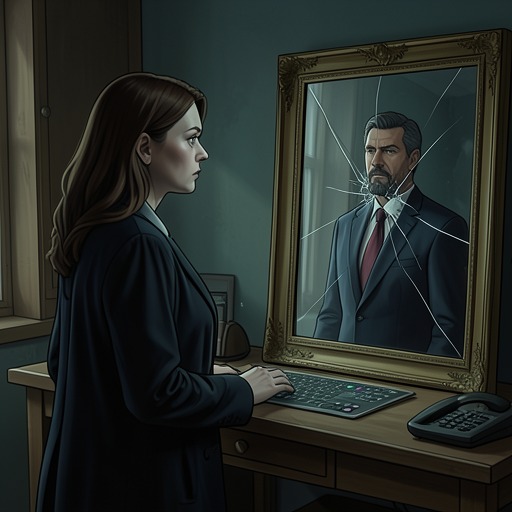
The camera later turns itself on again while Maya is watching. At first, the image is blocked by a person standing directly in front of the frame. Maya thinks the figure may be Isabella, but the clothing contradicts that guess: Isabella had worn a red blouse the day before, while the visible shirt is green. The obstruction does not resolve into an ordinary interruption. On the monitor, Maya sees Lily crawl onto the lap of her dead husband, Joe Burkett. The domestic camera has made an image feel immediate and intimate, but what it appears to show is so consequential that the recording cannot, by appearance alone, settle whether Joe is alive.
Recording, Missing Storage, and Compromised Privacy
Maya later tells Isabella that she keeps a camera in the family room and that it records what happens when she is away. When Maya tries to show the footage to Roger Kierce, she turns the laptop toward him, clicks play, and gets nothing. The SD card is gone. The absence changes the device's role: the camera may have produced an image, but the removable recording is no longer available for Maya to present at that moment.
Eileen's later experience reveals another danger in treating household cameras as private. She receives photographs by email that were taken inside her own home, including images of her children playing on the couch and a photograph of Eileen after a workout. Eileen believes Robby is responsible. She had thought the cameras were not connected to the web because they used an SD card; she did not understand that they could be hacked and admits she had not put security measures in place. Her account establishes that the camera system's apparent separation from the internet was not a reliable guarantee of privacy. Images made inside a home can leave it without the occupants' knowledge.
Staging the Image and the SD Card's Journey
The apparent sighting of Joe is eventually explained as a production rather than an unaltered record. Isabella tells Maya that she dressed up as Joe and that the two of them let the nanny cam record it. The Burkett family then hired a CGI specialist to alter the footage. Isabella took the SD card back to Farnwood; an hour later she returned to Maya's house with it, and Isabella put it back into the frame. The sequence supplies a concrete chain of capture, alteration, transport, and reinsertion behind the image that had seemed to show Joe alive.
Isabella also explains how she recognized the camera. The day after the funeral, Maya had a new digital frame already loaded with family photographs. That struck Isabella as unusual because Maya did not normally keep pictures of Lily around or hang up Lily's artwork. The frame's disguise was thus not foolproof: details of Maya's ordinary habits made the supposed decoration conspicuous to someone who knew the house. The device could hide its lens from casual attention while its sudden presence still invited suspicion.
From Household Surveillance to Public Broadcast
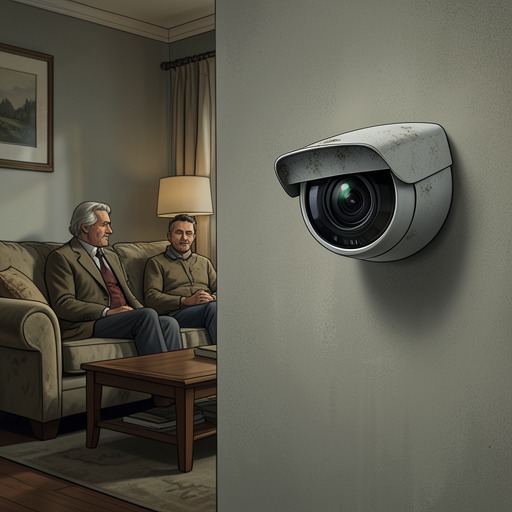
The frame's final use expands its audience far beyond the family. Maya puts a nanny cam above the fireplace at Farnwood, and, after asking Eileen to keep an eye on Hector and Isabella, arranges a live feed with someone who works with Corey Rudzinski. The camera transmits what happens in the Burkett house as it happens. Eileen later describes the footage as having gone viral: viewers around the world watch the events live, and the exposure helps make CoreyTheWhistle one of the largest sites on the web.
That broadcast changes the meaning of the device once more. A camera first installed to let a working mother observe a child's room becomes a tool through which images can be manipulated, a channel vulnerable to intrusion, and finally an instrument of deliberate transparency. Eileen says that Maya's decision to expose the truth in real time had consequences beyond the immediate household: people who had been afraid to speak came forward, and corrupt governments and businesses toppled. The ending does not erase the camera's capacity to invade privacy or mislead. Instead, it makes control of the image—and of who gets to watch—central to what the device can do.