Eileen Finn
Fool Me OnceEileen Finn is one of Maya Stern’s closest friends and an important link between the novel’s private family histories and its widening web of surveillance. A mother living with the consequences of domestic abuse, she gives Maya a nanny camera for her child’s safety; the device later becomes part of the mystery surrounding Claire Walker and, ultimately, a means of broadcasting events at Farnwood to the world. Eileen’s role is grounded less in formal investigation than in enduring friendship, careful observation, and the hard-won knowledge of what it takes to escape an abusive relationship.
Identity and Background
Eileen is described as strawberry blonde, freckled, and wide-smiling, with a face that lights up a room. That brightness is also described as a mask for the torment beneath it, setting her public warmth against the pain of her life with Robby. The contrast matters: she is not simply a cheerful friend who offers practical help, but someone whose apparent ease coexists with an experience of harm she has had to survive.
Her bond with Maya predates Maya’s marriage to Joe Burkett and the crises that follow. Maya attended Vassar a year after Claire, and the three women lived together during the period before Maya began Army Aviation School at Fort Rucker, Alabama. Eileen remained, along with Shane Tessier, among Maya’s closest friends. When Eileen embraces Maya, the gesture confirms a relationship of long-standing intimacy rather than the more distant condolences of an acquaintance. Their affection has room for teasing and judgment, but it also rests on the certainty that each knows the other well.
Eileen is also a mother. Her children, Kyle and Missy, figure both in her explanation of why she valued the nanny camera and in later photographs taken inside her home. The domestic setting is therefore not incidental to her character: it is where she tries to protect her children, where the camera promises reassurance, and where the threat of Robby’s continued access becomes most disturbing.
Friendship with Maya and the Nanny Camera
Eileen gives Maya a device that looks like a digital picture frame but is actually a nanny camera. She presents it as a precaution rather than an accusation: she thinks Isabella seems like a good caregiver, but tells Maya that, when a child is involved, extra reassurance can be worthwhile. Eileen’s own experience leaving Kyle and Missy with a nanny has shown her how comforting the camera can feel. The gift is an act of care shaped by parental anxiety, not evidence that Eileen suspects Isabella.
The frame’s ordinary appearance conceals its capacity to observe. That difference becomes consequential when Maya checks the image and finds the view blocked. She initially considers whether Isabella might be standing in front of it, but the visible green fabric does not match the red blouse Isabella wore the previous day, and Isabella is too short to account for the obstruction. Later, the camera’s SD card is missing. These details turn Eileen’s well-meant device from a source of reassurance into a point of uncertainty: it can show what occurs in a home, but it can also be obstructed, tampered with, or stripped of its stored evidence.
The camera’s significance expands again at the end of the story. In the retrospective account of that night, Eileen is with Shane while the events at Farnwood are recounted. Maya has asked Shane to keep an eye on Hector and Isabella, and she arranges a live feed using the nanny camera. The audience can watch what happens inside the Burkett house as it happens. Eileen is present in the closing frame of this account, while the device she once gave as a private safeguard has become part of a public exposure of the Burkett household. The change in scale—from watching over children to a worldwide audience—sharpens the book’s question of whether surveillance protects people or places them under another form of power.
Eileen and Claire’s Investigation
Eileen’s close friendship with Claire makes her a source of a small but consequential recollection. She remembers having lunch with Claire at Baumgart’s about a week or two before Claire’s murder. When Claire received a call, she turned pale, took the phone outside, and spoke animatedly for about five minutes. This departure from their usual openness stayed with Eileen: Claire normally answered calls in front of her, and they did not keep many secrets from each other.
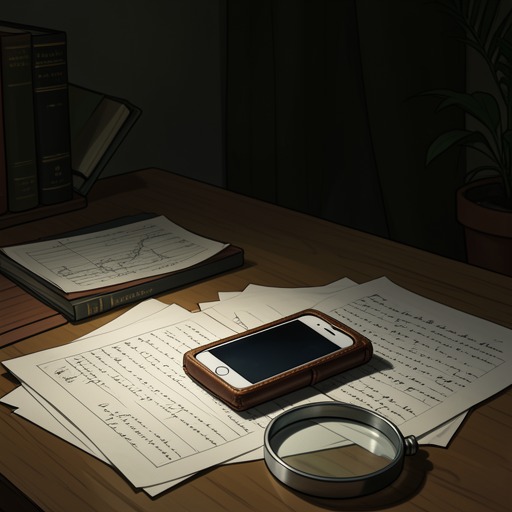
Eileen then identifies the detail that changes the meaning of the memory. Claire’s ordinary phone—the one in a case bearing a picture of her children—remained on the table. The phone she took outside was a second device. Eileen cannot explain the call’s contents, but her observation gives Maya concrete reason to think Claire had a concealed line of communication and a private matter she was pursuing. Eileen’s value to the investigation lies precisely in the limits and precision of what she remembers: where they were, how Claire reacted, and which phone was left behind.
The contrast between Eileen’s remembered closeness with Claire and the existence of Claire’s hidden phone echoes the novel’s larger struggle over secrets. Friendship does not mean that every fact is shared, and Eileen’s testimony cannot itself disclose what Claire was doing. It does, however, make the secrecy visible and gives Maya a lead rooted in the habits of someone who knew Claire well.
Abuse, Exposure, and Survival
Eileen’s own history with Robby gives her account of domestic safety a more painful context. When Maya later asks about what happened, Eileen says that secret footage was how she got rid of him for good. The account establishes that recorded evidence helped her break free of his control, though it does not specify the footage’s contents or the precise circumstances in which she used it. The device of recording, associated elsewhere with intrusion and uncertainty, has also served Eileen as a means of escape.
That escape does not make her feel secure. Eileen later tells Maya that Robby is back and has been watching her. She brings photographs sent from an anonymous, untraceable email address and says she knows Robby sent them. The pictures were taken inside her house: some show Kyle and Missy playing on the couch, while another shows Eileen after exercising, in a sports bra and holding a glass of ice water. She explains that she had come home, taken off her shirt, and put it in the downstairs hamper. The images expose how thoroughly a private home can be violated; the anonymous delivery conceals the sender’s identity while making the presence of an unseen watcher feel immediate.
Eileen’s story therefore complicates the comforting promise attached to the nanny camera she gave Maya. A camera can reassure a parent, preserve evidence, or enable a survivor to escape control; it can also be obstructed, its card removed, or its images turned against the person filmed. Eileen’s experience does not reduce these possibilities to a simple judgment that recording is either protective or invasive. The consequences depend on who controls the images and what they are used to do.
Narrative Role and Ending
Eileen connects three otherwise distinct strands: Maya’s effort to protect her child, the search for what Claire knew, and the novel’s attention to surveillance as a form of power. Her gift gives Maya a domestic camera; her memory of Claire’s second phone helps expose a concealed investigation; and her own reliance on secret footage shows that recording can serve a vulnerable person as well as threaten one. She is not presented as the person who solves the wider conspiracy, but her acts of care and her observations help make its hidden mechanisms legible.
The book’s final retrospective also places Eileen beside Shane as the story of the Farnwood live feed is recounted. Shane notes that Eileen rests a hand on his arm and that they are both single, with a history between them from years earlier. The moment suggests renewed closeness without spelling out a future for either of them. It leaves Eileen not only as a witness to the consequences of Maya’s plan, but as a friend still present at the story’s close—someone whose warmth, hard-won caution, and experience with the camera’s double edge have accompanied Maya through the unraveling of several secrets.