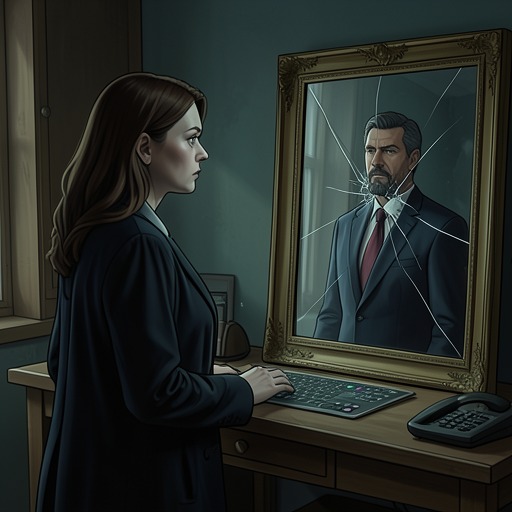
Fabricated nanny-camera video of Joe appearing
Fool Me OnceThe fabricated nanny-camera video of Joe appearing turns a domestic security device into an instrument of psychological manipulation. A staged scene, an altered image, and a missing SD card make the possibility of Joe Burkett’s survival seem credible enough to destabilize Maya Stern, while the later confession reveals that the apparent evidence was designed to make her doubt her own judgment.
The Frame and the First Doubts
Eileen Finn gives Maya a digital picture frame that is actually a nanny cam. The disguise initially makes it look like an ordinary household object, but the frame becomes a source of threatening uncertainty when its camera activates and the view is blocked. Maya first thinks Isabella is standing in front of it; then she notices that the visible shirt is green, not the red blouse Isabella had worn the previous day. The mismatch suggests that someone else, or some other event, may be present in the footage. The image offers a tantalizing clue without yet establishing what it shows.
When Maya later turns the laptop toward Roger Kierce and presses play, nothing appears. She checks the USB port and discovers that the SD card is gone. The missing card matters because the recording is not simply an unsettling image on a screen: it is a file that can be removed, withheld, and prevented from being examined by someone else. The device’s ordinary storage mechanism becomes part of the mystery, and the absence of the card leaves Maya without the material needed to demonstrate what she believes she saw.
The story also gives this kind of domestic camera a separate, unsettling context through Eileen’s experience. Eileen receives anonymous photographs taken inside her house, including images of her children playing and a private photograph of herself after exercising. She suspects her abusive husband, Robby, and realizes that she had wrongly assumed cameras using SD cards could not also be accessed over the internet. This is not the same as the Burkett family’s fabrication, but it establishes that a camera’s apparent local storage does not guarantee privacy. The book distinguishes two abuses of surveillance: an outsider may intrude on a household camera, while people with access to a recording can manipulate what it appears to prove.
How the Recording Was Made
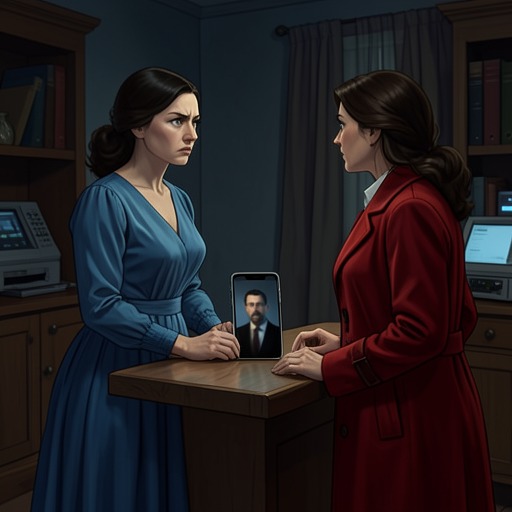
During Maya’s confrontation with Isabella and Hector, Maya reconstructs the apparent sighting as a staged performance. Hector is close to Joe in height and build, she observes, and could have played him in the recording. Maya reasons that he was allowed into the house, acted out the scene, and could approach Lily because Lily knew him and would go to him willingly. She also recognizes a smile on the video and suspects that Joe’s face was taken from their wedding footage. The resemblance is therefore not evidence that Joe survived: it is the result of combining a stand-in’s performance with an image of Joe.
Hector confirms the central mechanics. He dressed as Joe and performed for the nanny cam; afterward, he took the SD card back to Farnwood. The family had hired someone to create the image using CGI and Photoshop, and Hector returned roughly an hour later with the altered card for Isabella to put back in the frame. This account explains how the recording could look persuasive while having a constructed provenance: the scene was acted, the image was digitally altered, and the storage card passed from the house to Farnwood and back. The apparent video was not an unbroken record of Joe’s presence but a product assembled through performance, editing, and physical handling.
Isabella also explains how she recognized the camera. The day after Joe’s funeral, Maya already had a new digital frame loaded with family pictures, despite usually keeping few pictures of Lily or displaying Lily’s artwork. Isabella saw that conspicuous change and inferred that the frame was a nanny cam. Her observation reveals how a device’s disguise could fail to someone familiar with Maya’s habits. It also clarifies that the scheme depended not only on technical manipulation but on watching Maya closely enough to anticipate how she might use the camera.
The Trap and Its Intended Effect
Isabella’s assigned role was to retrieve the SD card if Maya showed her the footage. If Maya presented the video, Isabella was supposed to pretend that she could not see Joe in it. Isabella says she did not know how Maya would react after seeing the recording, but her instructions were to keep Maya from showing it to other people. The scheme therefore depended on controlling both the image and the possibility of independent confirmation: the card could be removed, and a trusted witness could deny what Maya believed she had seen. Maya had also inferred that Isabella was involved when Isabella pepper-sprayed her and fled with the card.
Maya recognizes the psychological purpose of that denial. If Isabella acted as though the footage showed nothing, Maya could begin questioning her own sanity rather than treating the recording as evidence that someone was deceiving her. The intended effect was isolation: remove the file, deny the sighting, and leave Maya alone with a perception she could neither verify nor confidently dismiss. The video’s power came less from proving that Joe was alive than from forcing Maya to confront the possibility that her judgment was failing.
Judith Burkett later acknowledges arranging the stunt. Maya says Judith told Rosa’s family that Maya had killed Joe, although there was no way to prove it, and set up the nanny-cam deception to shake the tree. Judith does not deny this. Maya explains the broader calculation: even if she did not believe Joe had survived and did not confess, she would react to the apparent evidence and start investigating. Under pressure, she might misstep and expose herself; meanwhile the family could learn what she knew. Caroline Burkett’s false claims about thinking her brothers were alive and about Roger Kierce being on the family payroll were part of the same psychological experiment. Together with the nanny-cam video, missing clothes, and phone calls, those lies produced a deliberately accumulating pattern of uncertainty.
Exposure and Reversal
The eventual explanation reverses the video’s apparent meaning. Maya’s initial question is whether the image proves Joe survived; the revealed answer is that the family wanted her to believe precisely that. Her recognition that the footage could be manipulated does not erase what she saw, but it changes the question from Joe’s whereabouts to the people controlling the recording and the pressure around it. Judith’s acknowledged role supplies the missing motive, while Hector and Isabella’s explanations supply the practical steps that made the false sighting possible.
The camera’s later use at Farnwood sharpens the contrast between concealment and disclosure. Maya places a nanny cam above the fireplace, and the video from it becomes widely watched. Shane later recounts that Maya arranged a live feed with help from someone who worked with Corey Rudzinski, allowing the public to see what happened in the Burkett house in real time. That later broadcast is not the fabricated Joe recording: it turns the same kind of device toward a different purpose. The first use restricts access and manufactures doubt; the later one makes events visible to an audience far beyond the family.
The fabricated footage thus links surveillance to credibility and control. A digital image can appear to settle a question while concealing the staged performance, editing, and movement of the SD card behind it. In the Burkett family’s experiment, the camera does not merely watch Maya: the family uses what it records, what it withholds, and what others pretend to see in order to shape her sense of reality. The later public feed offers a pointed counter-image, replacing private manipulation with exposure, even as the story leaves the camera’s capacity to serve either purpose firmly in view.