Farnwood nanny cam
Fool Me OnceThe Farnwood nanny cam is a camera concealed in a digital picture frame, an object whose domestic appearance masks its capacity to watch and record. At first, its footage gives Maya Stern reason to believe that Joe Burkett may still be alive; she later discovers that the apparent sighting was staged. The device’s significance changes again when Maya uses a nanny cam to broadcast events at Farnwood live to a global audience. Across these reversals, the frame becomes more than a source of images: whoever controls the camera, its recording, or its audience can shape what others believe.
Appearance and Early Suspicion
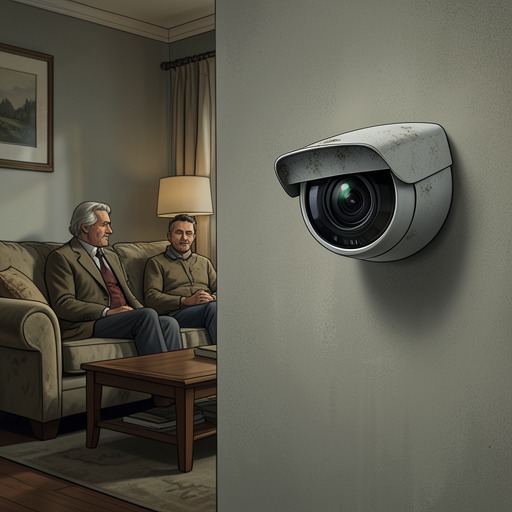
The camera sits behind the ordinary guise of a picture frame, a disguise that makes surveillance part of the home’s visual furniture. When Lily asks to see more, Maya looks at the screen and finds the camera has turned itself on again, but its view is blocked. She initially guesses that Isabella is standing in front of it. The image complicates that explanation: Isabella had worn a red blouse the previous day, while the visible color is green. Maya also judges that Isabella is too short for her back to obscure the camera. A small mismatch between clothing, height, and framing turns an apparently simple domestic image into a puzzle about who—or what—is in front of the lens.
The footage’s evidentiary force is therefore unstable from the outset. Maya sees enough to suspect a person, but not enough to identify one securely. The frame offers the authority of a recording without, by itself, establishing what the recording shows. That gap between an image and a verified account becomes central to the device’s later use against her.
The Missing Card and the Fabricated Image
When Maya decides to show Roger Kierce what she has found, she turns her laptop toward him and plays the material. Nothing appears. She checks the USB port and discovers that the SD card is missing. The camera’s recording depends on a removable object, and whoever possesses that card can control whether the footage can be examined. Its disappearance interrupts Maya’s attempt to make her evidence available to another person.
The later explanation reveals a deliberate chain of staging and alteration. Hector admits that he dressed as Joe and acted out the scene for the nanny cam. He took the SD card back to Farnwood, where the family had a CGI and Photoshop specialist modify the footage. About an hour later, Hector returned to Maya’s house with the altered card, and Isabella put it back in the frame. Maya recognizes that the smiling face used in the video may have come from her wedding video. The apparent return of Joe is thus manufactured from a performance recorded by the camera and imagery drawn from family history.
The frame also exposes how its presence was noticed. Isabella says she inferred that Maya had installed a camera because, the day after the funeral, a new digital frame had appeared already loaded with family photographs. She contrasts it with Maya’s usual lack of displayed pictures of Lily or of Lily’s artwork. The device’s disguise depends on seeming ordinary; here, the suddenness of its arrival makes it conspicuous. Isabella reads the frame not as decoration but as evidence of surveillance.
Surveillance as a Means of Isolation
The scheme depended on more than inserting altered footage. Isabella was supposed to take the SD card from Maya so that Maya could not show the video to other people. If Maya showed Isabella the image, Isabella was to pretend she had not seen it. Maya understands the intended effect: she was meant to question her own sanity and become isolated. The camera’s recording, the stolen card, and Isabella’s performance form parts of one operation designed to control both the evidence and Maya’s response to it.
Eileen Finn’s account adds a different security concern without resolving every technical detail. She says she believed the cameras were not connected to the web because they used SD cards, and that she had not realized they could be hacked. She thinks Robby was responsible and regrets not putting security measures in place. Her explanation presents network intrusion as a possibility she had not anticipated; the staged Joe footage, by contrast, is explained through physical access to the card and the deliberate alteration of its contents. The account distinguishes a camera’s perceived security from the actual vulnerability of the images it stores.
Removal and Repurposing at Farnwood
After the revelations, Maya puts the nanny-cam frame in the back of the car because she no longer wants it in the house. Removing it is a practical rejection of an object that has made the home feel watched and made recorded images unsafe to trust. Yet the device does not disappear from the story. Maya later has a live feed set up using the nanny cam she placed above the fireplace at Farnwood. What had served as an instrument of concealed observation becomes a means of deliberate public exposure.
The later broadcast is organized with help from an unnamed person who works with CoreyTheWhistle. The feed allows people around the world to watch events in the Burkett house as they happen. Corey Rudzinski’s site gains enormous attention afterward, and its new reach encourages people who had been afraid to speak about abuses by corrupt governments and businesses to come forward. The same general technology that once allowed a family to manipulate one woman’s perception now makes concealed events visible to a vast audience.
Image, Evidence, and Public Exposure
The camera’s changing role depends on the distinction between seeing and knowing. Maya’s first footage seems to offer a glimpse of Joe, but its missing SD card blocks scrutiny; the eventual explanation shows that Hector’s performance and digitally altered material created the apparent sighting. Later, a live feed makes events visible in real time, yet visibility does not make the outcome controlled or harmless: the broadcast ends with a murder witnessed by its audience. The frame’s images can mislead, disclose, and amplify, but they cannot guarantee a truthful interpretation or a safe result.
That reversal gives the device its particular narrative weight. It begins as a domestic object capable of turning private life into surveillance, becomes a tool for fabricating evidence and isolating Maya, and is then repurposed to expose events publicly. Maya’s decision to make the truth visible is intentional, but the ending is not what anyone expected. The nanny cam consequently stands at the intersection of privacy and accountability: it can be used to conceal manipulation behind the appearance of proof, or to bring hidden conduct into view, while leaving the consequences of being watched uncertain.