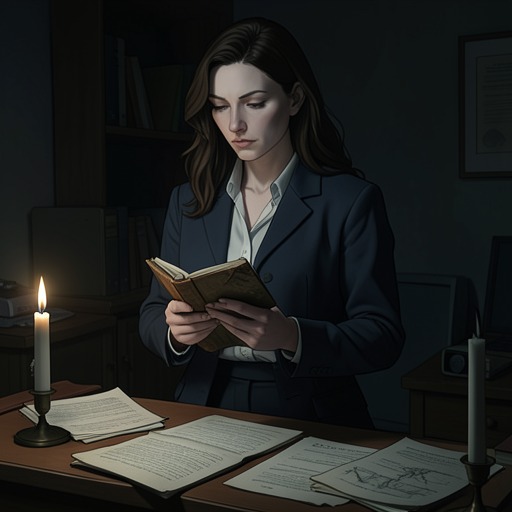
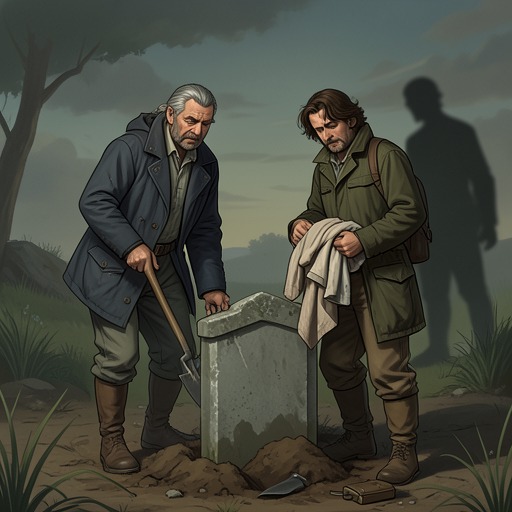
Joe's will reading is postponed for lack of a death certificate
Fool Me OnceThe postponement of Joe Burkett’s will reading makes the difference between a family’s acceptance of death and its official proof suddenly consequential. Nearly two weeks after Joe’s funeral, his relatives learn that probate cannot proceed without a death certificate and verification from police authorities. The delay is presented as a legal and administrative obstacle, but in a story already unsettled by questions about what Maya Stern has seen and what the Burketts know, the absent document gives uncertainty a material form.
The Postponed Reading
At the family meeting, Heather Howell tells Judith Burkett that the reading of Joe’s last will and testament must be postponed. Judith looks to Caroline Burkett and then to Maya, but neither offers an explanation; she asks Howell why the reading cannot go ahead. Howell carefully distinguishes a prohibition from a delay: the will can be read, she says, but probate has encountered a procedural problem.
The problem is not that the family has failed to hold a funeral. Judith points out that Joe has been dead almost two weeks and that the family has already buried him. Howell, who attended the funeral, nevertheless explains that probate requires an official death certificate or other proof. Because Joe was murdered, the necessary verification must come from authorities within the police department. She says an associate is checking the case law and that her office hopes the matter will take only another day or two, while admitting that she does not yet have all the facts.
Neil Burkett makes the implication explicit by asking whether the requested proofs mean proof that Joe is dead. Howell calls the situation a snafu that her staff must untangle, promises to be in touch, and quickly leaves the room. Her explanation supplies a bureaucratic reason for the delay, not a resolution: the family still does not have official confirmation, and the will remains unread at the end of the scene.
The Closed Casket and the Need for Proof
The certificate problem draws force from the funeral’s most important detail: Joe’s casket was closed. Maya remembers that this was not her decision. She had left the arrangements to Joe’s family and regarded death itself as sufficient; given that Joe had been shot in the head, a closed casket also seemed understandable. The funeral has taken place, but Maya has not treated seeing the body as necessary to her own recognition of his death.
Caroline understands the absence differently. When she asks Maya why soldiers’ bodies are brought home, Maya answers that they do not leave anyone behind. Caroline presses beyond the military principle to its effect on the living: families need the body, she argues, to know that the person is dead and to find closure. Her point turns the physical body into more than a funeral object. It is evidence that can help survivors accept what a verbal report or ceremony alone has not made emotionally real.
Caroline connects that belief to Andrew Burkett’s death. She was young when she was told that Andrew had died in an accident, but his body was never shown to her. She still dreams that he survived the fall into the sea and imagines him alive at a soccer net, smiling and making saves. She knows he is gone and yet cannot fully accept it; seeing his body, she says, might have prevented that uncertainty. For the same reason, she begged to see Joe, even if the sight would be disturbing. She was refused. The closed casket that seemed immaterial to Maya therefore echoes, for Caroline, a prior loss that remains unresolved.
Death, Uncertainty, and the Investigation
The delay is not the first time Joe’s death has been surrounded by missing or contradictory evidence. Earlier, Roger Kierce corrects the account Maya has given of the night in Central Park: Joe did not call her to arrange their meeting. Later, Kierce tells her that the .38-caliber bullets recovered from Joe’s body match another case in the ballistics database. These details do not themselves explain the probate delay, but they establish a pattern in which apparently settled facts about Joe’s death lead to further questions.
Caroline’s account intensifies that pattern. She says that both of her brothers died young and that, in neither case, did she see the body. With Joe’s death certificate still missing, she describes the resulting feeling that the brothers might somehow still be alive. The scene does not establish that Joe survived; it shows how the absence of direct confirmation can make such a possibility emotionally imaginable, even to someone who recognizes that the idea may sound irrational.
That uncertainty later becomes part of the pressure placed on Maya. She weighs whether to confront Judith and Neil immediately, but doubts that an accusation would produce an honest answer or preserve evidence. Much later, she identifies the nanny-camera image of Joe as one element in a deliberate effort to destabilize her. Caroline’s claims that her brothers might be alive and that Kierce was on the family payroll were fabrications, Maya says, deployed alongside the camera footage, missing clothes, and phone calls as part of a psychological experiment. The postponed probate reading is not itself proof of such a plan; rather, its genuine procedural uncertainty helps show why the possibility that Joe might still be alive could unsettle Maya so effectively.
Consequences and Significance
The immediate consequence is limited but consequential: the family leaves without reading Joe’s will, and Howell’s anticipated one- or two-day timetable is only a hope, not a confirmed outcome. The deeper consequence is that the family’s private funeral and the legal system’s requirement for official proof do not coincide. A ceremony can declare a death socially, while probate still waits for documentation that confirms it institutionally.
The episode also sets two responses to loss beside each other. Maya initially considers Joe’s death self-evident and leaves the funeral ritual to his family; Caroline needs the body precisely because she knows how the absence of one can prolong doubt. Neither the certificate nor a viewing can undo a death, but the scene shows how proof, ritual, and the body can shape whether survivors are able to recognize its finality. Its questions resonate beyond Joe: in the closing aftermath, Shane sees Maya’s smile in Lily and thinks of a newborn named Maya, finding a continuing presence where death once seemed absolute. That later belief does not settle the legal question raised at the will reading; it extends the story’s distinction between proof that someone has died and the ways the living continue to hold that person close.