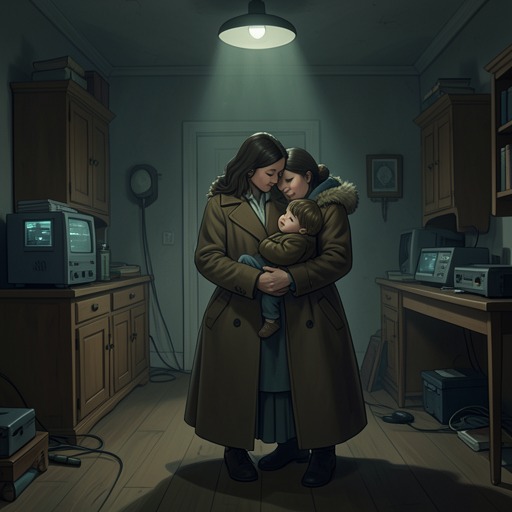
Maya Stern and Lily’s Mother-Daughter Bond
Fool Me OnceMaya Stern and Lily’s mother-daughter bond gives the story an intimate measure of what Maya is trying to protect amid bereavement and upheaval. Lily is only two when Joe Burkett is killed, so their relationship appears through the small, concrete demands of care: deciding whether to bring a toddler to her father’s funeral, lifting her over a child gate, and watching her respond with delight to the father she has lost. The story later extends that bond beyond Maya’s life, as Lily carries her mother’s presence into the next generation.
Motherhood in the Shadow of Loss
At Joe Burkett’s funeral, Maya stands beside his family with Lily at her side. The child grows restless and uses Maya’s arm as a rope swing, while Maya privately wrestles with the practical and emotional question of whether a two-year-old belongs at her father’s burial. The dilemma captures the mismatch between grief’s enormity and a young child’s immediate needs: Maya must mourn Joe while still attending to Lily as a small person who cannot be expected to understand the occasion.
Maya’s reflections on parenting are wry, but her attention to Lily is constant. She recognizes the difficulty of finding any instruction for a situation no parenting guide could anticipate. Even in the middle of funeral rites, motherhood requires her to consider what Lily can bear and what it means to include her in a family’s grief.
Care, Trust, and Everyday Attachment
Maya’s relationship with Lily is also shown through the care Isabella provides. When Lily runs to Isabella with cereal still in her mouth, Isabella scoops her up and hugs her. Maya feels the mixed pang of a working mother: gratitude that her daughter loves the nanny, accompanied by discomfort at how much Lily loves her. The moment makes affection visible as both reassurance and a reminder that care is shared with someone else.
In another domestic scene, Maya watches silent nanny-camera footage of Isabella picking up Lily’s stuffed giraffe. The camera has no audio, but seeing Lily brings Maya an immediate warmth; the rest of the world falls into the background. She goes upstairs, reaches over the child gate, and lifts Lily, who is holding an indestructible cardboard edition of One Fish Two Fish Red Fish Blue Fish. The book has become a comfort object she carries around like another child might carry a teddy bear. Maya’s pleasure in this detail shows how closely she notices Lily’s habits and how ordinary tenderness persists amid suspicion and surveillance.
Joe’s Image and the Reality of Death
When Lily asks where her father is, Maya faces the limits of what her daughter can understand. She shows Lily the nanny-camera video in which Joe appears. Lily watches intently and responds with excitement, recognizing him as Daddy. Maya acknowledges the child’s recognition while containing her own pang at Lily’s happiness. The video therefore holds two incompatible meanings at once: for Lily, it offers the joyful sight of her father; for Maya, it intensifies the difficulty of explaining his absence.
The story’s concern with death’s proof also touches Maya’s responsibilities as a mother. Caroline Burkett explains that she could not accept Andrew Burkett’s death after his body was not shown to her, and that she begged to see Joe’s body so she could accept that he was gone. Maya’s attention to this need for the bereaved to see the deceased gives her own grief a family dimension: death is not only a fact to be established but a loss that loved ones must find a way to live with. The scene does not make Lily responsible for resolving that uncertainty; instead, it places Maya’s grief beside the work of continuing to care for a child who still looks for her father.
Memory and Continuation
The closing perspective turns the bond toward what remains after Maya’s death. Lily does not remember her mother, yet her smile recalls Maya’s to Shane, who describes loving Lily and staying close to her partly because she resembles Maya. Lily’s face and manner become a living connection for someone who misses her mother, even though the child herself cannot consciously recall their life together.
When Lily says that she and her family have named a baby Maya, the name carries the bond forward without claiming that the new child replaces the woman who died. Shane’s final reflection unsettles his earlier certainty that death is simply an ending: in the newborn and in Lily’s continuing life, Maya seems present to him in another form. The mother-daughter relationship thus closes not with Lily’s recollection of Maya, which she lacks, but with the visible traces of attachment and a name passed on.